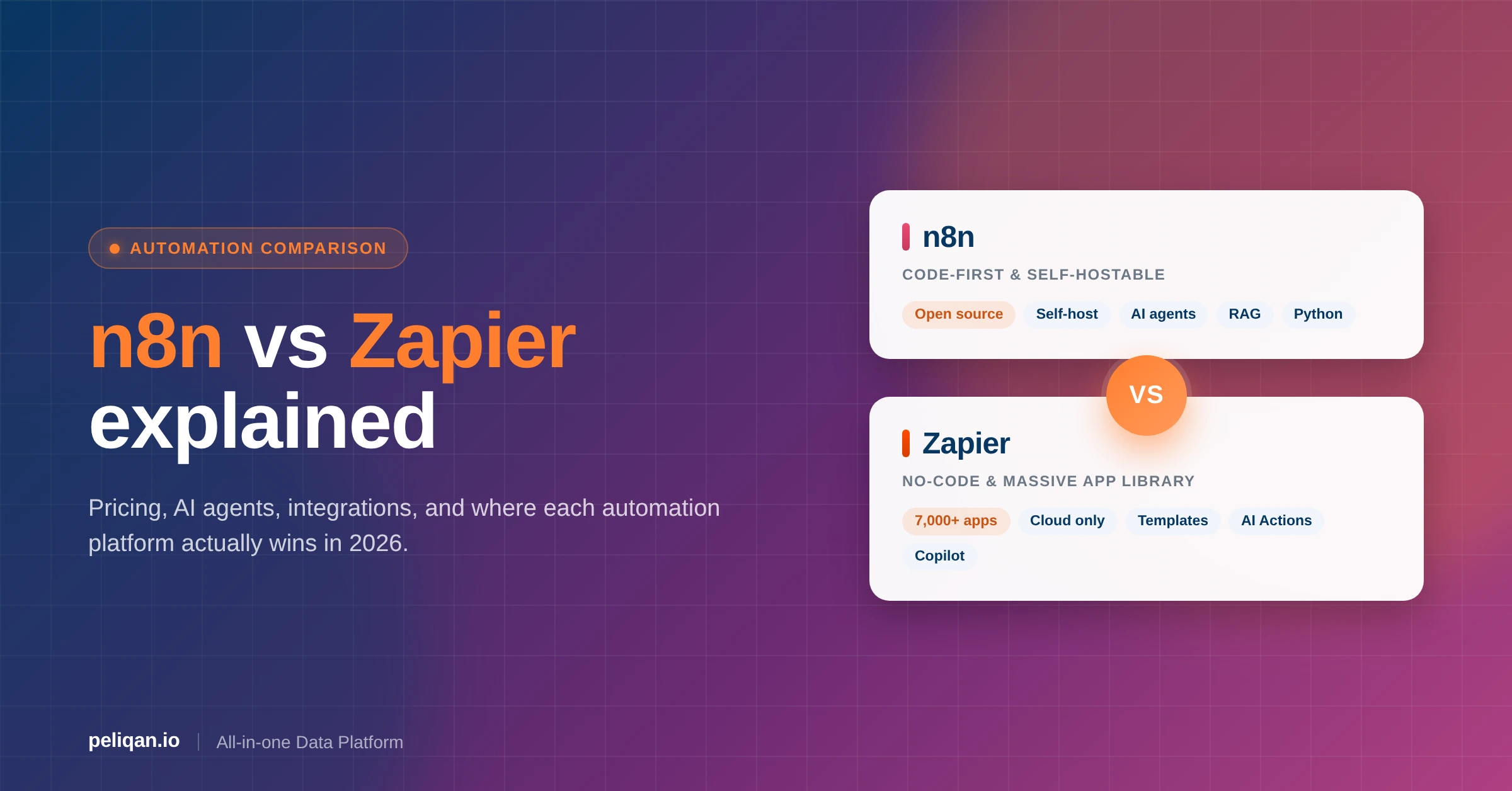





n8n vs Zapier is the defining automation choice of 2026. Zapier is the no-code automation default with 9,000+ pre-built integrations and the fastest setup curve on the market. n8n is the source-available, AI-native challenger that just hit a $2.5B valuation, ships 70+ native AI nodes, and lets you self-host the entire engine for the cost of a small VPS. The right pick depends on team skills, workflow complexity, AI ambitions, and how badly per-task pricing will hurt at your volume.
This guide compares n8n and Zapier head-to-head on pricing, integrations, AI and MCP capabilities, ease of use, self-hosting, debugging, and total cost of ownership at scale. By the end you will know exactly which one fits your stack, and where a data platform layer changes the equation when your workflows start touching the warehouse.
TL;DR – n8n vs Zapier at a glance
The 30-second verdict
- Pick Zapier if: Your team is non-technical, you live in mainstream SaaS apps (Slack, HubSpot, Salesforce, Gmail, Notion), you need to ship simple automations in under an hour, and your monthly task volume stays below ~2,000.
- Pick n8n if: You have developer or data-engineering capacity, your workflows have 5+ steps with branching logic, you want to self-host for data residency or cost reasons, or you are building AI agents that need memory, tool use, and multi-model orchestration.
- Use both: Many teams keep Zapier for citizen-developer Zaps in marketing and ops, then run high-volume or AI-heavy flows on n8n where execution-based pricing wins by 3-10x at scale.
- Add a data layer: Once your automations are reading from warehouses, joining cross-source data, or feeding AI agents that need governed business data, neither tool is a substitute for a managed data platform.
What is n8n
n8n in 60 seconds
n8n positions itself for technical teams that want full control over how automations run, where data flows, and how AI agents interact with their stack. The product was rebuilt around AI workflows in 2024, which is why it ships AI capabilities as first-class workflow primitives rather than bolt-on features. For a broader view of where workflow automation sits in the modern AI stack, see this overview of end-to-end ELT pipeline building with AI.
What is Zapier
Zapier in 60 seconds
Zapier optimizes for the citizen developer: a marketing manager, an ops lead, or a small-business owner who needs to connect SaaS apps without involving engineering. That focus has held for over a decade, and it is the single biggest reason Zapier still dominates raw integration breadth. For teams comparing automation platforms against the broader data-integration market, this guide to reverse ETL tools covers an adjacent category that often gets confused with workflow automation.
n8n vs Zapier – side-by-side comparison
Pricing – the 90% cost gap nobody warns you about
The pricing discussion is where n8n vs Zapier stops being a feature comparison and starts being a math problem. The two platforms charge for fundamentally different units, and the gap compounds fast.
How Zapier counts tasks
Every action step in a Zap counts as one task. A workflow that watches Gmail, parses the body, looks up the contact in HubSpot, updates a Google Sheet, and sends a Slack notification is four tasks per execution. Run that Zap 1,000 times in a month and you have consumed 4,000 tasks. Triggers, filters, formatter steps, and paths do not count toward the limit, but every successful action does.
Zapier’s 2026 plan structure looks like this:
- Free: $0/month, 100 tasks, 5 single-step Zaps, 15-minute polling
- Professional: from $19.99/month annual ($29.99 monthly), 750 tasks, multi-step Zaps, 2-minute polling
- Team: ~$69-103.50/month annual, 2,000 shared tasks, multi-user workspace, Premier Support
- Enterprise: Custom pricing, SSO/SAML, advanced governance, dedicated CSM
Annual billing saves roughly 30-40% over monthly. Premium app connectors (Salesforce, HubSpot Enterprise, NetSuite) require Professional or higher.
How n8n counts executions
One workflow run, start to finish, equals one execution. The same 5-step workflow above run 1,000 times costs 1,000 executions on n8n – five times less than Zapier consumes for identical work. Failed and test runs do not count.
n8n’s 2026 plan structure:
- Community Edition (self-hosted): Free forever, unlimited executions, every integration in the catalog. Pay only for your server (~$3-7/month on a small VPS).
- Cloud Starter: €24/month monthly (€20/month annual), 2,500 executions
- Cloud Pro: €60/month monthly (€50/month annual), 10,000 executions, workflow history, admin roles
- Cloud Business: €800/month, 40,000 executions, SSO, Git sync, RBAC
- Enterprise: Custom pricing, SAML, audit logs, dedicated infrastructure
All Cloud tiers include unlimited users, unlimited active workflows, and the full integration catalog. The €/$ conversion runs at roughly 1.08, so €24 is about $26 in 2026.
Real cost scenario – 10,000 runs/month, 8 steps each
The “task tax” at moderate volume
Take a realistic mid-sized workload: 10,000 workflow executions per month, with an average of 8 action steps per workflow. That is 80,000 Zapier tasks but only 10,000 n8n executions for the same work.
- n8n self-hosted: ~$10-15/month server costs only. Total: $10-15.
- n8n Cloud Pro: €60/month covers all 10,000 executions. Total: ~$65.
- Zapier Team: 80,000 tasks needs at least Team plus task add-ons. Realistic total: $250-400+.
- The gap: roughly 4-30x in n8n’s favor depending on whether you self-host.
The gap widens at higher volume. Heavy Zapier users on Reddit and G2 have shared monthly bills between $1,000 and $3,500 once AI Agents and Chatbots are added. n8n self-hosted at the same volume is still under $50/month for infrastructure. Below 2,000 tasks per month, however, Zapier can actually be cheaper than n8n Cloud because Zapier’s Starter tier starts at $19.99 versus n8n Cloud’s €24 Starter.
If you are evaluating ETL and pipeline costs alongside automation, how ETL pipelines actually work covers the related cost economics for the data layer underneath.
Integrations – 9,000+ vs 400+ (but it is not the whole story)
On raw counts, Zapier wins decisively. The catalog covers 9,000+ apps in 2026, including long-tail tools that no other platform has bothered to integrate. For mainstream SaaS – Slack, HubSpot, Salesforce, Gmail, Notion, Airtable, Shopify, Google Workspace – both platforms have polished native support and the comparison is roughly even.
The picture changes for two categories.
Niche apps and internal APIs
If you need to connect to an obscure SaaS tool, Zapier’s 9,000+ catalog usually has a pre-built integration ready. n8n’s 400+ native nodes cover the most-used 80%, and anything else you hit through n8n’s HTTP Request node, which can authenticate to any REST API with OAuth, API keys, or custom headers.
That difference matters more than the catalog count suggests. A non-technical user wants a ready-made connector with form fields and dropdowns. A developer is fine wiring up an HTTP Request node in 10 minutes. So the “n8n is missing integrations” complaint applies mostly to non-technical builders, which is exactly the audience Zapier already owns.
Custom code inline
n8n ships native JavaScript and Python code nodes that run inline as part of a workflow. You can drop in custom transformations, complex parsing, or proprietary algorithms without leaving the canvas. Zapier offers “Code by Zapier” steps, but the experience is more constrained – smaller execution limits, fewer libraries, and the code lives in a separate step rather than being threaded through the workflow.
For engineering teams that need to mix automation with real logic – data enrichment, custom scoring models, ML inference – n8n’s code-first design is significantly more productive.
AI and MCP – the 2026 battleground
AI capability is now the most-asked question in the n8n vs Zapier debate, and the two platforms took fundamentally different routes.
n8n – builder-first AI
n8n was rebuilt around AI workflows in 2024 and now ships 70+ native AI nodes that treat AI as a first-class workflow primitive. Direct connections cover OpenAI, Anthropic Claude (including Sonnet 4.6 and Opus 4.7), Google Gemini, Mistral, DeepSeek, Cohere, Hugging Face, and local models via Ollama. Vector database support spans Pinecone, Milvus, Qdrant, Weaviate, Supabase pgvector, and Chroma.
The flagship feature is the n8n AI Agent node – a LangChain-based primitive that handles tool selection, memory management, and multi-step reasoning natively inside the workflow canvas. You can give an agent a goal, a set of tools (which can be any other n8n node), and let it plan multi-step execution with retries and fallbacks. For teams building custom AI agents with full control over models, tools, and observability, n8n is the more capable platform.
Zapier – MCP-first AI
Zapier’s AI bet is the Model Context Protocol. The Zapier MCP server exposes 30,000+ actions across 9,000+ apps as tools that any MCP-compatible AI client can call – Claude, ChatGPT, Cursor, or custom apps using the Anthropic Messages API or OpenAI Responses API. One MCP tool call uses two tasks from your Zapier plan.
Zapier also ships Agents, a no-code AI teammate builder that lets non-developers create agents with access to specific Zapier-connected apps, OAuth credentials, AI Guardrails (PII scanning, prompt injection detection), and human-in-the-loop approvals. Agents and Chatbots are priced as separate add-ons on top of the base Pro or Team subscription.
The split is clear: n8n is better for engineering teams building AI agents from scratch with full control over tools, memory, and model providers. Zapier wins when the goal is “let an external LLM act across our existing SaaS stack” without rebuilding the integration layer.
The MCP picture is bigger than either tool
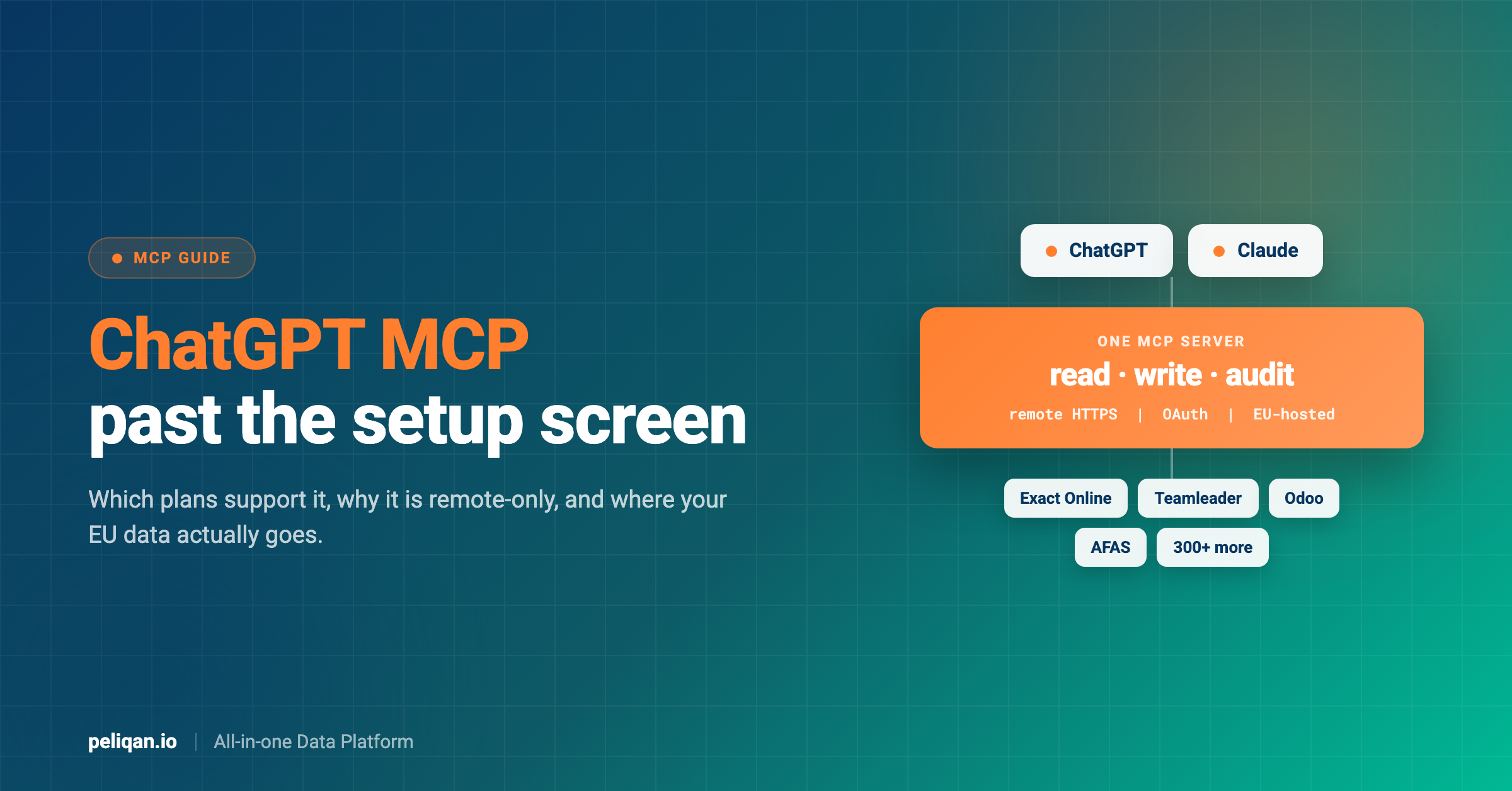
MCP itself is the more important story. Anthropic introduced the Model Context Protocol in November 2024 as an open standard for connecting AI assistants to external systems. By 2026 it has been adopted across Anthropic, OpenAI, Google, Microsoft, and major SaaS vendors. Both n8n and Zapier ship MCP support, but so do dozens of other platforms – including data platforms that expose warehouses and business data directly to AI. For a deeper look at how MCP fits into the broader 2026 AI stack, see the Peliqan MCP overview.
For practitioners who want the implementation detail, Peliqan’s MCP setup guide walks through connecting an MCP server to Claude Desktop or Visual Studio Code step by step.
Ease of use and learning curve
This is the cleanest split in the whole comparison. Zapier is dramatically faster to first automation. n8n is dramatically more powerful once you climb the curve.
Zapier’s onboarding
Sign up, get asked your role, get matched to a curated set of templates, build a 2-step Zap in under 10 minutes. The interface is a linear step builder: pick a trigger, pick an action, map fields, test, turn on. Most users ship their first working Zap within 30 minutes of signing up, and the company has a decade of UX research to keep that path clean.
Remote, the HR platform, runs an IT team of three supporting 1,700 employees – and Zapier is one of the reasons that ratio works. Department teams build their own AI-powered automations on Zapier without filing tickets.
n8n’s onboarding
n8n’s canvas is node-based and JSON-aware. New users typically need a week or two before they are productive, and developers report a steeper first month, followed by a productivity jump in month two that puts them ahead of where Zapier let them go.
The most common complaint on Reddit and the n8n community forum is debugging. Errors often surface as empty output from a downstream node, and the debug panel requires fluency with JSON data structures to interpret. For technical teams this is acceptable. For non-developers it is a brick wall.
Self-hosting, security, and data residency
For European, UK, and regulated US companies, this section is the deciding factor.
n8n – self-host anywhere
n8n Community Edition runs on Docker, Kubernetes, Railway, Render, AWS, or a $5 VPS. Self-hosting means your data, your credentials, and your workflow logs never leave your infrastructure. For EU companies with strict GDPR requirements, healthcare teams under HIPAA, or finance teams with data residency clauses, self-host is the cleanest path to compliance. The same logic applies on the data side – teams with hybrid environments often require on-premises connectivity for data sources behind firewalls.
Even n8n Cloud is EU-hosted by default (Frankfurt, Germany), which is a meaningful advantage for European buyers compared to most US-headquartered SaaS platforms. Enterprise tiers add SAML, audit logs, and SLA guarantees. The same EU-hosting consideration applies to the data layer underneath – if you connect Peliqan to n8n, see how source connections are configured for the warehouse side.
Zapier – cloud-only, US-hosted
Zapier cannot be self-hosted. It is exclusively a managed SaaS product running on US infrastructure. EU data residency is available on Enterprise contracts, and Zapier holds SOC 2 Type II compliance and has managed credential infrastructure for over 13 years, so the security posture is solid for most use cases.
The constraint is structural. If a regulator, a customer, or an internal compliance team requires that data never leaves a specific jurisdiction, or that workflow logs sit on your own servers, Zapier is off the table by definition. GDPR-compliant MCP and automation stacks covers the deeper EU compliance architecture for AI-driven workflows.
Workflow complexity, branching logic, and debugging
The architectural difference between linear trigger-action chains and a graph-based canvas matters more than any feature list.
n8n – graph-based with branching, loops, and parallel execution
n8n supports branching logic, loops, sub-workflows, error branches, and parallel execution natively. A workflow can fan out to ten parallel API calls, merge results, retry failed branches, and trigger downstream sub-workflows based on conditional logic. The visual canvas makes this readable, and the per-node “Execute Node” buttons let engineers test individual steps with mock data before running the full workflow.
Workflows can be exported as JSON for version control in Git, which is a meaningful productivity unlock for teams that want code review on automation changes. Engineering teams that need similar versioned control over SQL and Python data transformations typically pair n8n with a managed data platform rather than building both layers themselves.
Zapier – linear with optional branching
Zapier’s mental model is trigger then ordered actions. Paths (available on Professional and above) add branching, and Filters can short-circuit a Zap that should not continue. For workflows with 3-7 steps and modest branching, this is plenty.
Once you exceed 10-15 steps with heavy logic, the linear model becomes unwieldy. Debugging surfaces task history and per-step inputs/outputs but offers no replay or interactive testing – you cannot re-run a single step with edited data, which engineers iterating on logic miss.
Use case fit – which tool wins where
The honest answer is that n8n and Zapier are no longer direct competitors. They are complementary tools optimized for opposite ends of the automation spectrum, and the right question is “which fits this team and this use case?” – not “which is better overall?”
When Zapier is the right call
Zapier wins when
- Non-technical builders: Marketing, sales ops, or solo founders who need automation without engineering involvement.
- Low to moderate volume: Under 2,000 tasks per month puts you in Zapier’s pricing sweet spot.
- Long-tail SaaS: Obscure tools that only Zapier has integrated.
- Multi-departmental rollout: Hundreds of business users building their own Zaps without burdening IT.
- “AI act across my apps”: Zapier MCP gives any LLM client immediate read-write access to your existing SaaS stack with minimal setup.
When n8n is the right call
n8n wins when
- Technical teams: Engineers, data engineers, or DevOps-fluent ops teams.
- Complex workflows: 5+ steps with branching, loops, parallel execution, or custom code.
- High volume: 10,000+ executions/month where Zapier’s per-task pricing becomes painful.
- Data sovereignty: EU residency, HIPAA, or any “must stay on our infrastructure” requirement.
- Custom AI agents: Building agents with proprietary tools, custom memory, or local LLMs.
- Inline code: JavaScript or Python logic that needs to live next to the automation, not in a separate service.
When the right answer is both
Plenty of teams in 2026 run both. Zapier handles the citizen-developer surface area: marketing automations, sales notifications, lead enrichment, and small Zaps owned by individual contributors. n8n handles the engineering surface area: data sync orchestration, AI agent workflows, high-volume background processing, and anything that needs to live on private infrastructure.
The split is usually justified by the pricing math. Routing your highest-volume Zaps to n8n at execution-based pricing can cut the automation bill by 70-80% while keeping Zapier for the casual workflows where its UX still wins.
Where Peliqan fits – the data layer for either tool
n8n and Zapier are workflow automation tools. They are excellent at connecting apps and triggering actions. They are not built to be a data warehouse, an ELT pipeline, a reverse ETL platform, or a governed MCP layer over your business data – and once your automations start needing those things, both tools start to creak.
Common breaking points:
- Cross-source joins: “Find every HubSpot deal where the linked Stripe customer has churned in the last 30 days and the Salesforce opportunity is still open.” Neither n8n nor Zapier can do this in one step. You need a warehouse.
- Historical analytics: Pulling 18 months of Klaviyo events into a workflow to detect a trend. Direct API calls are slow and rate-limited. A cached warehouse handles it in seconds.
- AI agents that need governed data: An agent answering “what is our weekly recurring revenue by region” needs a semantic layer, row-level security, and audit logs – not a chain of API calls.
- Writeback with full audit: Reverse ETL pipelines that push warehouse data back into operational tools (CRM, ERP, marketing platforms) with a full prompt-to-API trail for compliance.
This is where a data platform sits below your automation layer. Peliqan is a data platform with 250+ pre-built connectors, a built-in Postgres + Trino warehouse, reverse ETL, and a single MCP endpoint that exposes everything to AI agents through one governed connection. It is designed to sit underneath n8n, Zapier, Make, or any automation tool and provide the structured data those tools cannot. The cross-source query layer uses federated SQL across 250+ connectors, so an automation can ask one question that spans HubSpot, Stripe, Salesforce, and an ERP without per-source plumbing.
The combinations that work in production:
- Zapier + Peliqan: Citizen developers build Zaps that query Peliqan’s warehouse via HTTP for cross-source data, then trigger downstream actions in their existing SaaS stack.
- n8n + Peliqan: Engineers build n8n workflows that read from Peliqan’s warehouse, run AI logic via OpenAI or Claude nodes, and write back via Peliqan’s reverse ETL – all with full audit logs.
- Peliqan MCP alongside Zapier MCP: A single AI agent can use Zapier MCP for action-oriented “send this email” tasks and Peliqan MCP for read-heavy “show me deal velocity by region” tasks. The Peliqan MCP server is installed via a single pip install command and exposes warehouse data through one governed connection.
Real-world example: CIC Hospitality
CIC Hospitality consolidated 50+ data sources through Peliqan, saving 40+ hours per month on board report automation. Their CRM, booking, and finance systems all flow through one governed warehouse – with dashboards, AI agents, and reverse ETL reading from the same layer that any n8n or Zapier workflow can also query. Read the full case study.
If your workflows are starting to need warehouse-shaped data, see how reverse ETL fits into the modern data stack.
The same warehouse-first pattern applies to AI – rather than wiring 250+ APIs into your agent one-by-one, a single MCP server can expose your entire business data layer, as covered in this HubSpot MCP architecture walkthrough.
The verdict on n8n vs Zapier in 2026
Both platforms have evolved past the simple “no-code vs developer tool” framing they had three years ago. In 2026:
Zapier is still the fastest, most accessible automation platform on the market, with the broadest integration catalog and the strongest no-code AI agent story for non-technical builders. It is the right call for citizen developers, low-volume use cases, and “let AI act across our SaaS stack” workflows. The pricing model is its biggest constraint – costs compound fast at scale, and the Trustpilot backlash around surprise overage billing is real.
n8n is the more powerful, more flexible, and more cost-effective platform for technical teams. Execution-based pricing, self-hosting, native AI agent primitives, and inline code make it the better choice for high-volume workflows, EU data residency requirements, and custom AI agent builds. The trade-off is a steeper learning curve and an explicit dependency on technical capacity.
Neither tool is the right answer for data-shaped problems – cross-source joins, governed AI access to business data, warehouse-backed analytics, or auditable reverse ETL writeback. For those, a data platform sits below the automation layer and feeds whichever workflow tool you have chosen. This is exactly the pattern OdooExperts uses to consolidate reporting across 50+ Odoo client environments, with the automation tooling sitting on top of a managed multi-customer data platform.
Choose Zapier when the workflow is mainly about connecting apps and triggering actions. Choose n8n when the workflow needs custom logic, scale, or AI agent depth. Use both when different teams need different fits. And add a data platform underneath when the questions stop being “what should this app do next” and start being “what does my business data actually say.”