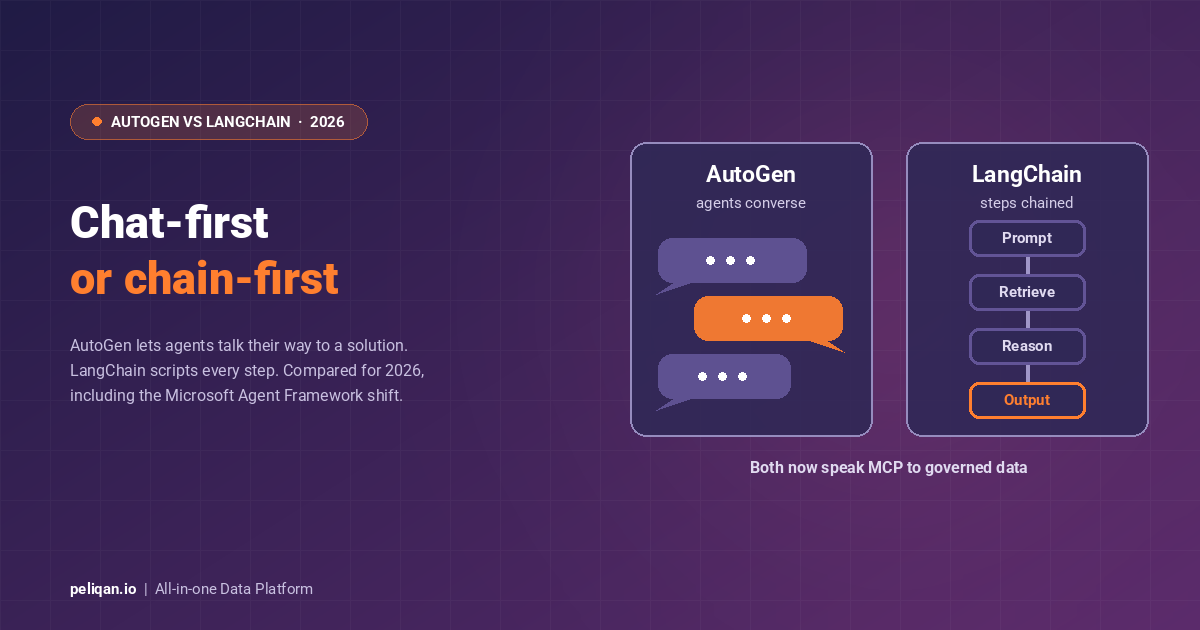





AutoGen vs LangChain is a comparison of two mental models. AutoGen orchestrates AI agents through conversation, where agents with roles debate, plan, and refine their work. LangChain, in contrast, composes LLM calls, tools, and retrievers into explicit pipelines. Both changed materially in the past year. AutoGen’s path now runs through the Microsoft Agent Framework, and LangChain shipped its 1.0 release. This guide compares them for 2026 and shows where a governed data layer fits under either.
Choosing the right agent framework affects reliability, auditability, and time to value for AI-driven automation. Here is the fastest way to frame the choice. AutoGen asks “which agents should talk to each other until this is solved?” LangChain asks “which exact steps should this application take?” In short, it is conversation-first versus chain-first, emergent versus explicit.
Platform overview: conversation-driven agents vs chain-first pipelines
AutoGen – conversation-first multi-agent collaboration
AutoGen, from Microsoft Research, builds automation around agents that communicate through an explicit conversational channel. Instead of following a fixed pipeline, AutoGen agents debate, propose plans, and refine outputs through chat-like exchanges. Roles such as planner, writer, and reviewer shape the dialogue. The v0.4 rewrite moved it to an event-driven, asynchronous actor architecture, so distributed multi-agent networks run more reliably. It is Python-first, and its mental model is chat. Messages, roles, and asynchronous exchanges drive orchestration. As a result, it suits exploratory, open-ended tasks where the best sequence of actions is not known in advance.
LangChain – chain-first LLM pipelines and tool composition
LangChain is a modular toolkit for composing LLM calls, prompt templates, retrievers, memory, and tools into explicit workflows. It excels at retrieval-augmented generation (RAG) and deterministic pipelines. It also connects LLMs to data sources and external services. Since the 1.0 release in October 2025, the centre of the framework is the create_agent abstraction. It runs the agent loop on LangGraph’s execution engine, and middleware hooks handle guardrails, summarisation, and dynamic prompts. Consequently, teams script exactly how data and calls flow through the application.
What changed in 2025-2026
The biggest shift happened on the Microsoft side. In late 2025, Microsoft consolidated AutoGen and Semantic Kernel into the Microsoft Agent Framework. That framework is now the supported production path for building agents in the Microsoft ecosystem. AutoGen’s multi-agent research patterns live on inside it. On top, Microsoft added enterprise lifecycle management, observability, and Azure AI Foundry integration. In practice, prototype freely with AutoGen, but plan production Microsoft-stack deployments on the Agent Framework.
LangChain, meanwhile, matured into a stable 1.0 stack. create_agent is the single entry point, LangGraph sits underneath for durable state, checkpoints, and human-in-the-loop, and LangSmith covers observability. In addition, both ecosystems adopted the Model Context Protocol. Agents on either side can therefore consume MCP servers as governed tool collections instead of hand-written adapters per API. As a result, governance now happens at the data-access layer, not in the framework.
AutoGen vs LangChain – comparison table
On cost, both are open-source SDKs. The bill therefore mostly comes from hosting, model calls, and the infrastructure needed to run agents at scale. Managed options exist on both sides for teams that want less ops. Azure AI Foundry hosts the Agent Framework, and LangGraph Platform hosts the LangChain stack.
Ease of use
AutoGen is quicker to prototype. AutoGen Studio lets you sketch agent interactions as chat flows and inspect message transcripts. For example, a less code-experienced user can ideate multi-agent behaviour in an afternoon. However, production use still demands engineering. Tools, data formats, stop conditions, and guards are yours to build.
LangChain has a steeper start and a stronger landing. There are more abstractions to learn, such as chains, agents, callbacks, and memory. However, the community, docs, and ready-made components are the largest in the ecosystem. Since 1.0, a working agent takes a dozen lines with create_agent. Once configured, chains behave predictably, so testing stays straightforward.
Integration ecosystem
AutoGen takes a plugin-like approach. Agents call external APIs or databases as part of their chat. Built-in tools cover sandboxed code execution, web browsing, and vector lookups. Adding a tool means defining a Python function and schema that agents invoke mid-dialogue. For example, one agent can fetch deal data from HubSpot while another drafts the report.
LangChain wins on raw breadth. It offers hundreds of model and data connectors, plus first-class retrievers for documents and databases such as Postgres. LangGraph adds multi-agent topologies, and LangSmith adds logging.
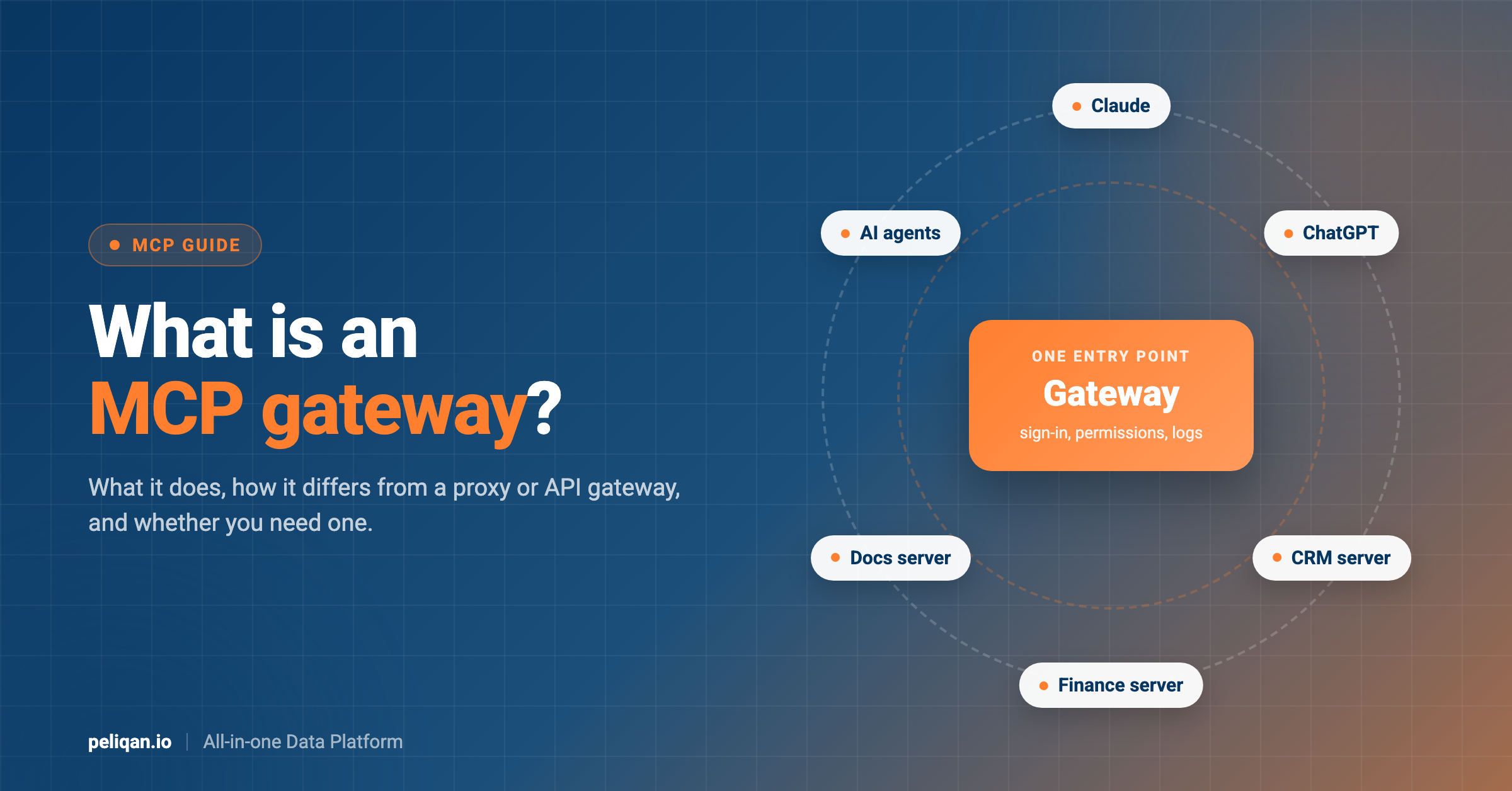
With MCP adapters on both sides, whole tool collections can now be mounted rather than integrated one by one. This is where a governed MCP server over business data slots in for either framework.
Hosting, security, and governance
Teams typically self-host both frameworks in production, in containers, VMs, or serverless. You therefore retain control over API keys, data residency, and compliance logs. AutoGen ships safety features like sandboxed Docker execution and configurable stop conditions, so no agent runs away. The Agent Framework adds enterprise lifecycle controls on top. LangChain, in turn, relies on standard engineering discipline, input validation, output parsers, and LangSmith audit logs. Choose the conversational model when flexible collaboration matters, and plan strong audit trails around the exchanges. Choose explicit chains when you need deterministic, audit-friendly workflows from day one.
When to use AutoGen, LangChain, or a hybrid
A practical decision guide
- Use AutoGen when multiple agents with distinct roles must collaborate on open-ended or creative tasks. It also fits R&D prototypes that benefit from chat-like workflows. For production, plan on the Microsoft Agent Framework.
- Use LangChain when workflows are well-defined: retrieve, reason, output. It is also the pick when RAG is core, or when you want fast iteration on proven patterns with reproducible outputs.
- Use a hybrid (plan then execute) when you want both. For example, a deterministic LangChain planner hands subtasks to collaborating agents, or a chain finalises agent brainstorming with strict output formats. Many projects start chain-first and add agent autonomy later.
How Peliqan complements AutoGen and LangChain
Whichever framework wins your evaluation, both operate best on consistent, cleaned, and governed data. A stable data layer reduces brittle prompts and cuts repeated model calls. It also gives you lineage for audits. Neither framework provides that part.
Peliqan supplies that foundation.
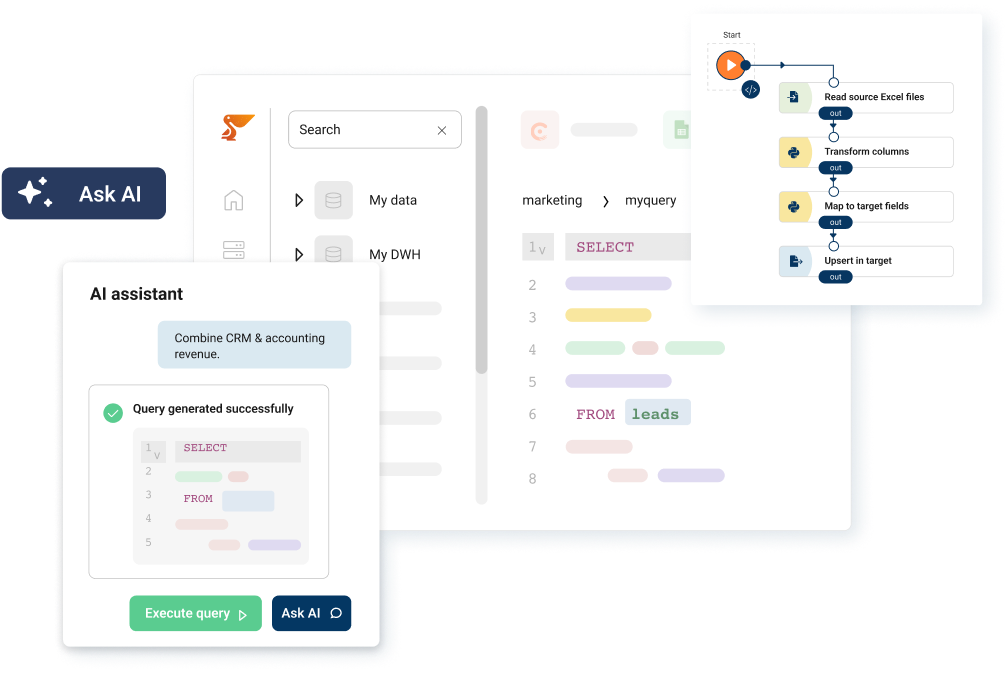
300+ connectors unify SaaS apps, databases, files, and APIs into one ingestion layer. Peliqan also delivers custom connectors within 2 weeks. As a result, agents and chains stop relying on ad-hoc payloads.
Centralised transformations in SQL and Python cleanse, enrich, and deduplicate data once, before agents consume it. Meanwhile, the cached, queryable warehouse reduces repeated calls, throttling risk, and embedding costs.
The AI layer adds RAG patterns, text-to-SQL, and a governed MCP server. An AutoGen agent network or a LangChain chain therefore queries the same permissioned, versioned datasets with an audit trail.
There is also a documented pattern for building AI agents on Peliqan that works with either framework. The platform holds SOC 2 Type II, ISO 27001, GDPR, HIPAA, and CCPA certifications, and it runs EU-hosted on AWS Frankfurt.
Summary
The AutoGen vs LangChain decision is less about which framework is objectively better. Instead, it is about matching the mental model to your product and compliance needs. AutoGen is best for multi-agent collaboration, conversational planning, and adaptive problem solving. Its production path runs through the Microsoft Agent Framework. LangChain, in contrast, is best for deterministic pipelines, RAG, and reproducible outputs, now on a stable 1.0 stack.
For the adjacent agent-framework comparison, see CrewAI vs AutoGen.
At the integration layer, LangChain vs n8n covers when a workflow platform beats a framework.
And under either choice, a governed data platform with centralized ingestion, transformations, caching, and lineage is what turns agent demos into reliable automation.