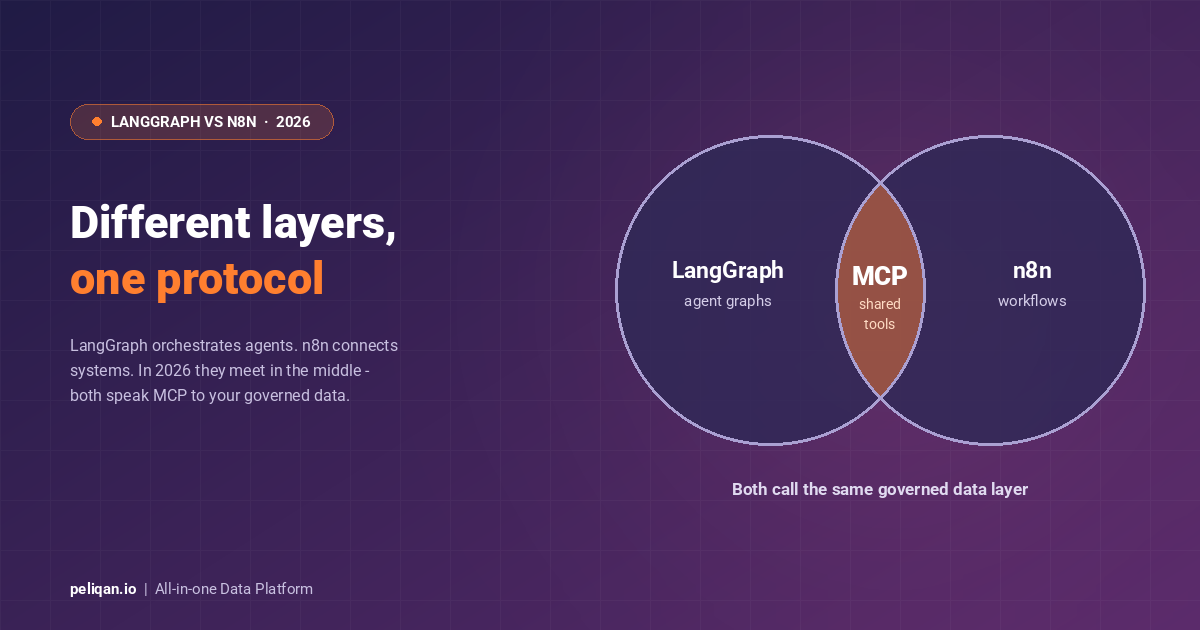
LangGraph vs n8n is really a comparison of two layers: LangGraph is a graph-based framework for orchestrating LLM agents and multi-step reasoning, while n8n is a visual workflow and integration platform for connecting systems and moving data. This guide compares them as a data automation team would: features, 2026 updates, pricing models, hosting and security, the MCP convergence, and how a governed data layer makes both work better.
Choosing the right automation stack for AI-driven data workflows can mean the difference between reliable, maintainable systems and brittle point-to-point scripts. The fastest way to frame it: n8n answers “when X happens in app A, do Y in app B.” LangGraph answers “given this goal, how should agents plan, call tools, and keep state until it is done.” One sits at the integration layer, the other at the AI orchestration layer, and many production stacks run both.
Platform overview: agent graph orchestration vs workflow orchestration
LangGraph – graph-based LLM agent orchestration
LangGraph is a framework for defining node-and-edge graphs of LLM agents, tools, and memory modules. It provides abstractions to compose multi-agent workflows, conditional branching, and tool calls within a directed, stateful graph, with checkpointing so long-running agents can pause, resume, and recover. LangGraph excels when you need to coordinate multiple AI agents and tools in complex, branching pipelines with human-in-the-loop steps.
n8n – visual workflow and integration platform
n8n offers a node-based canvas for building integrations and automations across APIs, databases, and apps. It targets engineering-savvy teams who want the productivity of a visual builder plus the option to drop into code through Function and Code nodes. n8n excels at event-driven flows, ETL-style jobs, scheduled tasks, and cross-system orchestration, and it supports self-hosting for security and compliance under its fair-code Sustainable Use License.
What changed in 2026
If you last evaluated these tools in 2025, both have moved. LangGraph reached its stable 1.0 release on October 22, 2025, alongside LangChain 1.0, and is now the execution engine underneath LangChain’s create_agent abstraction. The March 2026 updates added type-safe streaming and async subagents, making multi-agent graphs easier to run in production. Observability through LangSmith and visual debugging in LangGraph Studio have matured with it.
n8n, meanwhile, leaned hard into AI. The AI Workflow Builder generates working flows from plain-language prompts, AI Agent nodes embed LLM reasoning steps directly on the canvas, and the integration library has grown past 500 official and community nodes. The result is that the old “n8n is just plumbing” framing no longer holds: modest agentic behaviour now lives comfortably inside n8n flows, while LangGraph remains the tool for deep, stateful agent systems.
Feature comparison – core differences that matter
At a glance: LangGraph focuses on orchestrating multiple AI agents and tool calls via graph definitions. n8n focuses on connecting systems, routing data, and visual orchestration. Both are extensible, but their abstractions and developer experience differ substantially.
Why this matters for data automation teams: choosing LangGraph or n8n decides where decision-making logic lives, how data flows through agents, and who carries the operational burden. Use LangGraph when complex AI agent graphs and tool orchestration are core. Use n8n when connecting many systems, scheduling jobs, and operationalising integrations are the primary needs. Often both are combined: n8n handles triggers and data motion, LangGraph handles the agent graph execution. For the same comparison at the framework level, see our LangChain vs n8n guide.
The MCP factor: where the two tools now meet
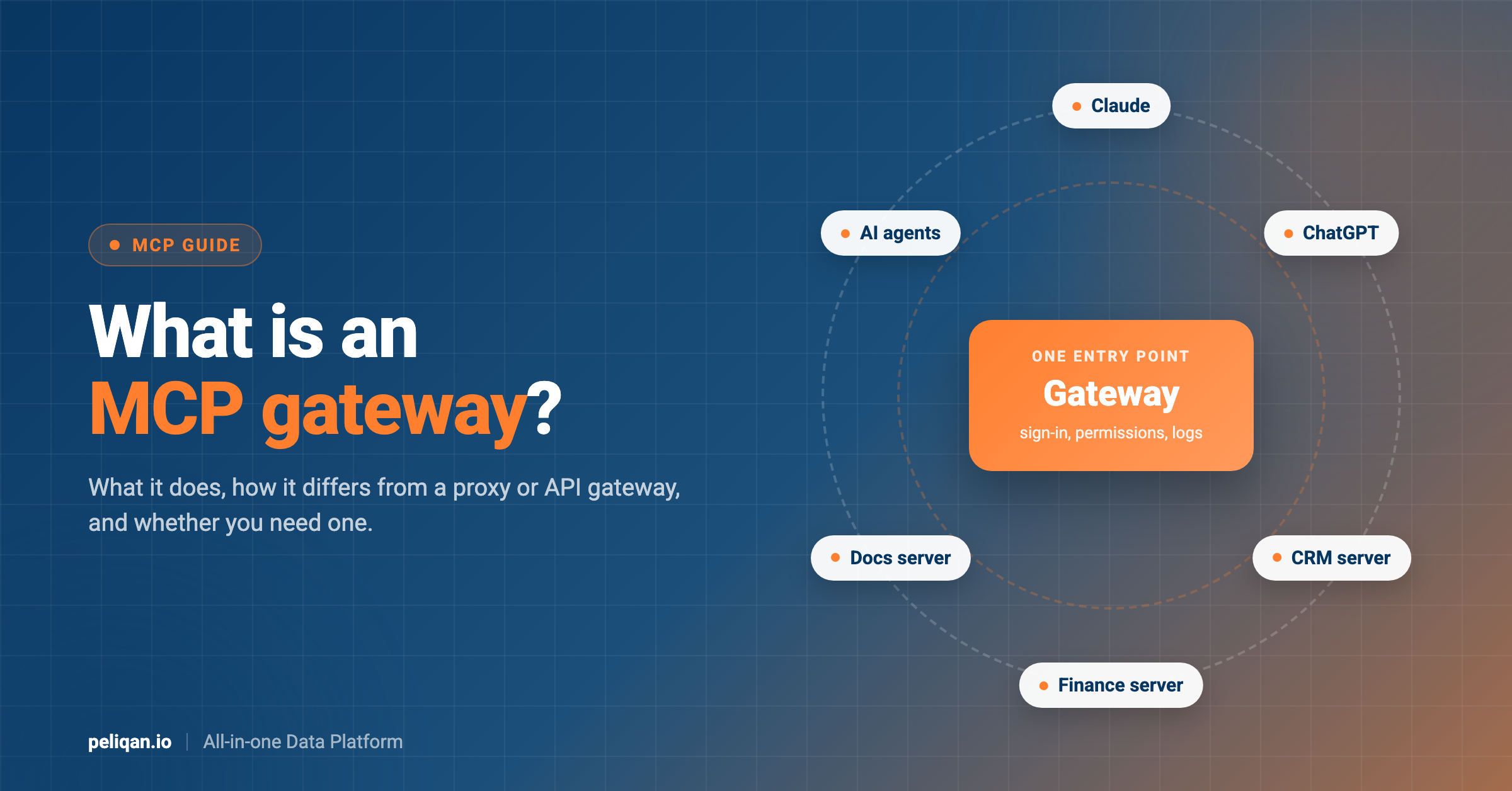
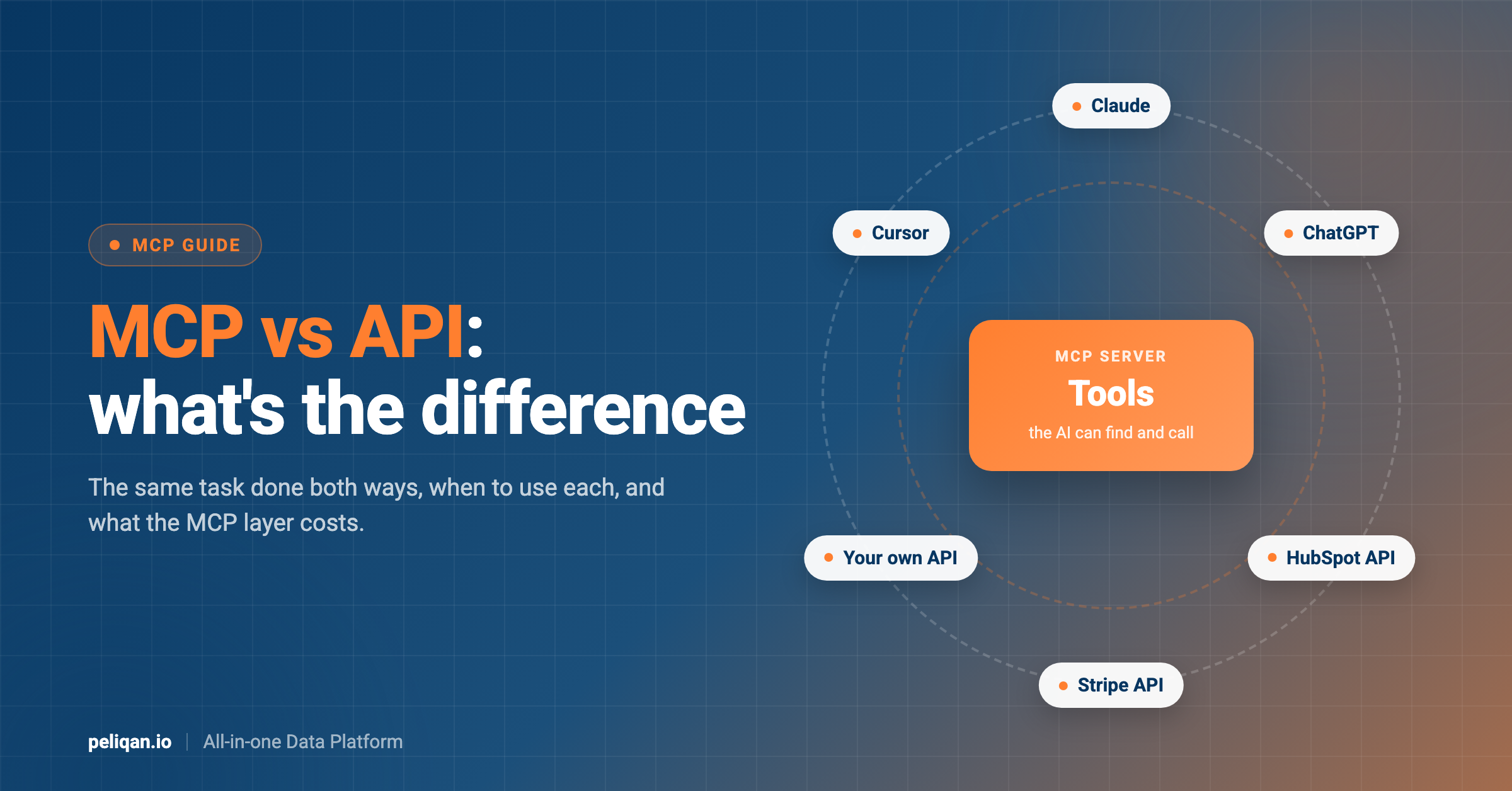
The biggest 2026 convergence is the Model Context Protocol. LangGraph agents can consume MCP servers as tool collections through the LangChain MCP adapters, so a graph can discover and call external tools without custom glue code per API. n8n added both sides: an MCP client node that lets a flow call any MCP server, and an MCP server trigger that exposes an n8n workflow as a tool that agents elsewhere can invoke.
In practice this dissolves the old boundary. A LangGraph agent can call an n8n workflow as one of its tools, and an n8n flow can hand a hard reasoning step to an agent. The remaining question is what those tools are allowed to touch, which is a data governance question, not a framework one. A governed MCP server over your business data gives both platforms one permissioned, audited entry point to live company data instead of a pile of per-workflow credentials.
Pricing and cost model
Interpretation: LangGraph costs centre on infrastructure and AI or tool API spend. n8n costs centre on execution volume and hosting. For agent-graph-heavy pipelines, model spend usually dominates; for broad integration workloads, execution scaling is the larger line item. Neither tool solves the hidden data bill: if workflows repeatedly fetch and re-fetch the same CRM or ERP data, you pay in API rate limits and latency on both platforms.
Ease of use
LangGraph is built for engineers. It assumes familiarity with code, graph definitions, and agent patterns. It gives deep control over multi-agent flows, but designing, testing, and observing execution graphs is engineering work, even with LangGraph Studio easing the debugging side.
n8n is visual first, engineer extendable. Non-developers can assemble many automations on the canvas, the AI Workflow Builder drafts flows from a prompt, and engineers insert JS or Python for edge cases and maintain reusable subflows. Complex pipelines still need technical skill, but the entry barrier is far lower.
Integration ecosystem
LangGraph is API and tool-first: it connects to any external tool or API via code, and with MCP adapters it can consume whole tool collections dynamically inside agent graphs. That is unlimited extensibility, at the cost of writing and maintaining the code.
n8n is connectors and nodes: 500+ integrations cover the common SaaS apps and APIs out of the box, handling auth, webhooks, and polling triggers, which makes cross-system automation fast to stand up and easy to hand over.
Hosting and security
LangGraph runs embedded in your microservices or serverless functions, so you secure model keys, tool credentials, and data in transit under your own policies. n8n supports self-hosting for sensitive environments and a managed cloud for teams that want less ops overhead; self-hosting gives control over logs, network access, and data residency. Choose LangGraph when agent orchestration must stay inside your controlled environment; choose self-hosted n8n when workflow data must remain under your governance but you want visual flows and connectors.
Customization and developer power
LangGraph offers maximum control: primitives for agent nodes, tool integration, memory modules, and conditional graph edges, so engineers can implement complex branching, loops, and feedback-driven agent behaviour with full state management. n8n offers practical extensibility: pre-built connectors combined with custom JS or Python, ideal for teams that want bespoke transforms without building an integration platform from scratch. In short: LangGraph is best for designing deep multi-agent workflows; n8n is best for end-to-end process automation and moving data between systems quickly.
How Peliqan complements LangGraph and n8n
LangGraph and n8n are often combined: LangGraph executes agent graphs and tool calls, n8n triggers and orchestrates cross-system flows. Both, however, need a stable, queryable data layer to scale reliably. Data-heavy pain points show up fast: high-volume document ingestion for embeddings, repeated API calls causing throttling and latency, complex joins and deduplication before agents can trust their inputs, and ad-hoc payloads feeding agent prompts.
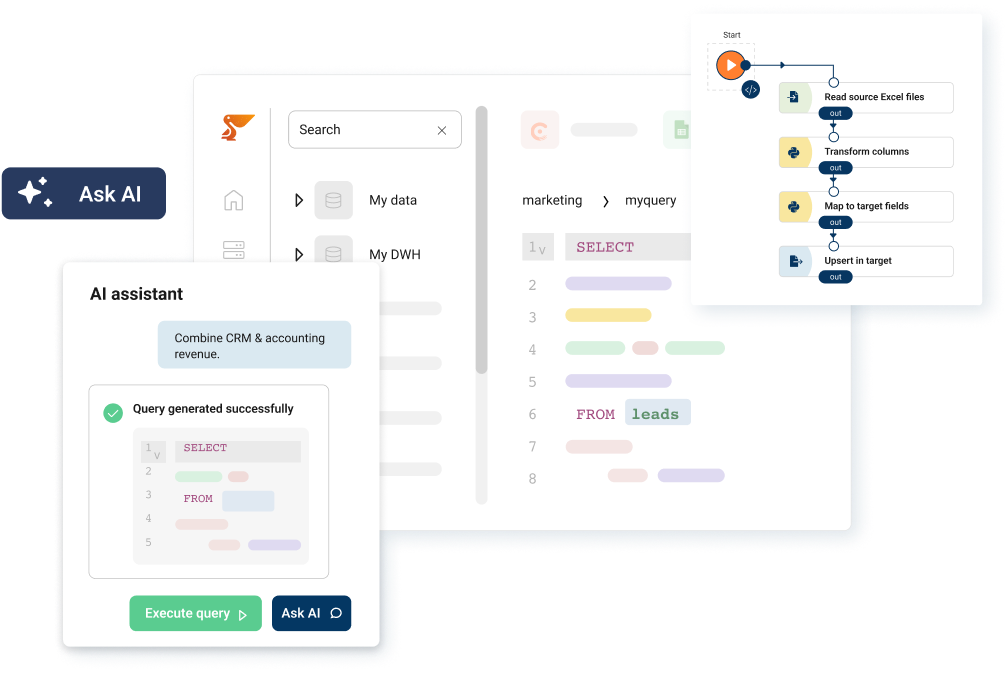
Peliqan becomes that data foundation. 300+ connectors unify SaaS apps, databases, and files into one consistent ingestion layer, with custom connectors delivered within 2 weeks.
Centralised transformations in SQL and Python handle cleansing, enrichment, and joins once, before agents consume the data, instead of scattering that logic across graphs and flows.
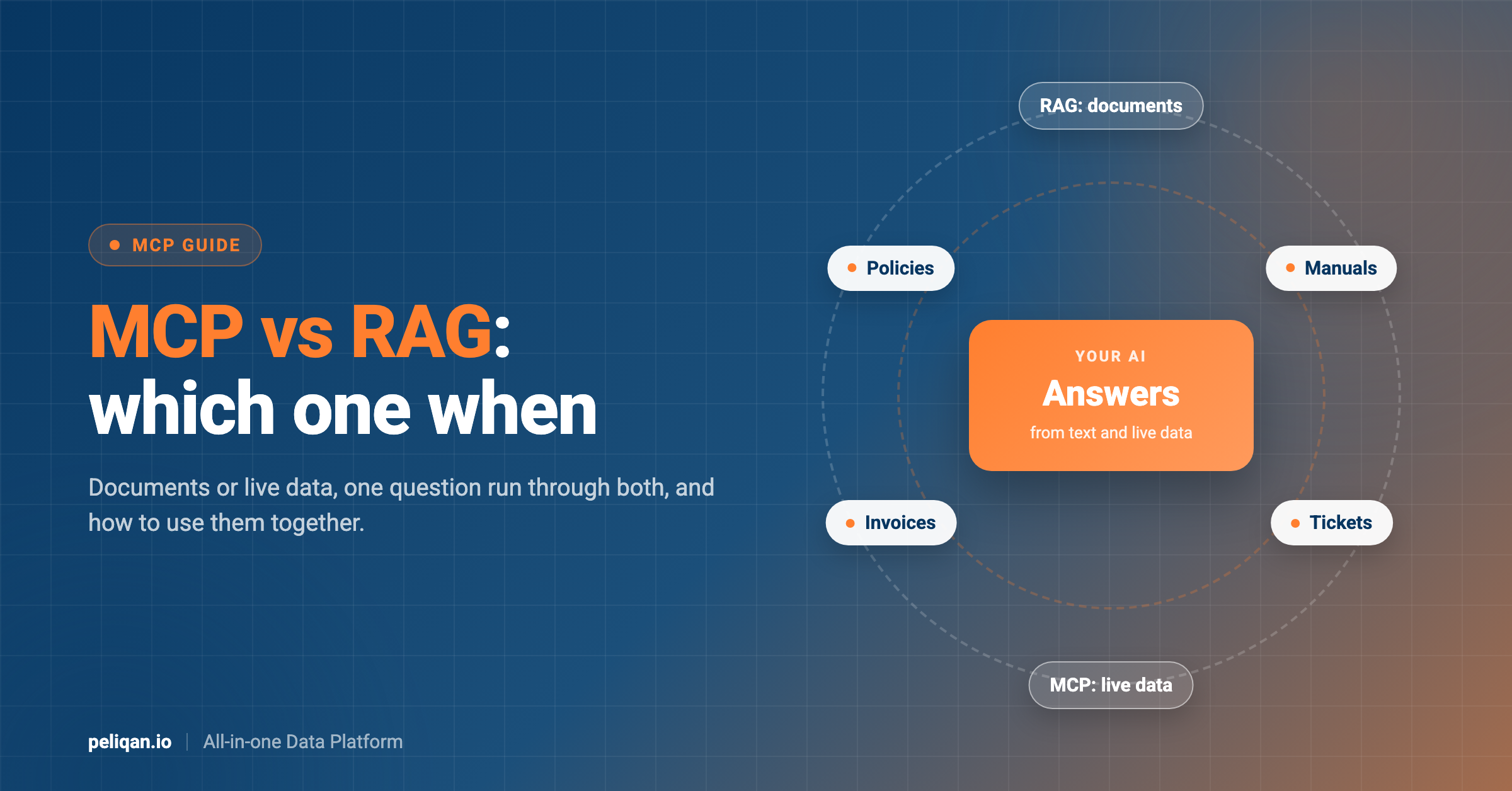
The cached, queryable warehouse avoids repeated source calls, and the AI layer adds RAG and text-to-SQL patterns on clean, versioned datasets, with governance and lineage for audits and debugging.
For n8n specifically, there is a documented pattern for building AI agents with n8n and Peliqan, where n8n handles the trigger and delivery while Peliqan serves governed data through MCP.
Example architectures
Multi-agent research pipeline: APIs and databases flow into Peliqan for ingestion and embeddings, a LangGraph agent graph handles tool calls and reasoning, and n8n triggers the downstream notifications.
Customer insights orchestration: an event fires, n8n orchestrates the CRM and billing calls, for example pulling deal data from HubSpot, raw data lands in Peliqan where a central pipeline normalises and enriches it, and LangGraph agents generate the insights.
Automated compliance reporting: n8n triggers a nightly extract, Peliqan runs the transformations and stores snapshots, a LangGraph agent compiles the audit summary, and n8n distributes the report.
Conclusion
LangGraph and n8n are complementary tools. LangGraph gives you the control to orchestrate complex, stateful AI agent graphs; n8n helps you build and operationalise integrations and data flows, now with real AI steps of its own. For data automation teams, the pragmatic architecture is layered: use each tool where it is strongest and rely on a dedicated data foundation like Peliqan to handle ingestion, transformation, caching, and governance. That reduces operational risk, improves agent inputs, and shortens time to value for AI-driven automation.