



Almost every integration you will build is one of six shapes. Naming the shape first makes the tooling decision much easier, because most tools implement several of them and the question is which one you actually need.
The six patterns
- 1Migration – move a set of records once. From an old system to a new one, usually with a cutover. The work is in mapping and validation, not in the movement, and the pattern ends when the old system is retired.
- 2Broadcast – one source to many, continuously. A change in the system of record is pushed out to every downstream tool that needs it. One-way, and expected to be near real time.
- 3Bi-directional sync – two systems stay current with each other. Both sides are edited by people, so both sides change. This is the pattern that needs conflict rules, and the one teams underestimate.
- 4Correlation – join only what exists in both. Not everything from either side: the intersection. Useful when two systems share some records and you only care about the overlap.
- 5Aggregation – many sources into one place. The reporting pattern, and what an ELT pipeline into a warehouse is doing. One modelled destination, many contributors.
- 6Live query – read on demand, keep no copy. The agent or application queries the source when the question is asked. Nothing to sync and nothing to go stale, at the cost of depending on the source being available.
Choosing between them
Two questions settle it most of the time. Who needs the data – one destination or many? And how fresh does it have to be – is a scheduled batch acceptable, or must it reflect the current state? Aggregation and migration tolerate batch; broadcast, bi-directional sync and live query generally do not.
Patterns are not tools
A single platform will implement several patterns, and a single project often needs more than one – aggregation into a warehouse for reporting, broadcast back out for operations. Choosing the tool first tends to force whichever pattern that tool does best.
Where each pattern is drawn out
Aggregation is ETL or ELT into a warehouse; broadcast back to operational tools is reverse ETL; incremental capture behind both is change data capture; and live query for agents is MCP.
What this looks like in Peliqan
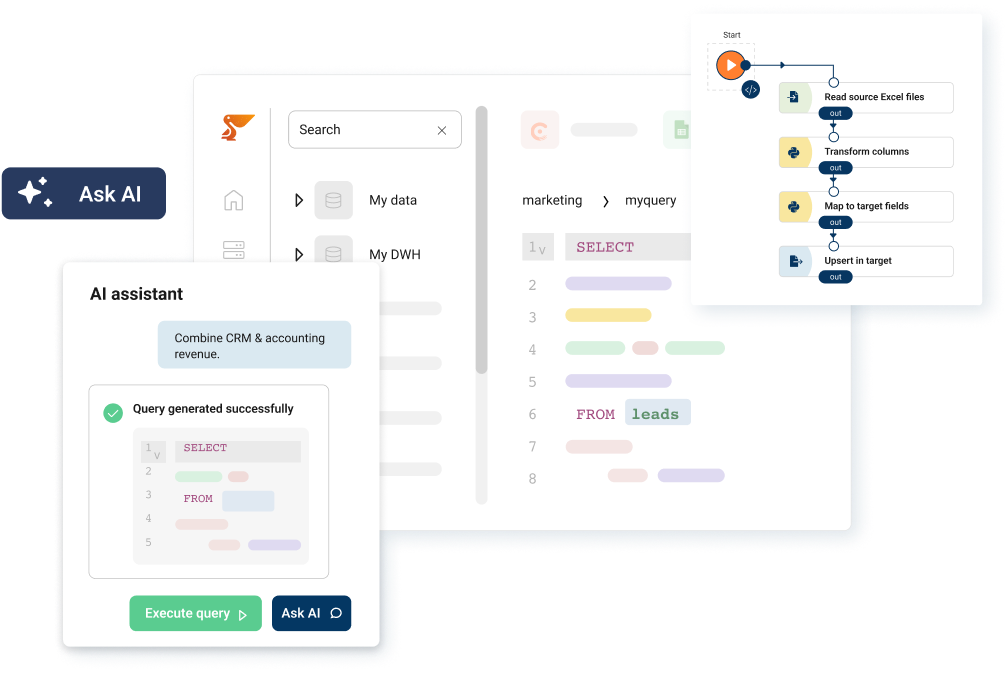
One platform across 300+ sources covers aggregation into a warehouse, broadcast back out to operational tools, and live query over MCP – so the pattern is a configuration choice rather than a procurement one.
Use this diagram wherever you like
The diagram is free to use, including commercially, as long as there is a visible link back to this page. Download the PNG for slides and documents, or the SVG if you want to edit the labels. No email required. You can browse the rest of the set in the Peliqan diagram library.
Ready to build this on your own data? Get started with Peliqan.