


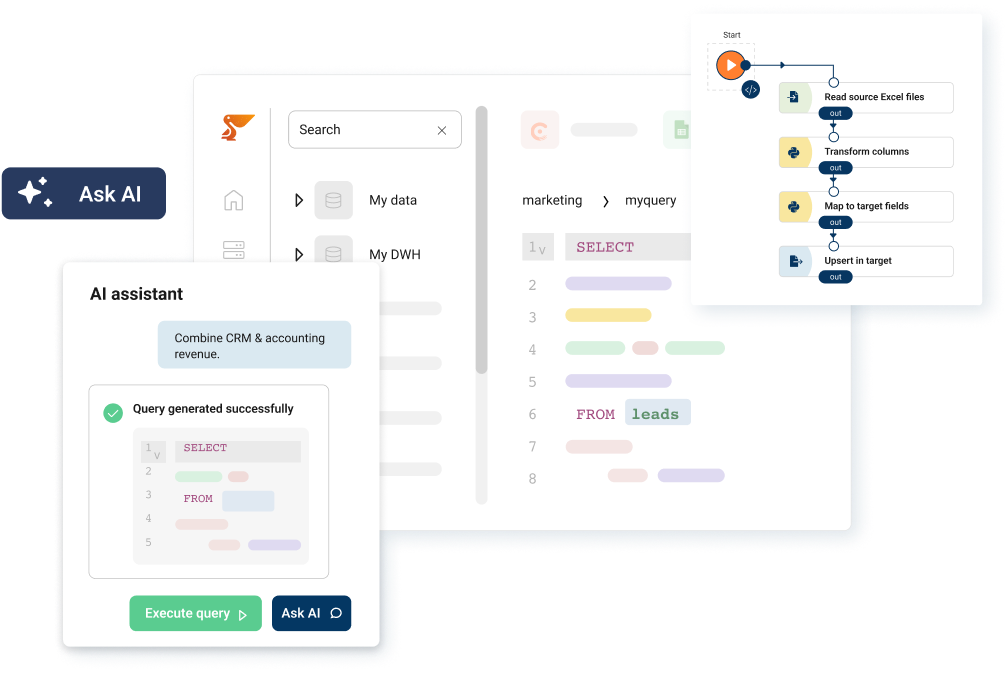


A data catalog is the inventory people check before they use a dataset. The diagram below shows a single entry expanded, because what matters is not that a catalog exists but whether each entry answers the questions people actually have.
The four questions every entry should answer
- 1Who owns it. A named person, not a team. When a definition is disputed or a column changes, there has to be someone who can settle it.
- 2What it means. One row per what, exactly? Written so somebody outside the team that built it can tell whether it is the table they want.
- 3How fresh it is. When it last rebuilt and whether that succeeded. A catalogue entry with no freshness signal is a table you still have to go and check.
- 4Who may see it. The access rule, visible before someone requests it, so the answer to a request is predictable.
How a catalog fills up
Crawling is the easy half: connect a source and the catalog can read schemas, column types and usage automatically. The half that decides whether anyone trusts it is curation – owners, plain-language meaning, and a mark on the version that is safe to build on. Crawled metadata alone produces a searchable list of table names.
Catalog, dictionary or glossary?
- A data dictionary documents the technical structure of one database: columns, types, constraints.
- A business glossary defines terms in business language – what “active customer” means, regardless of where it is stored.
- A data catalog is the enterprise-wide inventory, and usually contains both of the above plus lineage, ownership and access.
What makes a catalog usable
An entry is only actionable if you can see what it is built from and what reads it, which is a lineage question, and if someone is accountable for it, which is a governance one.
What this looks like in Peliqan
Because ingestion and modelling happen in one place, the catalog is a by-product rather than a separate project: connect a source from the 300+ available and its tables, their models and the people using them are already in one system to describe.
Use this diagram wherever you like
The diagram is free to use, including commercially, as long as there is a visible link back to this page. Download the PNG for slides and documents, or the SVG if you want to edit the labels. No email required. You can browse the rest of the set in the Peliqan diagram library.
Ready to build this on your own data? Get started with Peliqan.