



Data lineage is the graph that connects a number on a dashboard back to the row in the source system it came from. It answers two questions, and the diagram below follows one path through both of them.
The two questions lineage exists to answer
- 1Upstream: where did this number come from? Someone disputes a figure. Lineage lets you walk backwards from the dashboard to the model, to the raw table, to the source system and the extraction that produced it, without asking the person who built it four years ago.
- 2Downstream: what breaks if I change this? Before renaming a column or changing a join, you can see every model, report and agent that reads it. This turns a change from an act of faith into a review, which is the difference between shipping on a Tuesday and shipping on a Friday.
Table-level and column-level lineage are not the same thing
Table-level lineage tells you that a dashboard depends on a table. That is enough to warn you that something changed, but not enough to tell you whether it matters. Column-level lineage tells you the revenue tile reads one specific field, so a change to a different column in the same table is safe to ship. In practice, table-level answers the alerting question and column-level answers the impact question.
Where lineage comes from
- Parsed from the SQL that builds each model, which is the most reliable source because it reflects what actually ran.
- Captured from the pipeline as it executes, which catches transformations that never appear in SQL.
- Declared by hand, which is accurate on the day it is written and wrong within a quarter.
What lineage is really for
Most teams buy lineage for audit and then use it for change management. The audit case is real, particularly where a number ends up in a regulatory filing. But the everyday value is that engineers stop being afraid to change things, because the blast radius is visible before the change rather than after it.
What this looks like in Peliqan
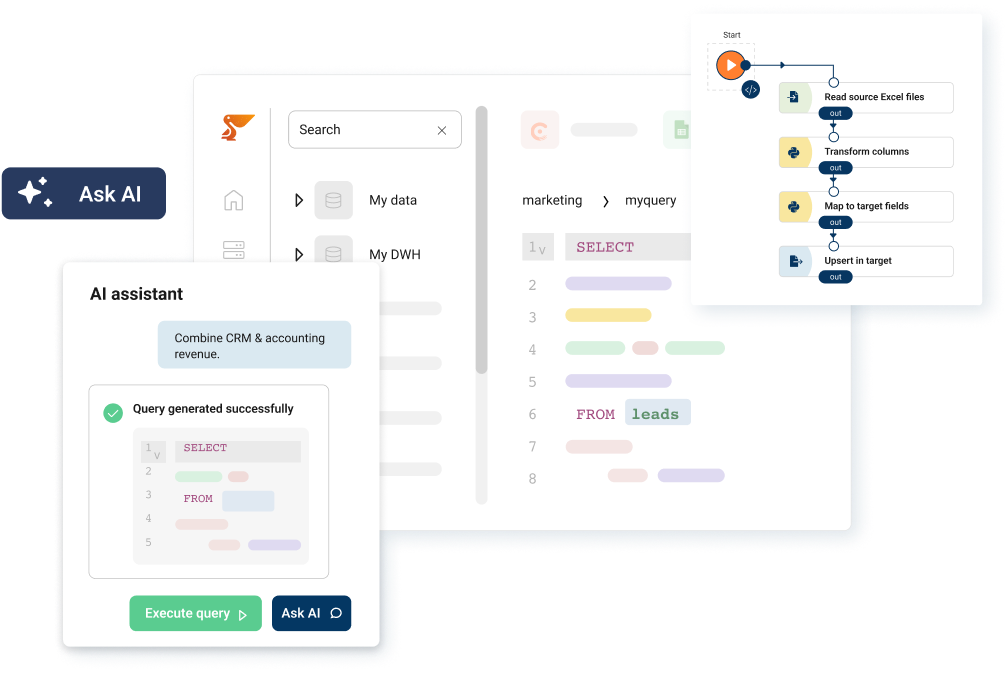
Because ingestion, modelling and serving happen in one place, the chain from a connector through your models to the dashboard or the AI agent reading them is visible rather than reconstructed from three tools’ logs. Lineage is also what makes a governance framework enforceable instead of aspirational.
Use this diagram wherever you like
The diagram is free to use, including commercially, as long as there is a visible link back to this page. Download the PNG for slides and documents, or the SVG if you want to edit the labels. No email required. You can browse the rest of the set in the Peliqan diagram library.
Ready to build this on your own data? Get started with Peliqan.