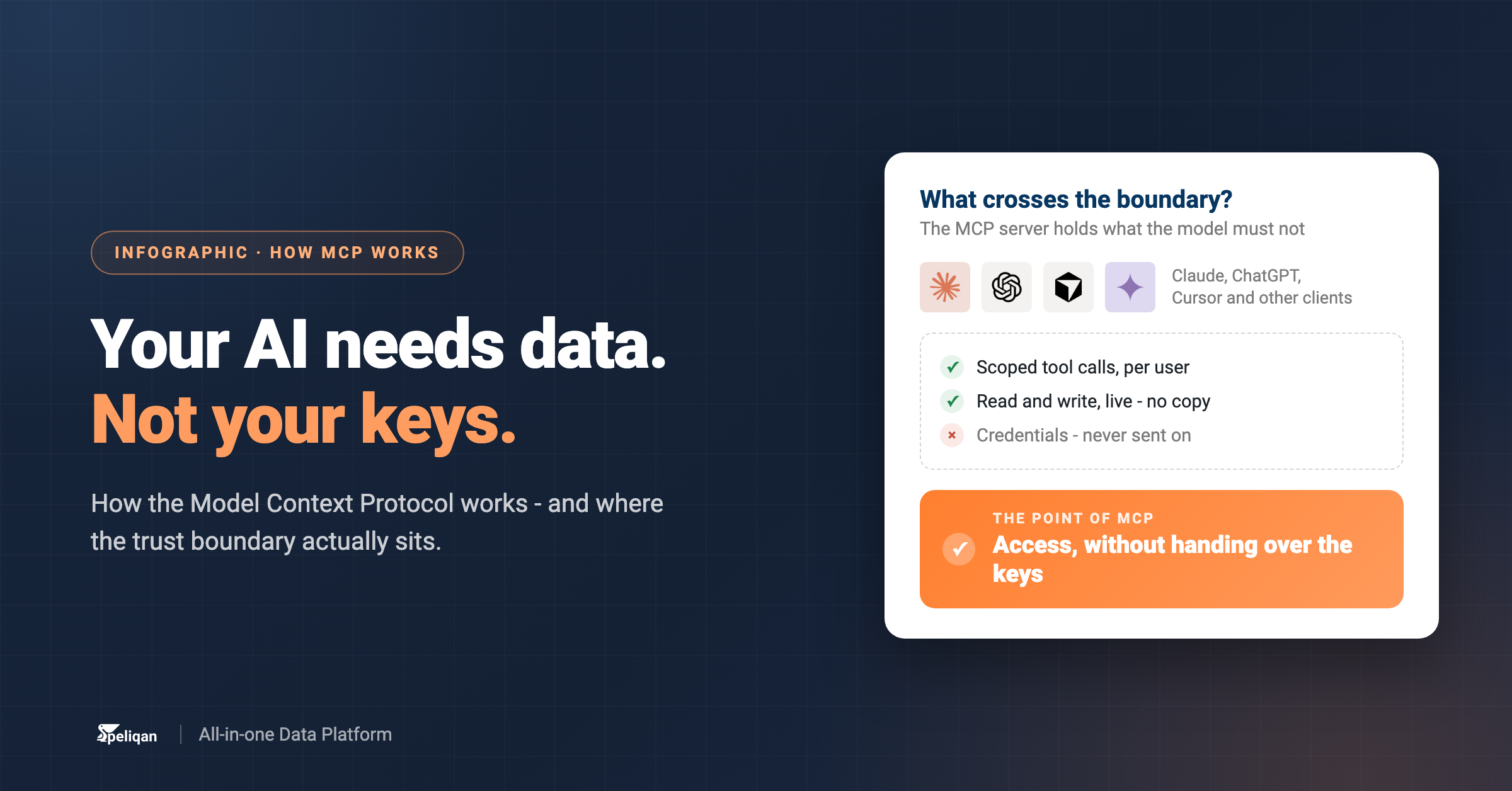


The Model Context Protocol is an open standard for connecting AI clients to the systems that hold your data. The diagram below shows the three parts and, more usefully, where the trust boundary falls.Do I need a data warehouse to use MCP?
No. An agent can query business systems live through MCP. A warehouse is still useful when you need history or heavy modelling, and the agent can read that too.
Do I need a data warehouse to use MCP?
No. An agent can query business systems live through MCP. A warehouse is still useful when you need history or heavy modelling, and the agent can read that too.
The three parts
- 1The client is whatever your team already uses. Claude, ChatGPT, Cursor, Gemini and other MCP-capable clients all connect the same way. That is the argument for a protocol rather than a plugin: you are not committing to one assistant, and adding a second later costs nothing.
- 2The server is where the control lives. It exposes tools, which define what an agent is allowed to do. It holds the credentials for each connected system, so they are never sent to the model. It applies per-user scope, deciding who can read and who can write. And it logs every call, so an answer can be traced back to the request that produced it.
- 3The systems are read and written live. ERP, accounting, CRM, databases and the warehouse. The agent reads them as they are now rather than from a copy, and where you allow it, writes back. No sync window, so no gap between what the agent says and what the system holds.
What MCP replaces
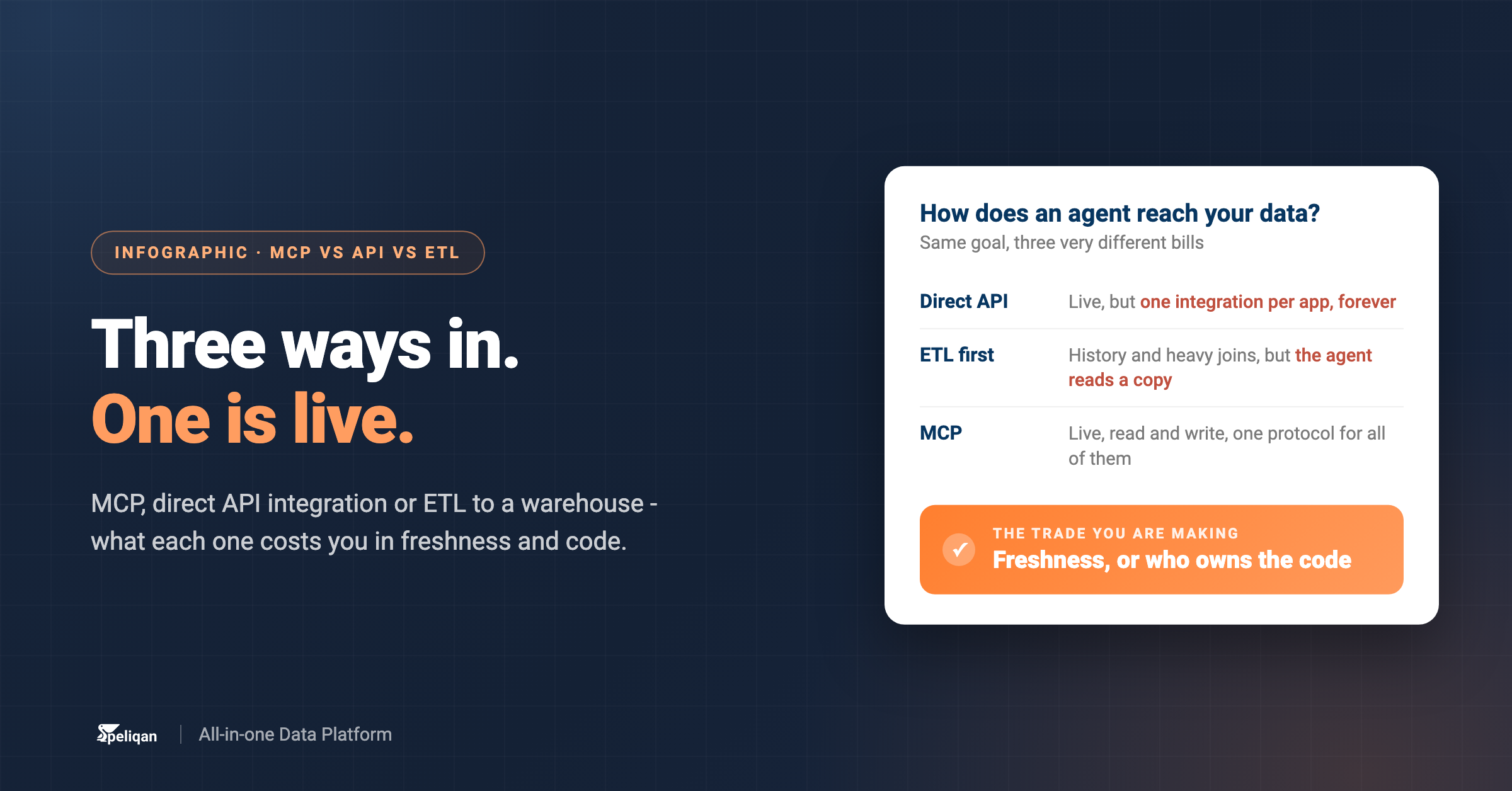
- A custom integration per application, which you then own and maintain forever
- Piping everything into a warehouse so the agent can read a copy that is only as current as the last sync, with no way to write back
- Pasting exported data into a prompt, which is current for exactly one conversation and leaves no audit trail
Why the trust boundary matters
The useful question about any AI data setup is where the credentials live. Because the MCP server holds them, the model receives results rather than secrets, and revoking access is one change in one place. As a result you can give an agent real access without giving it your passwords.
Setting it up with Peliqan
With Peliqan the server is a single endpoint, https://mcp.eu.peliqan.io/mcp, and credentials stay inside Peliqan. Connect a source once, then add that endpoint in your AI client. There is a walkthrough on the Peliqan MCP server page, and per-application guides in the Peliqan academy.
Use this diagram wherever you like
The diagram is free to use, including commercially, as long as there is a visible link back to this page. Download the PNG for slides and documents, or the SVG if you want to edit the labels. No email required. You can browse the rest of the set in the Peliqan diagram library.
Ready to build this on your own data? Get started with Peliqan.