




Data warehouse architecture is the framework that governs how a data warehouse is structured, organized, and implemented. It covers the components (source systems, staging, ETL, central database, data marts, metadata, query tools, governance, security), the patterns (single-tier, two-tier, three-tier, hub-and-spoke, federated), and the design decisions that determine performance, scalability, and total cost. This guide covers all of the above plus how a modern platform like Peliqan consolidates the architecture into one product.
A well-designed data warehouse architecture sits at the center of every serious analytics, BI, and AI initiative. Get it right and queries are fast, data is trusted, and AI agents have clean entities to reason on. Get it wrong and you spend the next two years rebuilding while the business loses faith in the data.
What is data warehouse architecture?
Data warehouse architecture refers to the framework and design principles that govern how a data warehouse is structured, organized, and implemented within an organization. It encompasses the various components, layers, and processes involved in collecting, storing, and retrieving data from multiple sources to support business intelligence and decision-making activities.
A well-designed data warehouse architecture ensures that data is:
- Integrated from various sources
- Cleansed and transformed for consistency
- Stored efficiently for quick retrieval
- Accessible for analysis and reporting
The evolution of data warehouse architecture
Data warehouse architecture has evolved significantly since its inception in the late 1980s. A brief look at this evolution:
- Traditional architecture: Initially, data warehouses were built on-premises using relational database management systems (RDBMS) with a focus on batch processing and historical data analysis.
- Data mart architecture: As organizations grew, smaller, subject-specific data marts emerged to cater to departmental needs.
- Hub-and-spoke architecture: This model combined centralized data warehouses with distributed data marts for a more flexible approach.
- Modern cloud-based architecture: With the rise of cloud computing, data warehouse architectures have shifted toward scalable, flexible, and cost-effective cloud-based solutions.
- Hybrid architecture: Many organizations now adopt a hybrid approach, combining on-premises and cloud-based components to use existing investments while embracing new technologies.
Data warehouse architecture: 9 core components
A typical data warehouse architecture consists of several key components, each playing a crucial role in the overall functionality and efficiency of the system.
1. Source systems
These are the various operational databases, external data sources, and applications that generate the raw data to be stored in the warehouse. Examples include CRM systems, ERP software, and transactional databases. The diversity of these sources highlights the need for a strong integration strategy in your data warehouse architecture.
2. Data staging area
The staging area is where data from source systems is temporarily stored before being processed and loaded into the main data warehouse. This area allows for initial data cleansing and transformation without affecting the source systems or the warehouse itself. It acts as a buffer, enabling efficient data processing and reducing the load on both source and target systems.
3. ETL layer
The Extract, Transform, Load (ETL) layer is responsible for:
- Extracting data from source systems
- Transforming it to fit the data warehouse schema
- Loading it into the data warehouse
This layer is critical for ensuring data quality and consistency. Modern data platforms like Peliqan offer advanced ETL capabilities, letting users connect to over 250 SaaS applications, databases, and file sources with just a few clicks. Peliqan’s automatic ETL data pipeline creation significantly reduces the complexity and maintenance overhead traditionally associated with this process.
4. Data warehouse database
This is the central repository where the integrated, cleansed, and transformed data is stored. It’s typically implemented using a relational database management system (RDBMS) optimized for analytical queries. The design of this database is crucial for performance and scalability, often employing techniques like star or snowflake schemas to optimize query performance.
5. Metadata repository
The metadata repository stores information about the data warehouse itself, including data definitions, schema information, data lineage, and transformation rules. This component is essential for data governance and management. Peliqan provides a built-in Data Catalog to manage and store all metadata, supporting governance and discoverability.
6. Data mart layer
Data marts are subject-specific subsets of the data warehouse, often used to serve specific departmental or functional needs. They provide faster query performance for focused analyses. By organizing data into smaller, more manageable units, organizations can improve query performance and user experience for specific business domains.
7. Query and analysis tools
These are the front-end applications that let users interact with the data warehouse, run queries, generate reports, and perform advanced analytics. Business intelligence (BI) tools, data visualization software, and ad-hoc query tools fall into this category. The choice of these tools significantly impacts user adoption and the overall value derived from the warehouse.
8. Data governance layer
A solid data governance layer is crucial in modern data warehouse architectures. This layer encompasses policies, procedures, and tools for ensuring data quality, security, and compliance throughout the data lifecycle.
9. Security and access control
With the increasing importance of data privacy and regulatory compliance, a dedicated security layer is essential. This component manages user authentication, authorization, and data encryption, ensuring sensitive information is protected and only accessible to authorized users.
In large enterprises, physical security is often enforced through an access control system that regulates entry to data centers, server rooms, and restricted workspaces using badges or fob cards. Aligning physical access controls with data governance policies makes sure only authorized personnel can physically reach the infrastructure that supports sensitive data and analytics operations.
To summarize the core components, the table below provides a quick reference:
This table provides a quick overview of each component’s role in the data warehouse architecture and highlights key considerations for implementation. As you design your data warehouse, keep these components and their interrelationships in mind to build a strong and efficient system.
Types of data warehouse architecture
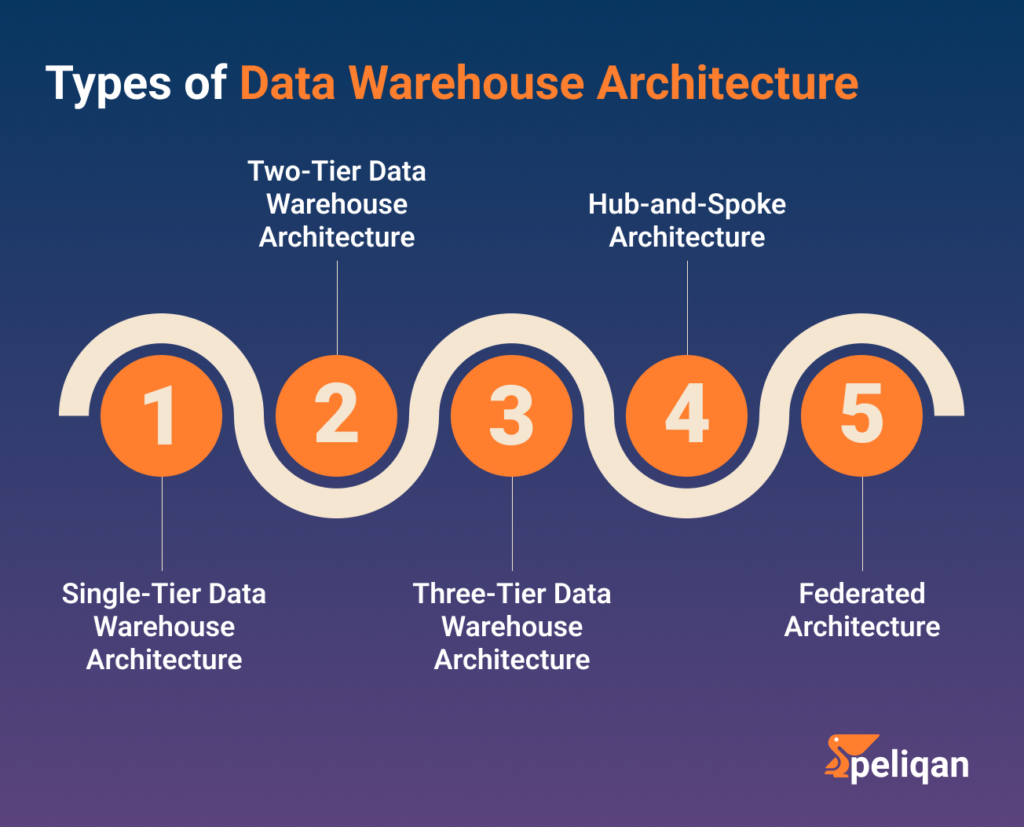
Different organizational needs and technological constraints have led to several architectural patterns. The most common types in detail:
Single-tier data warehouse architecture
The simplest form, where the data warehouse acts as a centralized repository for all data. Data is extracted from source systems, transformed, and loaded directly into the data warehouse, which also serves as the platform for querying and analysis.
Pros
- Simplicity in design and implementation
- Lower initial costs
- Suitable for small organizations with limited data sources
Cons
- Limited scalability
- Potential performance issues as data volumes grow
- Lack of separation between storage and compute resources
Use case: Small businesses or departments with straightforward reporting needs and limited data sources.
Two-tier data warehouse architecture
In this model, the data warehouse is separated from the source systems, creating two distinct layers. Data is extracted from source systems, transformed, and then loaded into the warehouse. The warehouse handles both storage and querying.
Pros
- Better scalability compared to single-tier
- Improved performance by offloading analytical queries from operational systems
- Allows for more complex transformations
Cons
- Increased complexity in design and maintenance
- Potential for data latency between source systems and the warehouse
Use case: Medium-sized organizations with multiple data sources and more complex analytical needs.
Three-tier data warehouse architecture
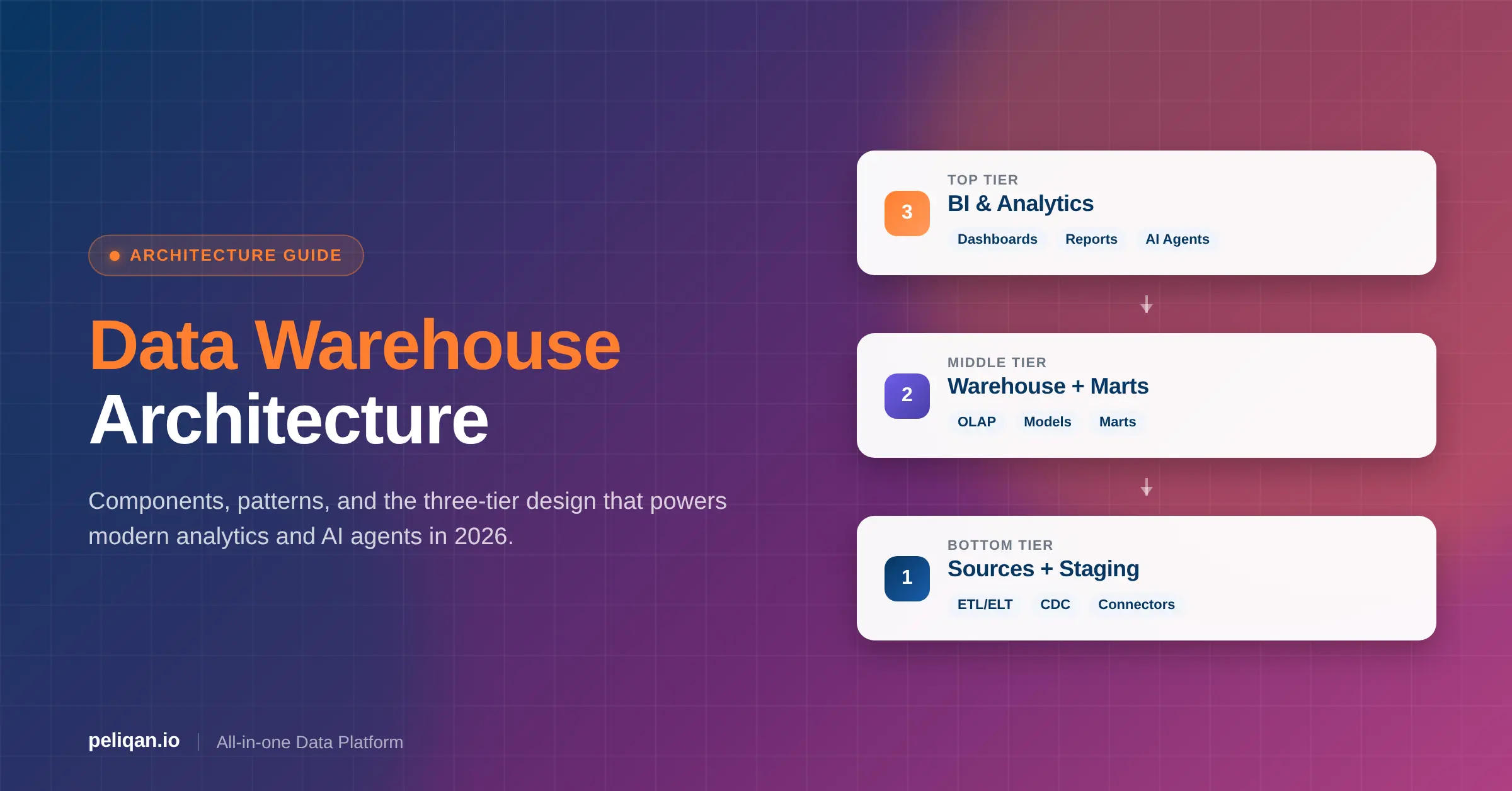
The most common EDW type is three-tier data warehouse architecture, consisting of a bottom tier (data source layer), a middle tier (data warehouse layer), and a top tier (client or BI tools layer). This architecture provides high scalability, performance, and integration with advanced analytics tools.
- Bottom tier: Includes source systems and the staging area for initial data extraction and storage.
- Middle tier: Comprises the main data warehouse and potentially separate data marts.
- Top tier: Consists of query and analysis tools, reporting applications, and data mining tools.
Pros
- High scalability and flexibility
- Clear separation of concerns between layers
- Supports complex querying and analytics
- Better performance for large-scale data processing
Cons
- More complex to design and implement
- Higher initial costs
- Requires more specialized skills to manage
Use case: Large enterprises with diverse data sources, complex analytical requirements, and the need for high scalability.
Hub-and-spoke architecture
This architecture combines a centralized data warehouse (the hub) with multiple subject-specific data marts (the spokes). Data is first integrated and stored in the central warehouse, then distributed to various data marts for specific departmental or functional needs.
Pros
- Balances centralized control with departmental flexibility
- Improves query performance for specific business domains
- Supports easier data governance and consistency
Cons
- Can lead to data redundancy
- Requires careful coordination between the central warehouse and data marts
- More complex ETL processes
Use case: Organizations with distinct departmental data needs but requiring a single source of truth.
Federated architecture
In this model, data remains distributed across multiple sources, with a virtual layer providing a unified view of the data. Instead of physically moving all data to a central repository, queries are distributed across the various sources.
Pros
- Reduces data movement and storage costs
- Provides real-time access to source data
- Useful for organizations with regulatory constraints on data centralization
Cons
- Can have performance issues with complex queries
- Requires sophisticated query optimization
- Challenging to maintain data consistency across sources
Use case: Organizations with strict data residency requirements or those needing real-time access to operational data.
The choice of architecture depends on the organization’s size, data volume, analytical needs, existing infrastructure, and budget. Many modern implementations use a hybrid approach, combining elements from different architectures to create a solution tailored to specific business requirements.
Modern data warehouse architecture trends
The landscape of data warehouse architecture is evolving fast, driven by advancements in technology and changing business needs. The key trends shaping modern data warehouse architectures:
Cloud-based data warehouses
The shift toward cloud platforms has reshaped data warehouse architecture, offering scalability, flexibility, and cost-effectiveness. Solutions like Snowflake, Google BigQuery, and Amazon Redshift have gained popularity due to their ability to handle massive datasets and complex queries with ease.
Key features
- Elastic scaling of compute and storage resources
- Pay-as-you-go pricing models
- Built-in data sharing and collaboration tools
- Automated maintenance and upgrades
Peliqan integrates with these popular cloud data warehouses, letting users choose between its built-in warehouse or bring their own.
Real-time data processing
Traditional batch processing is being supplemented or replaced by real-time or near-real-time data ingestion and processing to support more timely decision-making. This trend drives the adoption of stream processing engines and change data capture (CDC) tools.
Implications
- Reduced latency between data generation and analysis
- Support for real-time analytics and operational intelligence
- Integration of streaming and batch processing in unified architectures
Data lakes and data lakehouses
These architectures allow for storage of both structured and unstructured data, providing more flexibility in data analysis. Data lakes store raw data in its native format, while data lakehouses combine the best features of data lakes and data warehouses.
Benefits
- Support for diverse data types and formats
- Ability to perform both batch and real-time analytics
- Cost-effective storage of large volumes of data
AI and machine learning integration
Modern data warehouses are increasingly incorporating AI and ML capabilities, and tools like AI video generator can help teams communicate these insights through engaging video content. This integration helps organizations derive deeper insights and automate decision-making processes.
Applications
- Automated data quality checks and anomaly detection
- Predictive maintenance and forecasting
- Natural language querying and conversational analytics
Peliqan’s low-code Python scripting environment lets users implement machine learning models directly within the platform.
Data mesh architecture
This decentralized approach treats data as a product, with domain-oriented teams responsible for their own data pipelines and governance. It represents a shift from centralized, monolithic data architectures to a distributed model that aligns more closely with organizational structures.
Key principles
- Domain-driven data ownership and architecture
- Data as a product
- Self-serve data infrastructure
- Federated computational governance
Serverless data warehousing
Serverless architectures are gaining traction in the data warehouse space, offering automatic scaling and pay-per-query pricing models. This approach eliminates the need for capacity planning and infrastructure management.
Advantages
- Reduced operational overhead
- Improved cost efficiency for sporadic workloads
- Smooth scaling to handle varying query loads
Multi-cloud and hybrid architectures
Organizations are increasingly adopting multi-cloud or hybrid approaches, combining on-premises infrastructure with multiple cloud providers. This strategy provides flexibility, avoids vendor lock-in, and allows for optimal resource allocation based on specific workload requirements.
Considerations
- Data integration and movement across environments
- Consistent governance and security policies
- Performance optimization across diverse infrastructures
These modern trends are reshaping data warehouse architectures, making them more flexible, scalable, and capable of handling the increasing complexity of data and analytics requirements.
Challenges in implementing data warehouse architecture
While data warehouse architecture offers numerous benefits, organizations often face several challenges during implementation:
- Data quality and consistency: Ensuring data accuracy and consistency across various sources can be difficult, especially when dealing with legacy systems or poorly maintained databases.
- Scalability issues: As data volumes grow, maintaining performance and query response times becomes increasingly challenging, requiring careful capacity planning and optimization.
- Integration complexities: Integrating data from diverse sources, each with its own format and structure, can be time-consuming and resource-intensive.
- Cost management: The initial setup and ongoing maintenance of a data warehouse can be expensive, particularly for smaller organizations or those with limited IT resources.
- Security and compliance: Protecting sensitive data and ensuring compliance with regulations like GDPR, NIS2, or CCPA adds layers of complexity to data warehouse design and management.
- User adoption: Encouraging users across the organization to use the data warehouse effectively often requires significant change management and training efforts.
- Performance tuning: Optimizing query performance as data volumes grow and user needs evolve requires ongoing attention and expertise.
- Data governance: Establishing and maintaining solid data governance policies across the entire data lifecycle can be challenging, especially in large or decentralized organizations.
- Technology evolution: Keeping up with rapidly evolving data warehouse technologies and deciding when to upgrade or migrate can be daunting.
- Real-time data integration: Incorporating real-time or near-real-time data processing capabilities into traditional batch-oriented data warehouse architectures often requires significant architectural changes.
Best practices for data warehouse architecture design
To build an efficient data warehouse architecture, the practices below have been validated across hundreds of real-world implementations.
Start with a clear business strategy
Before diving into technical implementations, align your data warehouse architecture with specific business goals and use cases. This involves extensive consultation with stakeholders across different departments to understand their data needs, reporting requirements, and analytical objectives.
By doing so, you make sure the data warehouse is designed to answer critical business questions and support key decision-making processes. This alignment also helps in prioritizing data sources, defining key performance indicators (KPIs), and structuring the data model in a way that supports meaningful analysis.
Implement strong data governance
Data governance is the backbone of a successful data warehouse implementation. It involves establishing clear policies and procedures for data quality, security, privacy, and access control. This includes defining data ownership, setting up data stewardship roles, creating data dictionaries, and implementing metadata management practices.
A solid governance framework ensures data consistency, reliability, and compliance with regulatory requirements. It also supports better data lineage tracking, which is crucial for understanding how data flows through the system and how it’s transformed at each stage. Peliqan’s built-in Data Catalog is useful here, helping to maintain a comprehensive repository of metadata and data lineage information.
Design for scalability
As data volumes grow and business needs evolve, your data warehouse architecture must scale accordingly. This involves choosing technologies and architectures that can accommodate increasing data volumes, user concurrency, and SQL query complexity without significant performance degradation.
Consider using cloud-based solutions or platforms that offer elastic scaling capabilities. Implement partitioning strategies to manage large tables efficiently. Design your ETL processes to handle growing data volumes and more frequent data refreshes. Also consider future integration needs – your architecture should be flexible enough to incorporate new data sources and types as your business expands.
Prioritize data quality
The value of a data warehouse is directly proportional to the quality of data it contains. Implement data cleansing and validation processes in your ETL pipeline to make sure only high-quality data enters your warehouse. This includes data profiling to understand the characteristics of your source data, implementing data quality rules to detect and correct errors, and handling missing or inconsistent data.
Consider implementing a data quality firewall that prevents substandard data from entering the warehouse. Regular data quality audits and continuous monitoring are also crucial.
Optimize for performance
A well-performing data warehouse is critical for user adoption and deriving timely insights. Use techniques like data partitioning to divide large tables into smaller, more manageable chunks. Implement appropriate indexing strategies based on common query patterns.
Consider using materialized views for complex, frequently-run queries to pre-aggregate data and speed up retrieval. In cloud environments, use features like auto-scaling and query result caching. Regularly monitor query performance and optimize based on usage patterns.
Embrace automation
Automation is key to maintaining an efficient and error-free data warehouse environment. Use tools that automate ETL processes, metadata management, and data lineage tracking. Automated ETL not only saves time but also reduces the risk of human error in data processing.
Implement automated testing of data loads and transformations to catch issues early. Use scheduling tools to automate regular data refreshes and report generation.
Plan for data integration
Your data warehouse architecture should be designed with the flexibility to easily incorporate new data sources and types over time. This involves creating a modular architecture where new data sources can be added without disrupting existing processes. Implement a standardized approach for data ingestion and transformation that can be applied to new sources.
Consider using a staging area or data lake to store raw data before it’s processed and loaded into the warehouse. Peliqan offers connections to a wide array of data sources that keep your warehouse adaptable to changing business needs.
Implement strong security measures
Data security is paramount in data warehouse architecture. Implement comprehensive security measures including data encryption (both at rest and in transit), strong authentication mechanisms, and fine-grained access controls. Set up role-based access control (RBAC) to make sure users only have access to the data they need.
Implement auditing and monitoring to track data access and detect any unusual activities. For sensitive data, consider data masking or tokenization techniques. Regular security audits and vulnerability assessments should be conducted to identify and address potential weaknesses.
Consider a hybrid approach
A hybrid approach combining on-premises and cloud solutions can offer the best of both worlds. This lets organizations balance performance, cost, and compliance requirements. On-premises components can be used for sensitive data or applications that require low latency, while cloud solutions can be used for scalability and cost-effectiveness.
This approach also provides a pathway for gradual migration to the cloud, letting organizations move at their own pace. When implementing a hybrid architecture, make sure you have a clear data integration strategy and consider using data virtualization techniques to provide a unified view of data across different environments.
Invest in user training
The success of a data warehouse depends on user adoption. Invest in comprehensive training programs so end-users are properly equipped to use the full potential of your data warehouse. This includes training on how to access data, use BI tools, interpret results, and create reports.
Consider creating user guides, video tutorials, and a knowledge base to support ongoing learning. You can also create an AI video with platforms like Synthesia to simplify complex topics. For technical users, provide training on data modeling, ETL processes, and performance tuning.
The role of modern data platforms in data warehouse architecture
As data warehouse architectures evolve, platforms like Peliqan play an increasingly important role in simplifying and streamlining the entire data management process. These all-in-one solutions offer several advantages:
- Unified data access: Peliqan lets users connect to various data sources, including SaaS applications, databases, and files, providing a single point of access for all enterprise data.
- Built-in ETL and data warehouse: With automatic ETL pipeline creation and a built-in data warehouse, Peliqan reduces the complexity of setting up and maintaining a data warehouse infrastructure.
- Flexible data transformation: Peliqan’s combination of SQL, low-code Python, and spreadsheet-like interfaces caters to users with different skill levels.
- Data activation capabilities: Beyond traditional data warehousing, Peliqan enables data activation through reverse ETL, API publishing, and custom reporting.
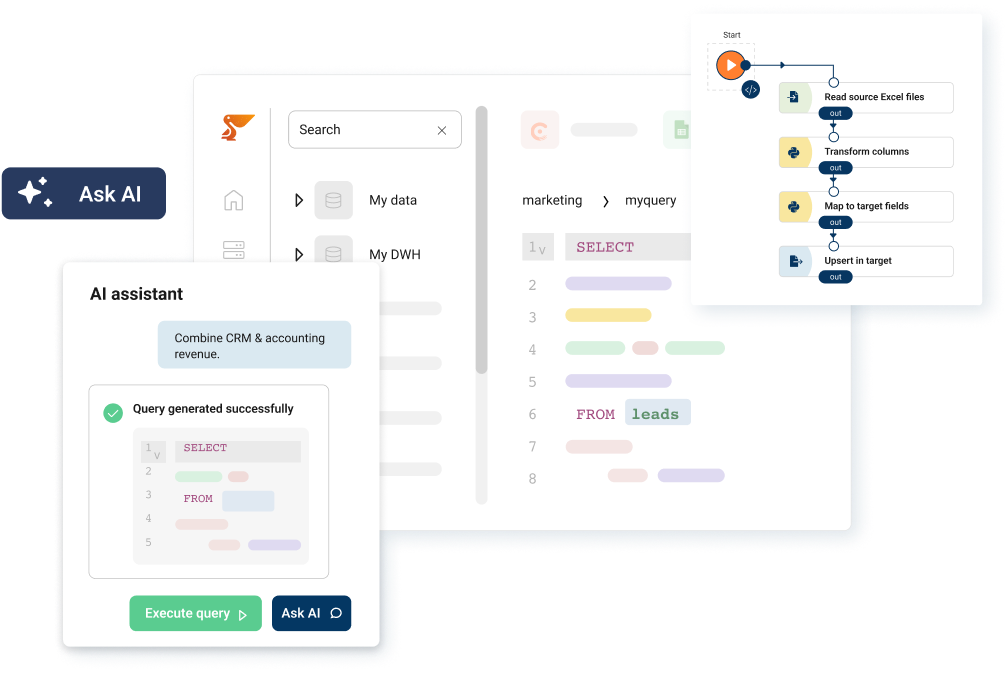
- AI-powered assistance: Peliqan’s AI assistant helps users write SQL queries and gain insights faster, democratizing data access.
- Scalability and integration: The platform’s ability to integrate with cloud data warehouses ensures scalability and flexibility as data needs grow.
Building a modern data warehouse architecture
To successfully implement a data warehouse that meets your organization’s needs, consider the steps below.
Assess your current data landscape
- Inventory your existing data sources and systems
- Identify key business requirements and analytical needs
- Evaluate your current data management challenges
Choose the right architecture
- Based on your assessment, select the most appropriate architectural approach (cloud-based, hybrid, data lakehouse)
- Consider scalability, performance, and flexibility requirements
Select appropriate tools
- Use the insights from the Data Warehouse Tools guide to choose tools that align with your chosen architecture
- Make sure the selected tools integrate well with each other and your existing systems
Design for data governance and security
- Implement strong data governance policies from the start
- Make sure you have compliance with relevant regulations (GDPR, NIS2)
- Build in security measures at every layer of the architecture
Plan for scalability and future growth
- Design your architecture to accommodate increasing data volumes and user demands
- Consider how emerging trends like AI integration and real-time processing fit into your long-term strategy
Implement in phases
- Start with a minimum viable product (MVP) and iterate
- Prioritize high-value use cases to demonstrate early wins
Foster a data-driven culture
- Provide training and support to end-users
- Encourage data literacy across the organization
- Showcase success stories to drive adoption
Continuously monitor and optimize
- Regularly assess performance and user satisfaction
- Stay informed about new technologies and best practices
- Be prepared to evolve your architecture as needs change
Conclusion: the future of data warehouse architecture
As organizations continue to grapple with growing data volumes and increasing demand for real-time insights, data warehouse architecture will keep evolving. The future points toward more flexible, scalable, and intelligent data warehouse solutions that can adapt to changing business needs and technological advancements.
Key trends to watch:
- Further integration of AI and machine learning capabilities
- Increased adoption of cloud and hybrid architectures
- Greater emphasis on real-time data processing and analysis
- More focus on data governance and security
- The rise of augmented analytics and natural language querying
By understanding the fundamentals of data warehouse architecture and staying current on these trends, organizations build data infrastructures that drive innovation and competitive advantage. Platforms like Peliqan are at the forefront of this evolution, offering comprehensive, user-friendly solutions that help businesses use the full potential of their data assets.
Whether you’re just starting your data warehouse journey or looking to modernize an existing architecture, the key is to choose flexible, scalable solutions that align with your business goals and can adapt to the ever-changing data landscape. Ready to take your data strategy to the next level? Contact us today to learn more.