



Data fabric and data mesh are answers to the same complaint – nobody can find or trust the data – from opposite directions. One is an architecture you build, the other is an operating model you adopt. The diagram below asks both the same five questions.
The five questions
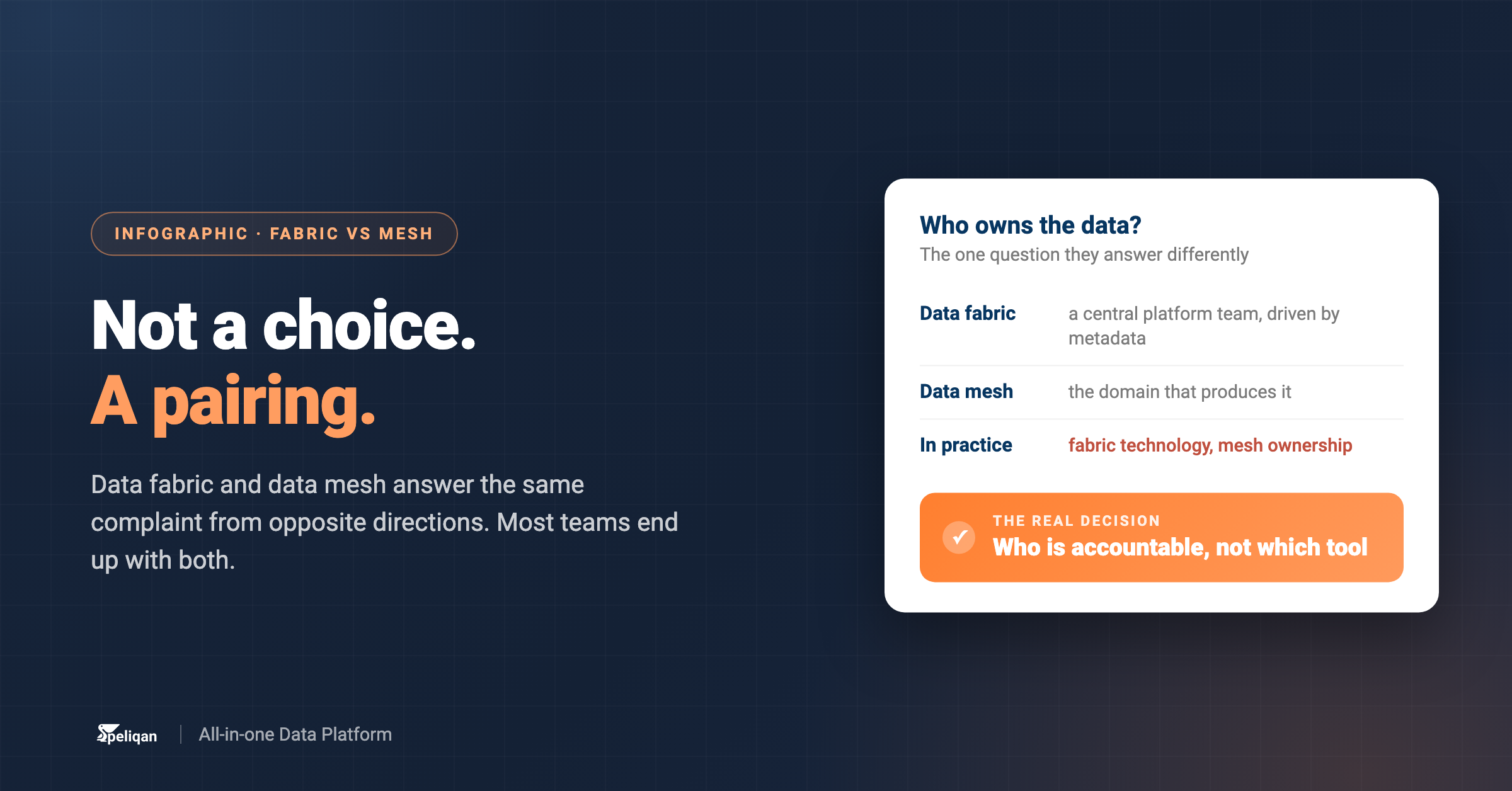
- 1Who owns the data? Fabric: a central platform team. Mesh: the domain that produces it. This is the fundamental difference, and every other one follows from it.
- 2What gets centralised? Fabric centralises the technology and the metadata that describes everything. Mesh centralises only the standards, deliberately never the data itself.
- 3What does the work? Fabric relies on automation driven by metadata – discovery, integration and access generated from a catalogue. Mesh relies on people in each domain, working on a shared platform.
- 4When does each one work? Fabric suits sprawling sources where nobody can find anything. Mesh suits organisations where one central team has become the bottleneck for everyone else.
- 5When does each one fail? Fabric fails when metadata is thin, because the automation is then guessing. Mesh fails when no one in a domain can actually own a data product.
They are not alternatives
The framing as a choice is mostly a vendor artefact. A catalogue, automated metadata and policy enforcement are useful whoever owns the tables; domain ownership is useful whatever technology sits underneath. Most organisations that get this right end up running fabric-style technology under mesh-style ownership, and the decision that actually matters is who is accountable for a data set.
A practical way to choose
- If your problem is discovery – people cannot find data that already exists – start with fabric-style tooling: a catalogue, lineage and automated metadata.
- If your problem is throughput – one team is a queue for every request – start with ownership, and give domains a platform they can use without help.
- If your problem is trust – the numbers disagree – neither one fixes it alone. That is a definitions problem.
Read the mesh side in full
The four principles behind the mesh column, drawn out properly, are on our data mesh architecture diagram. The trust problem is on the semantic layer diagram.
What this looks like in Peliqan
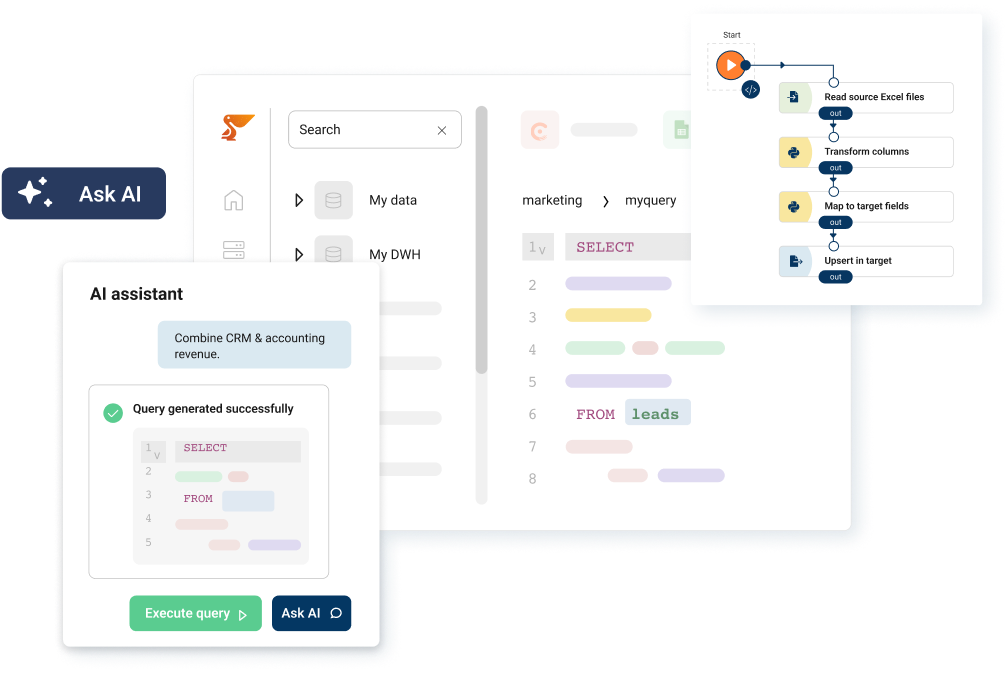
Peliqan provides the shared platform either model needs: managed connectors to 300+ sources, modelling in SQL or Python, and per-user access control – so a central team can run it as a fabric, or domains can publish their own products on it, without changing the underlying tooling.
Use this diagram wherever you like
The diagram is free to use, including commercially, as long as there is a visible link back to this page. Download the PNG for slides and documents, or the SVG if you want to edit the labels. No email required. You can browse the rest of the set in the Peliqan diagram library.
Ready to build this on your own data? Get started with Peliqan.