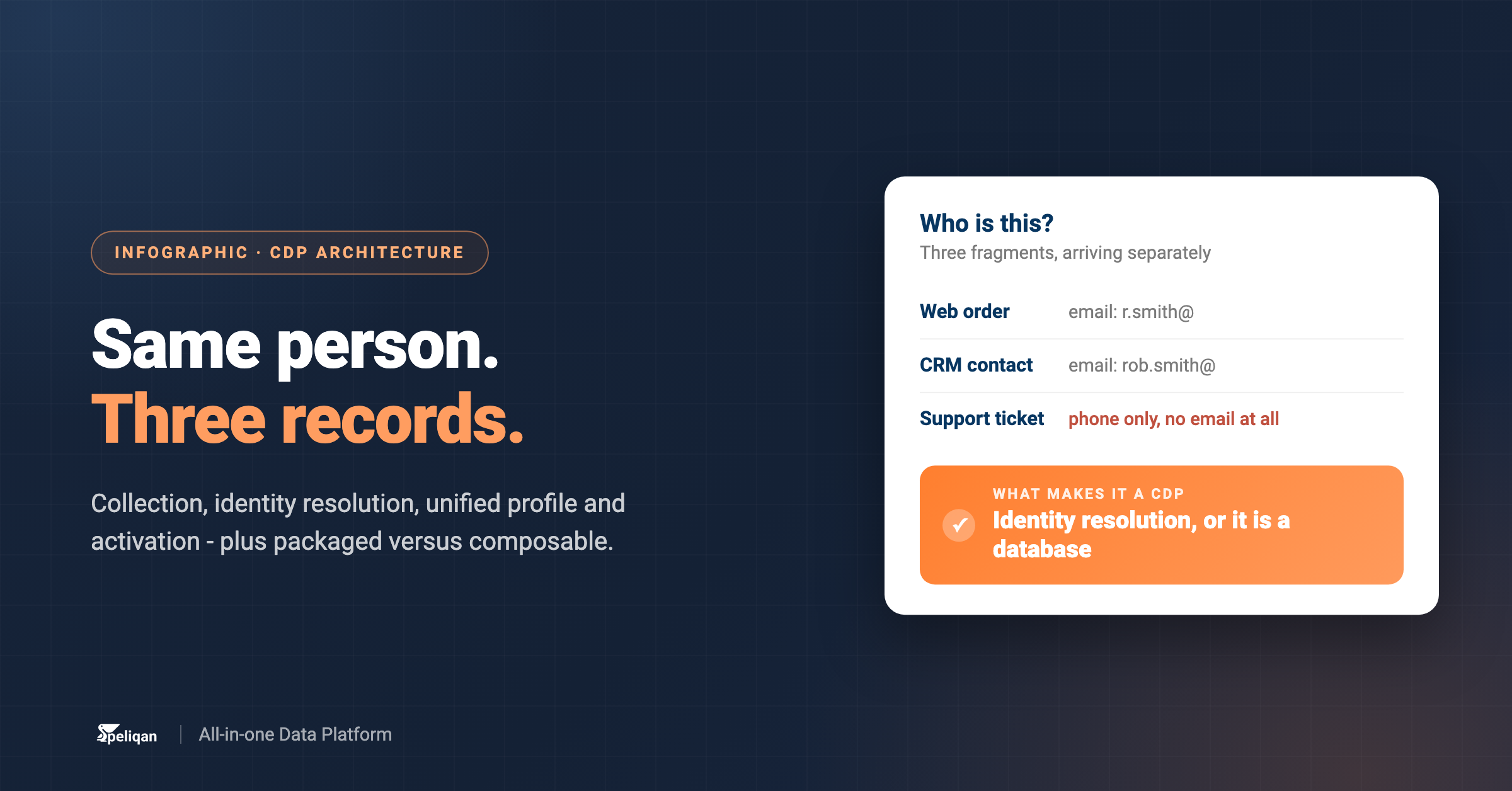




A customer data platform collects fragments of one person from every channel and decides they are the same person. Everything else it does depends on getting that right, which is why the diagram below puts identity resolution in the middle.
The four stages
- 1Collection: fragments arrive from everywhere. A web order with one email, a CRM contact with another, a support ticket with only a phone number. Each system is internally consistent and none of them knows about the others.
- 2Identity resolution: the part that makes it a CDP. Deterministic matching joins on shared identifiers such as a login or email. Probabilistic matching infers from device, address or behaviour. Merge rules decide what happens when the two disagree.
- 3Unified profile and segments: one record per person. Traits, events and consent in one place, with segments built on top. Consent belongs here rather than in each tool, because that is the only way it can be honoured consistently.
- 4Activation: the profile goes back out. Segments and traits pushed to email, ads and support tools, so the definition of a high-value customer is the same wherever it is acted on.
Packaged or composable?
A packaged CDP keeps its own copy of the customer profile. A composable CDP leaves the data in your warehouse and runs resolution and activation on top of it. The composable route has become the default for teams that already have a warehouse, because the profile stays joinable to finance, product and support data instead of living in a marketing silo – and because you are not paying to store the same customers twice.
CDP, CRM or DMP?
- A CRM records your relationship with known contacts, and is edited by people.
- A DMP handled anonymous third-party audience data for advertising, and has largely faded with third-party cookies.
- A CDP unifies first-party data about known and anonymous users, and is populated by systems rather than by people.
How activation actually works
Pushing a warehouse-built segment back into the tools people work in is reverse ETL – which is precisely why a composable CDP is mostly identity resolution plus reverse ETL over a warehouse you already own.
What this looks like in Peliqan
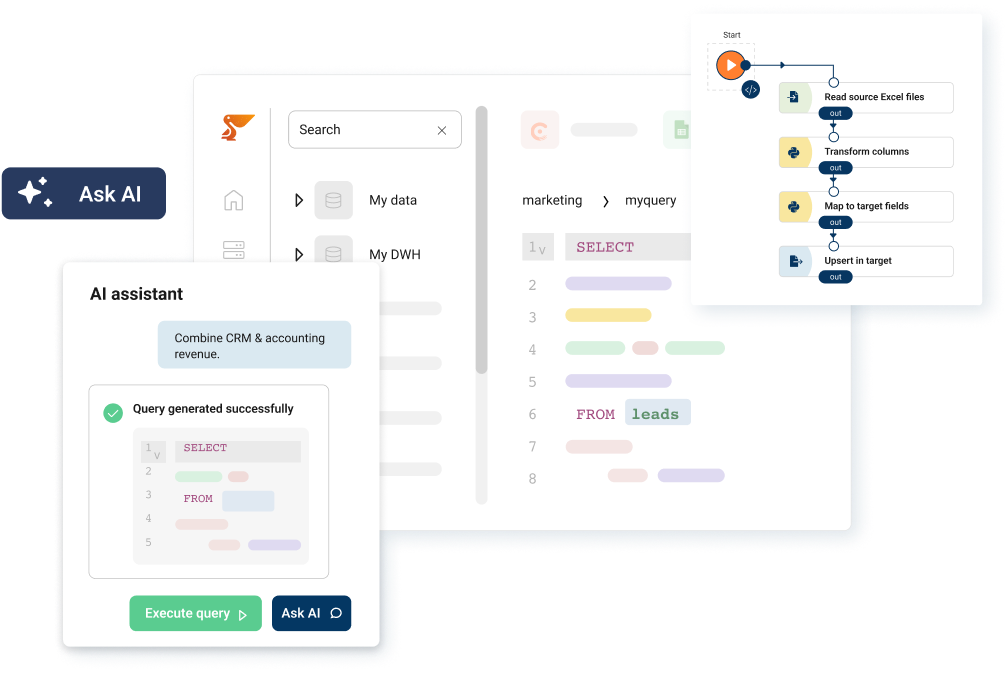
Peliqan brings customer data from 300+ sources into one place, lets you write matching and merge logic in SQL or Python, and pushes the resolved segments back out to operational tools – the composable pattern, on the warehouse you already have.
Use this diagram wherever you like
The diagram is free to use, including commercially, as long as there is a visible link back to this page. Download the PNG for slides and documents, or the SVG if you want to edit the labels. No email required. You can browse the rest of the set in the Peliqan diagram library.
Ready to build this on your own data? Get started with Peliqan.