




SAP Datasphere alternatives have become a serious conversation for any data leader weighing whether to consolidate everything inside SAP Business Data Cloud or step outside to a more flexible, multi-platform stack. This guide compares 10 platforms – including cloud warehouses, lakehouses, data fabrics, and integrated data platforms – and shows where each one wins for SAP-heavy and non-SAP-heavy environments.
The cloud data warehouse market is on a steep ramp, expected to grow from $14.94 billion in 2026 to $49.12 billion by 2031, a 26.86% CAGR, per Mordor Intelligence. AWS, Microsoft, Google, and Snowflake collectively hold roughly 68% of the vendor revenue, which means SAP customers evaluating Datasphere are also competing for budget against the platforms most of the modern data stack already runs on.
SAP itself has changed the math in 2026. Datasphere and SAP Analytics Cloud were removed from the Eligible Cloud Services list for new BTPEA, CPEA, and PAYG subscriptions as of January 1, 2026, and those services now live inside SAP Business Data Cloud (BDC). For anyone signing a new RISE agreement, Datasphere is a separately licensed product, not part of the standard bundle. That alone is pushing SAP analytics leaders to re-open their data platform decision.
What is SAP Datasphere
SAP Datasphere at a glance
- Category: cloud data warehouse and business data fabric, the successor to SAP Data Warehouse Cloud and SAP BW
- Engine: built on SAP HANA Cloud, with an optional object store and data lake tier
- Strengths: native S/4HANA and BW/4HANA integration, semantic layer, spaces for departmental governance, live data federation
- Pricing model: Capacity Units (CUs) covering compute, storage, BW Bridge, data integration, and catalog, estimated through SAP’s CU calculator
- Now sold via: SAP Business Data Cloud, alongside SAP Databricks for advanced analytics and ML
For SAP-centric organizations, especially those running SAP BW 7.5 against the 2027 mainstream maintenance deadline, Datasphere is positioned as the path to modernize without losing the semantic models, currencies, hierarchies, and compliance logic baked into decades of SAP development. But that gravity is also its limitation: organizations whose analytics span finance, marketing, product, IoT, and external SaaS data often find Datasphere is one of several platforms they need, not the one platform that does it all.
Why teams look at SAP Datasphere alternatives
Common reasons buyers consider alternatives
- Cost unpredictability: Capacity Unit pricing covers core, data lake, BW Bridge, integration, and catalog separately, and G2 reviewers consistently flag pricing as steep for smaller teams and hard to forecast at scale.
- Steep learning curve: reviewers note advanced configuration requires deep SAP expertise, and graphical transforms cover roughly 80% of cases, with the rest needing SQLScript or external prep.
- Limited fit outside SAP: cloud-native startups, mid-market firms with a small SAP footprint, and teams building Python-heavy ML pipelines tend to pick Snowflake, Databricks, or BigQuery instead.
- Egress complexity: getting SAP data out into Snowflake, Databricks, BigQuery, or Microsoft Fabric often means SLT, Theobald, Fivetran, Qlik Replicate, or SNP Glue on top, so teams pay twice.
- BTPEA and PAYG sunset: as of January 1, 2026, Datasphere is no longer available for renewal under BTPEA, CPEA, or PAYG, forcing migration into SAP Business Data Cloud.
- Connector breadth for non-SAP sources: marketing, finance SaaS, e-commerce, and operational tools usually need separate ELT tooling, since Datasphere’s strength is SAP-native.
Top 10 SAP Datasphere alternatives in 2026
1. Peliqan – all-in-one data platform with built-in warehouse
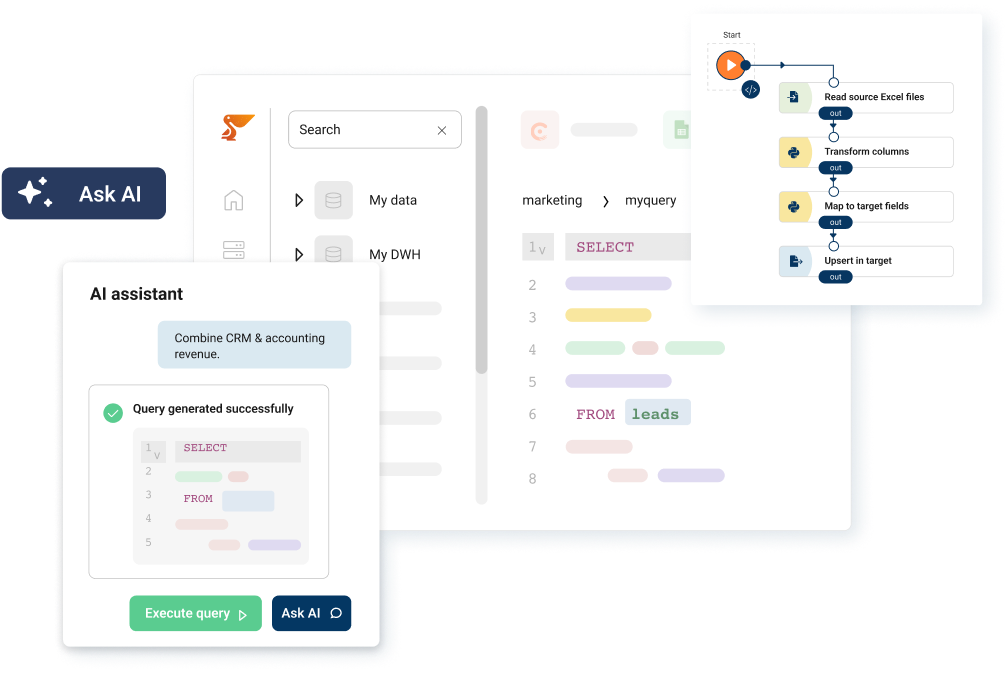
Peliqan is an all-in-one data platform that combines an embedded data warehouse, 250+ connectors, low-code Python and SQL transformations, reverse ETL, and AI-agent-ready endpoints in a single interface. It is positioned for teams that want a Datasphere-style experience where one tool covers integration, modeling, governance, and activation, without being tied to the SAP HANA pricing model or the SAP-only ecosystem.
Where Datasphere assumes you start from S/4HANA or BW/4HANA, Peliqan is connector-agnostic. The 250+ catalog covers SAP, Salesforce, NetSuite, HubSpot, Snowflake, BigQuery, PostgreSQL, MongoDB, REST APIs, MQTT streams, and dozens of European ERP and accounting systems, which matters for regulated EU enterprises that need GDPR-aware data residency without licensing the full SAP BTP stack.
Peliqan capabilities
- Built-in data warehouse: Postgres and Trino warehouse included, with no separate Snowflake, BigQuery, or HANA bill required to get started
- 250+ connectors: SAP, ERP, finance, marketing, and SaaS connectors out of the box, with a 2-week SLA for custom connectors
- Low-code SQL and Python: transform data in SQL, Python, or a spreadsheet UI, with no separate Spark cluster needed
- Reverse ETL and data activation: sync warehouse data back into business applications without a second tool
- AI agent and MCP-ready: a native MCP server lets LLMs query the governed warehouse safely with row-level permissions
- White-label and multi-tenant: brandable for consultancies, ISVs, and shared service teams managing many customer environments
- EU data residency: SOC 2 Type II, ISO 27001, GDPR, HIPAA, and CCPA certified, EU-hosted on AWS Frankfurt for European data sovereignty requirements
- Fixed pricing: transparent, predictable billing with no Capacity Unit accounting
Peliqan suits organizations that want governed, semantically modeled data without buying separate licences for ingestion, warehouse, transformation, and activation. The platform handles connecting to data sources, materializing into the built-in warehouse, transforming with SQL and Python, and pushing curated results back to operational systems. For SAP customers specifically, this means you can keep S/4HANA in place for transactions, extract it into Peliqan alongside non-SAP sources, and avoid the “Datasphere plus Fabric plus Fivetran plus dbt” sprawl.
The platform’s comparison with other data warehouse tools highlights how the bundled approach changes total cost of ownership. Where Datasphere requires layered SKUs and Snowflake or BigQuery require an ingestion partner, Peliqan ships the warehouse, ELT engine, and activation layer together, so a single subscription replaces what is typically three or four line items.
Real-world example: CIC Hospitality
CIC Hospitality unified fragmented data from 50+ sources, including ERP, finance, and operational systems, into real-time, board-level reports, eliminating manual Excel consolidation and saving 40+ hours per month. Read the case studies.
Best for: mid-market and enterprise teams that want a single platform covering integration, warehouse, transformations, reverse ETL, and AI agents, especially European organizations with mixed SAP and non-SAP estates that want predictable pricing and a data warehouse they can stand up in minutes.
Pricing: fixed and transparent, on the pricing page.
2. Snowflake – the cloud-native warehouse standard
Snowflake’s separation of storage and compute, multi-cluster architecture, and native data sharing have made it the default warehouse choice for cloud-native organizations and an increasingly common destination for SAP data extracted via Theobald, SNP Glue, or Fivetran. Its strengths are independent virtual warehouses that scale on the same dataset, governed data sharing across accounts, Cortex AISQL for natural-language and LLM-powered queries, and a mature ecosystem of BI, ELT, and reverse ETL integrations.
Snowflake’s weakness for SAP shops is the same as its strength: it is not opinionated about your source systems. Getting SAP data into Snowflake is a separate project that needs an extraction tool, a transformation framework, and an orchestration layer. For SAP-light organizations that flexibility is a feature; for SAP-heavy ones it is overhead, which is why some teams prefer an all-in-one data warehouse as a service that bundles the missing pieces. Best for: cloud-native teams and SAP customers willing to invest in a separate SAP extraction stack. Pricing: consumption-based, per-second compute billed against a credit balance, plus storage.
3. Databricks – lakehouse for AI and large-scale processing
Databricks is the lakehouse pioneer and Snowflake’s main rival in 2026, and it is now part of the SAP partnership ecosystem, with SAP Databricks shipping inside Business Data Cloud as the advanced analytics and ML companion to Datasphere. Delta Lake unifies structured warehousing with raw data lake storage, Unity Catalog handles cross-workspace governance and lineage, and MLflow plus large-scale Spark cover ML training, while it reads Datasphere data products as Delta files inside the SAP object store.
The trade-off is operational complexity. Databricks is powerful but expects engineering teams comfortable with Spark, notebooks, and infrastructure tuning. For analytics teams, it is often paired with a simpler activation layer for syncing curated data back to business applications. Best for: engineering-heavy teams running ML, large-scale ETL, and unstructured data alongside structured analytics. Pricing: DBU consumption plus underlying cloud compute.
4. Microsoft Fabric – end-to-end SaaS data platform
Microsoft Fabric is the most direct architectural competitor to SAP Business Data Cloud. Like BDC, Fabric bundles ingestion, lakehouse, warehouse, real-time analytics, ML, and Power BI into one capacity-priced SaaS product, with OneLake as a single AI-ready lake shared across all workloads. For Microsoft-aligned enterprises, Fabric is the path of least resistance away from Datasphere, and it carries a 4.7/5 G2 rating, with reviewers calling out price and complexity for smaller teams.
Fabric’s pricing logic mirrors Datasphere’s CU model, powerful but easy to misforecast: F2 starts around $262/month, F64 lands above $8,000/month, and Spark autoscale costs are billed at pay-as-you-go rates outside reserved discounts. Teams already running Power BI heavily will find the value compelling, while teams that just need a warehouse will find it overbuilt; connecting Fabric to existing reporting via the Power BI integration path is straightforward, but the capacity model needs careful sizing. Best for: Microsoft-first organizations already standardized on Power BI and Azure. Pricing: F-SKU capacity from ~$262/month (F2) to ~$33,000/month (F128), plus OneLake storage.
5. Google BigQuery – serverless analytics with built-in ML
BigQuery is Google Cloud’s serverless data warehouse and consistently ranks among the top Datasphere alternatives. Its serverless model means no cluster management, instant scale, ML model training directly in SQL via BigQuery ML, Gemini-integrated generative AI features, and BigQuery Omni for querying data in AWS S3 and Azure Blob without movement.
For SAP shops, the on-demand pricing model can flip from cheap to expensive quickly when poorly written queries scan entire tables, so reservations help but careful query design matters. Looker Studio pairs naturally for visualization, while teams that prefer open-source BI often pair BigQuery with Metabase as the consumption layer. Best for: Google Cloud-aligned teams and analytics workloads with bursty, unpredictable query patterns. Pricing: on-demand at roughly $6.25 per TB scanned, or flat-rate slot reservations.
6. Amazon Redshift – the AWS-native warehouse
Redshift remains a strong option for AWS-anchored organizations. The Serverless tier removed much of the historical cluster management pain, and Redshift’s deep integration with S3, AWS Glue, and SageMaker makes it a natural lakehouse complement. Spectrum queries S3 data directly without loading, and Zero-ETL provides continuous replication from RDS and DynamoDB.
As one of the longest-running cloud warehouses, it has broad partner support and a mature feature set. Best for: AWS-standardized organizations and teams already running operational databases on RDS or Aurora. Pricing: provisioned per-node-hour, or Serverless billed per RPU-hour.
7. IBM watsonx.data – hybrid open lakehouse
IBM watsonx.data is IBM’s open lakehouse platform, designed for hybrid environments spanning cloud, on-premises, and air-gapped deployments. For regulated industries that need data sovereignty plus modern AI workloads, it positions itself as a more open alternative to walled gardens, using Iceberg and Parquet with Presto and Trino query engines, consistent governance across cloud, on-prem, and edge, native ties to watsonx.ai, and Db2 compatibility.
Best for: regulated industries needing hybrid deployments and existing IBM customers extending into modern AI workloads. Pricing: subscription tied to compute and storage, with published rates that vary across regions.
8. Denodo – data fabric and virtualization
Where most alternatives focus on storing data, Denodo focuses on virtualizing it. Denodo’s data fabric exposes a unified semantic layer across SAP, databases, cloud sources, and unstructured data without physical replication, which makes it philosophically closest to Datasphere’s federation features, with strong support for big data and cloud systems and connectors for S/4HANA, BW, and HANA Cloud.
Virtualization avoids replication latency and storage cost but pushes load back to source systems, which can be a problem against an SAP transactional database, so Denodo is often deployed as a federation layer alongside a warehouse rather than in place of one. Teams that need federated SQL across multiple sources often benefit from a hybrid approach. Best for: large enterprises needing a virtualization-first semantic layer across heterogeneous estates. Pricing: enterprise licensing, quote-based.
9. Qlik Talend Cloud – SAP-aware data integration
Qlik Talend Cloud (formerly Talend Data Fabric, after the Qlik acquisition) is one of the leading dedicated data integration platforms for SAP environments. Its SAP-certified connectors for ECC, S/4HANA, and BW with change data capture, built-in data quality and profiling, and the Replicate engine (formerly Attunity) for real-time replication are widely used as the extraction layer feeding Snowflake, Databricks, or BigQuery from S/4HANA.
Qlik Talend solves part of the Datasphere problem, getting data out of SAP, but is not itself a warehouse, so you pair it with Snowflake, BigQuery, or Redshift for storage. Best for: SAP shops migrating data into a non-SAP warehouse who need certified connectors and CDC. Pricing: tiered subscription, quote-based.
10. Fivetran + dbt – the modern ELT stack
Not a single product, but the most common open alternative to Datasphere for greenfield modern data stacks. Fivetran handles managed ELT with 700+ connectors and automated schema drift into a warehouse like Snowflake or BigQuery, dbt handles transformations with version-controlled SQL, and the warehouse handles compute. After the 2025 Fivetran-dbt merger, the two products are increasingly sold as one stack, and Fivetran HVR Replicate covers S/4HANA, ECC, and BW with log-based CDC.
The trade-off is unbundling: Fivetran handles ingestion but not transformations, dbt handles transformations but not ingestion or activation, and you still need a warehouse, a BI tool, and a reverse ETL platform on top, so the total cost can exceed Datasphere quickly once all the line items are added. Best for: engineering teams that want best-in-class components and are comfortable assembling a stack. Pricing: Fivetran is Monthly Active Rows-based, dbt Cloud is per-developer-seat plus consumption.
SAP Datasphere alternatives compared
Market trends shaping the decision in 2026
Three trends are driving the wave of SAP Datasphere alternative evaluations this year. First, SAP itself is consolidating Datasphere into Business Data Cloud and removing it from BTPEA, CPEA, and PAYG renewals, which forces every existing customer into an explicit re-evaluation moment. Second, the cloud data warehouse market continues to consolidate around AWS, Microsoft, Google, and Snowflake, who together hold roughly 68% of vendor revenue. Third, AI agents and Model Context Protocol-style endpoints are becoming a first-class workload, which pushes platforms to expose governed SQL access not just to humans but to LLMs.
Gartner’s data observability research signals the same shift, with the firm expecting 50% of enterprises that have distributed data architectures to adopt data observability tools by 2026, up from roughly 20% in 2024. The implication for buyers is that the platform decision is no longer just about storage and compute; it now has to include governance, lineage, and AI-readiness as table-stakes features.
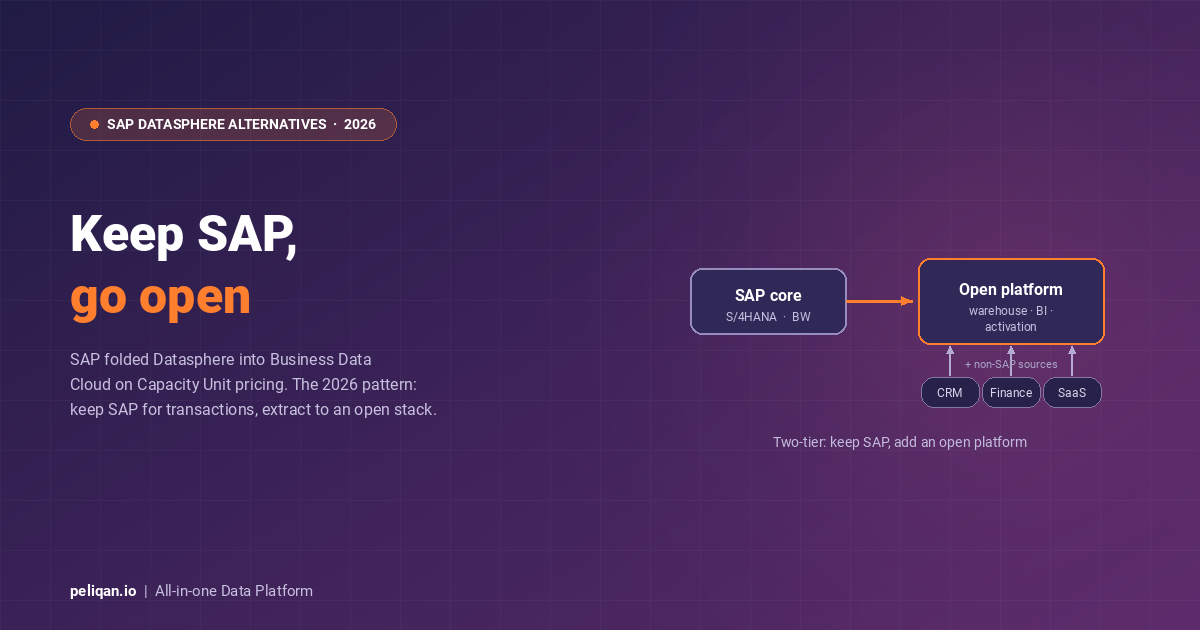
For SAP-heavy organizations specifically, the practical pattern emerging in 2026 is two-tier: keep S/4HANA and BW data inside SAP for transactions and SAP-only analytics, but extract a curated subset into a flexible platform (Snowflake, Databricks, Fabric, or an all-in-one like Peliqan) where it can be combined with non-SAP sources, transformed, governed, and activated.
How to choose the right alternative
Quick decision guide
- One platform replacing ingestion, warehouse, transformation, and activation: Peliqan, especially with mixed SAP and non-SAP sources and EU data residency requirements
- Microsoft-first with heavy Power BI usage: Microsoft Fabric, sizing capacity carefully
- AI/ML and unstructured data heavy: Databricks remains the lakehouse leader
- Deepest cloud-native warehouse ecosystem: Snowflake has the broadest partner network
- Hybrid or air-gapped deployment for regulated workloads: IBM watsonx.data
- Only need to get SAP data into a modern warehouse: pair Qlik Talend Cloud or Fivetran HVR with the destination of your choice
One question decides most evaluations: how much of your data lives outside SAP. If 80% is SAP transactional data and 20% is everything else, staying inside Business Data Cloud often makes sense. If 50% or more lives in marketing tools, e-commerce platforms, finance SaaS, or operational databases, an open platform that treats every source equally, rather than treating SAP as the centre of gravity, usually wins on time-to-value. Teams that have outgrown spreadsheets but are not ready for a multi-tool stack benefit from a single architecture that bundles ingestion, warehouse, and activation, which keeps the operating model simple and the cost predictable.
Conclusion
SAP Datasphere is a capable platform inside the SAP ecosystem, and for organizations whose data centre of gravity is S/4HANA or BW, Business Data Cloud will continue to make sense. But the 2026 reality is that very few enterprise data estates are SAP-only, and SAP’s own pricing changes are forcing the conversation. The right alternative depends on where your data actually lives, what your engineering team is comfortable owning, and how predictable you need the bill to be.
For mid-market and enterprise teams that want a single, governed platform across SAP and non-SAP sources, with a built-in warehouse, 250+ connectors, low-code SQL and Python, reverse ETL, and AI-agent endpoints, Peliqan is worth a direct comparison. Its approach to modern data warehouse best practices bundles everything into one platform, with a warehouse you can stand up in minutes and pricing that does not require a Capacity Unit calculator.