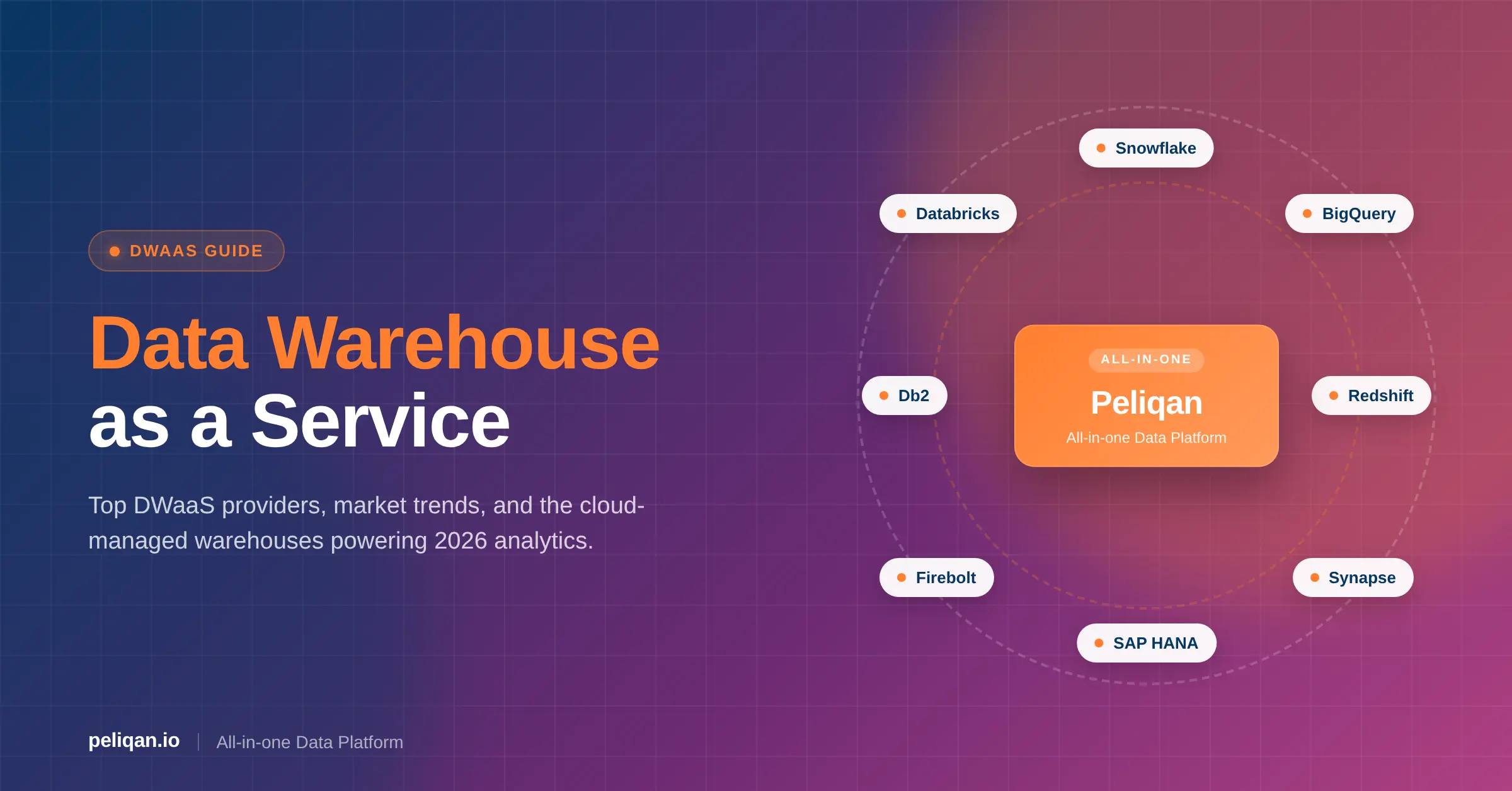





Data Warehouse as a Service (DWaaS) is a cloud-delivered, fully-managed model for storing and analyzing large datasets – eliminating the upfront hardware costs, dedicated DBAs, and long implementation cycles of traditional warehouses. This guide covers what DWaaS is, how it works, the top providers (Peliqan, BigQuery, Snowflake, Redshift, Synapse, SAP HANA Cloud, Db2 Warehouse, Firebolt), key features to evaluate, and how to implement it without falling into the common pricing traps.
Businesses generate massive volumes of data, but turning that data into actionable insights remains a challenge. Traditional data warehouses demand huge upfront investments, complex infrastructure management, and long deployment cycles. As organizations scale, the need for faster, cost-effective, and scalable analytics becomes critical. DWaaS solves that problem by offering cloud-based, fully managed data warehousing on a subscription basis.
The category has matured rapidly since 2020, and by 2026 every major cloud provider plus a handful of independent vendors offer credible DWaaS options. The challenge is no longer whether to use DWaaS – it’s which provider to pick and how to keep costs under control as data volumes grow.
What is Data Warehouse as a Service (DWaaS)?
Data Warehouse as a Service (DWaaS) is a cloud-based service model that provides businesses with fully-managed data warehousing capabilities on a subscription basis. It eliminates the need for on-premises infrastructure while offering scalable, secure, and cost-effective data analytics solutions.
Traditional data warehouses require significant upfront investment in hardware, software, and specialized personnel. Organizations must allocate resources for planning, implementation, maintenance, and upgrades. The entire process can take months, if not years, before delivering any business value.
DWaaS changes this paradigm by providing:
- Fully managed data warehouse infrastructure in the cloud
- Immediate provisioning and deployment capabilities
- Pay-as-you-go pricing models
- Automatic scaling based on business needs
- Built-in security and compliance features
- Regular updates and maintenance without downtime
Evolution of data warehousing
The journey from traditional data warehousing to DWaaS represents a significant technological evolution:
Key benefits of Data Warehouse as a Service
DWaaS offers numerous advantages over traditional data warehousing approaches, enabling organizations of all sizes to use powerful analytics capabilities without massive investments. These benefits translate to faster time-to-value and stronger decision-making capabilities.
Cost efficiency
DWaaS eliminates the need for upfront capital expenditure on hardware and infrastructure. Organizations only pay for the resources they actually use, making it possible to:
- Convert capital expenditures (CapEx) to operational expenditures (OpEx)
- Scale costs directly with usage and business value
- Eliminate expenses related to hardware refreshes
- Reduce personnel costs for infrastructure management
Scalability and flexibility
One of the most compelling advantages of DWaaS is its inherent scalability:
- Resources can be dynamically adjusted based on workload demands
- Compute and storage can be scaled independently
- Seasonal or unexpected spikes in analytics needs can be accommodated without planning
- Organizations can start small and grow as their data needs evolve
Speed of implementation
DWaaS dramatically accelerates the time-to-value for data warehousing initiatives:
- Provision new data warehouses in minutes rather than months
- Begin loading and analyzing data immediately
- Rapidly test new analytics approaches without infrastructure constraints
- Implement proof-of-concepts quickly before full deployment
Enhanced security and compliance
Modern DWaaS providers offer comprehensive security features:
- Encryption of data at rest and in transit
- Role-based access controls
- Compliance with industry standards (GDPR, NIS2, SOC 2, etc.)
- Regular security updates and patches
- Automated backups and disaster recovery
Top data warehouse service providers
The DWaaS market has grown significantly in recent years, with several providers offering compelling solutions. Each platform has its unique strengths and specializations – the comparison below covers the leaders.
Key features to look for in a DWaaS solution
When evaluating Data Warehouse as a Service providers, organizations should consider several critical features that determine the solution’s suitability for their specific needs. These aspects significantly impact implementation success and long-term value.
Performance and scalability
A good DWaaS solution should deliver high-speed query performance, handle large workloads efficiently, and scale dynamically as data needs grow. The ability to process both structured and semi-structured data in real time is crucial.
- Elastic scaling of compute and storage to optimize costs
- Performance tuning features like indexing, caching, and materialized views
- Support for real-time and batch data processing
Data integration capabilities
Effective integration with multiple data sources is essential for a strong DWaaS platform. It should simplify data ingestion, transformation, and connectivity with third-party applications.
- Built-in connectors for databases, SaaS apps, and cloud storage
- Support for ETL/ELT workflows and API-based data ingestion
- Ability to handle structured, semi-structured, and unstructured data
Security and compliance
Since DWaaS platforms store and process sensitive data, they must offer enterprise-grade security and adhere to compliance standards. Data encryption and granular access controls are non-negotiable.
- End-to-end encryption (data at rest and in transit)
- Role-based access controls and detailed audit logs
- Compliance with industry standards (GDPR, NIS2, SOC 2)
Pricing and cost optimization
DWaaS should provide a transparent and flexible pricing model to align with business needs. A cost-efficient solution ensures companies pay only for the resources they use.
- Pay-as-you-go and reserved capacity pricing options
- Auto-scaling to optimize costs during peak and idle times
- Cost monitoring tools for better budgeting and forecasting
Ease of use and low-code capabilities
A DWaaS solution should minimize the technical expertise required for data management. Low-code and no-code features can support business users while letting developers build advanced workflows.
- Intuitive UI for query building and data visualization
- Drag-and-drop interfaces for data transformation
- AI-powered automation for data preparation and optimization
Best practices for DWaaS implementation
Successfully implementing a DWaaS solution requires strategic planning for smooth data migration, cost optimization, and sustained performance. The practices below help organizations maximize their investment.
Data migration strategy
Moving data to a DWaaS platform requires careful planning so disruption is minimized and data integrity holds. A phased approach can help mitigate risks and streamline the transition.
- Assess and classify existing data before migration
- Perform data cleansing and normalization to improve quality
- Validate data integrity through automated testing and checks
Optimizing for cost efficiency
DWaaS pricing is consumption-based, so optimizing resource utilization can significantly reduce costs. Proper workload planning and auto-scaling features can prevent unnecessary expenses.
- Set up auto-scaling policies to manage peak and idle workloads
- Implement data retention policies to avoid excessive storage costs
- Regularly review usage reports and fine-tune configurations
Ensuring performance and query optimization
Query performance directly impacts analytics speed and user experience. Tuning data models and optimizing storage can enhance efficiency.
- Use partitioning and indexing strategies for faster query execution
- Use caching and materialized views for frequently accessed data
- Monitor query performance and adjust configurations dynamically
Key implementation challenges and solutions
The table below presents common DWaaS challenges with their corresponding solutions:
Industry use cases for DWaaS
DWaaS is reshaping industries by enabling data-driven decision-making, real-time analytics, and scalable data management. Organizations across various sectors use DWaaS for efficiency, compliance, and strategic insights.
Retail and e-commerce
Retailers generate vast amounts of transactional and customer data across multiple channels. DWaaS enables clean integration of sales, inventory, and customer behavior data, helping businesses optimize pricing, personalize marketing, and improve supply chain management. Real-time analytics ensure stock levels are managed efficiently, reducing overstocking or shortages.
By unifying data from websites, mobile apps, and physical stores, retailers can deliver personalized shopping experiences. This boosts customer engagement through targeted promotions, loyalty programs, and demand-driven inventory adjustments, ultimately driving revenue and customer satisfaction.
Financial services
Banks, fintech firms, and insurers rely on real-time data for fraud detection, risk analysis, and compliance. DWaaS enables rapid processing of financial transactions, helping detect suspicious activities instantly and mitigate fraud risks. Advanced analytics let institutions assess customer creditworthiness and personalize financial products.
Regulatory compliance is another critical use case. DWaaS automates reporting, ensuring adherence to regulations like GDPR and Basel III. By consolidating financial data in a secure, auditable environment, institutions streamline compliance processes while strengthening risk management strategies.
Healthcare and life sciences
Healthcare organizations manage massive amounts of patient data, requiring secure and efficient analytics. DWaaS supports real-time monitoring of medical records, treatment effectiveness, and disease patterns, leading to better patient care and resource allocation. Hospitals can predict patient admission rates, optimize staffing, and reduce wait times.
In pharmaceuticals, DWaaS accelerates clinical trials by enabling fast data integration and analysis. Researchers can track drug performance, identify trends, and ensure regulatory compliance, speeding up drug discovery while maintaining data integrity and security.
Manufacturing and supply chain
Manufacturers use DWaaS to enhance production efficiency and predict maintenance needs. By analyzing IoT sensor data from machines, businesses can detect early signs of failure and schedule maintenance proactively, reducing downtime and operational costs.
Supply chain operators benefit from real-time data on shipments, supplier performance, and demand forecasting. DWaaS provides end-to-end visibility, helping businesses optimize logistics, reduce bottlenecks, and improve delivery timelines.
Conclusion
Data Warehouse as a Service (DWaaS) represents a fundamental shift in how organizations manage and analyze data. By eliminating infrastructure burdens and providing scalable, real-time insights, DWaaS helps businesses make faster, more informed decisions.
Whether in retail, finance, healthcare, or manufacturing, companies can use cloud-based data warehousing to drive efficiency, enhance security, and remain competitive in an increasingly data-driven world.
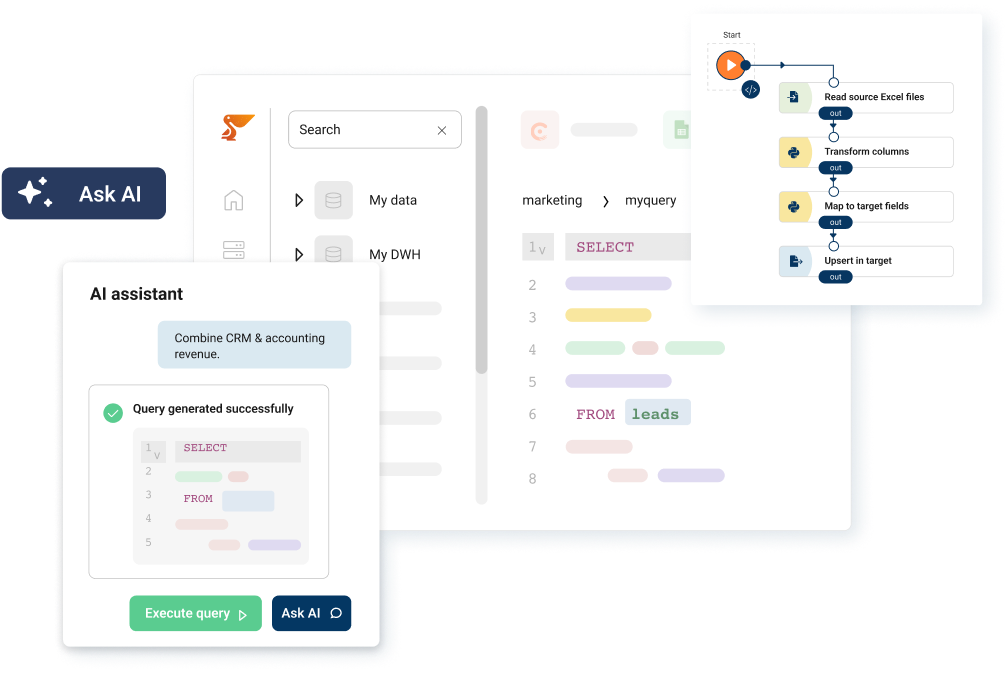
While most DWaaS solutions focus solely on data storage and querying, Peliqan.io goes beyond traditional DWaaS by offering an all-in-one low-code data platform. With Peliqan, you can not only store and query data but also perform ETL (Extract, Transform, Load), reverse ETL, and data activation – such as triggering alerts or sending data to operational systems.
Peliqan also includes a built-in BI layer powered by Metabase, letting users create visualizations and dashboards without switching tools. This makes Peliqan a comprehensive solution that combines the power of DWaaS with modern data workflow automation, making it easier for businesses to fully use the potential of their data.