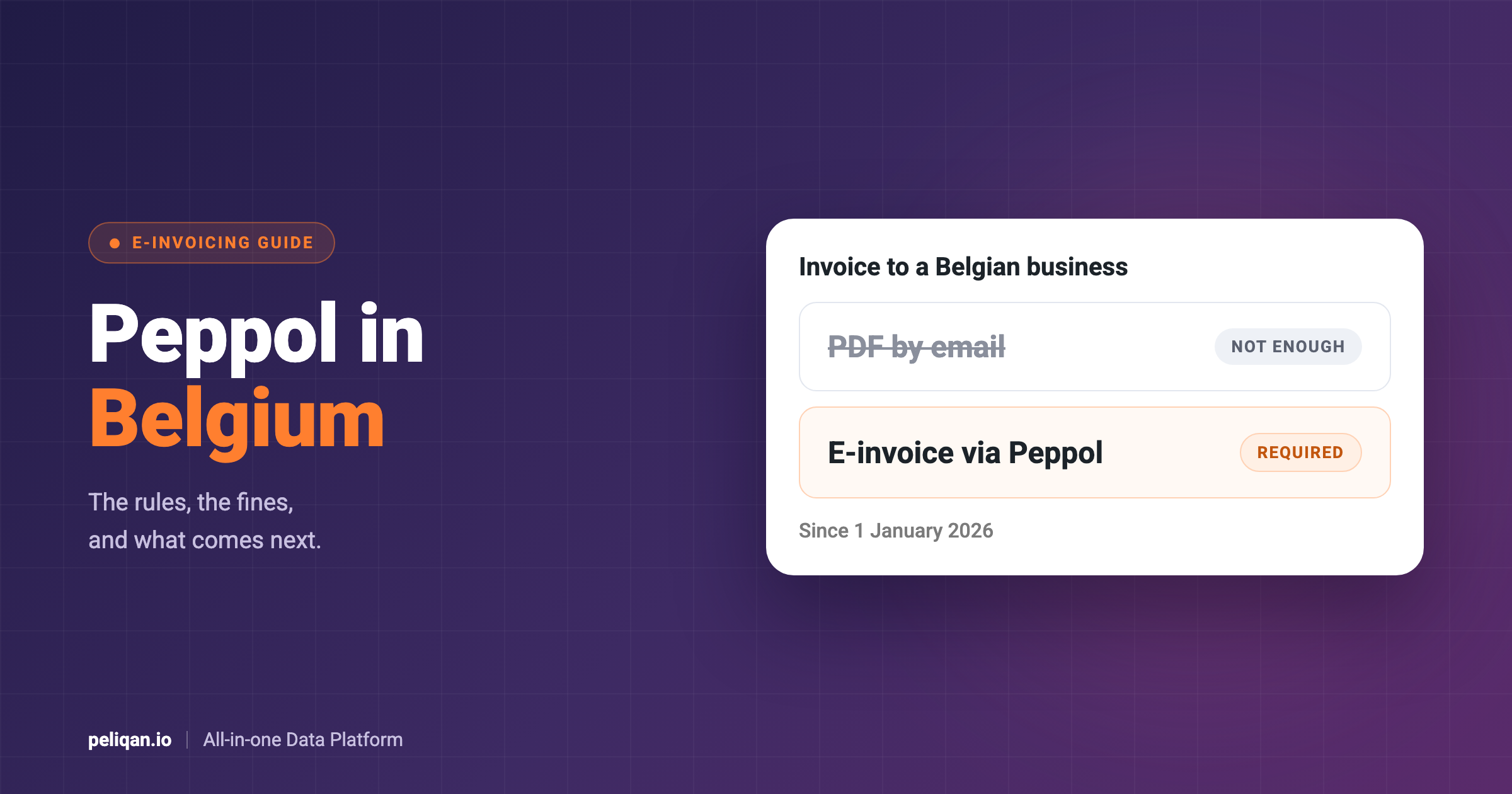





Since 1 January 2026, Belgian businesses must send each other structured electronic invoices through the Peppol network. As a result, a PDF by email no longer counts as a valid invoice between two Belgian VAT-registered companies. This guide explains how Peppol works in Belgium, who must comply, what the fines are and what comes next. It reflects the official rules as checked in November 2026. It is general information, not tax advice.
The short answer
Peppol is the network that Belgium chose for mandatory e-invoicing between businesses. Does your company have an active Belgian VAT number? Then you must send invoices to other Belgian VAT-registered companies as structured e-invoices over Peppol. You must also be able to receive them that way.
The obligation started on 1 January 2026. The tax authority applied no fines during the first three months, but that tolerance period has ended. So today, a business without the means to send and receive e-invoices risks a fine of EUR 1,500. That amount rises for repeat offences.
What Peppol is and how it works in Belgium
Peppol is an open network for exchanging business documents, such as invoices, between software systems. The Belgian government compares it to a telecom network, because you can exchange documents with anyone connected to it.
A structured e-invoice is a data file that software reads automatically, so nobody has to retype it. A PDF, in contrast, only looks like an invoice on screen. On Peppol, the standard document type has the name Peppol BIS, and it applies the European e-invoicing standard EN 16931.
You cannot register on Peppol by yourself, though. Instead, you connect through a recognised Peppol service provider, often called an access point. Your invoicing or accounting software usually does this for you, because it already has a connection to the network.
Every participant has a Peppol ID, which works like a phone number on the network. In Belgium, that ID includes at least the company’s enterprise number. As a result, your customers and suppliers can find you without exchanging any technical details first.
Who must comply, and who is exempt
The rule is broad. According to the official overview of structured electronic invoices between companies, the obligation applies to your business when you have a valid VAT number. The table below shows the most common situations.
The official list exempts only two groups from receiving: businesses with only VAT-exempt activities, and foreign companies without a Belgian establishment. So everyone else must be able to receive e-invoices.
Two points that catch people out
One is that the rule also includes small businesses under the VAT exemption scheme. In April 2026, the government repeated this after media reports had suggested otherwise. The other is that a business serving only consumers still buys from Belgian suppliers, so it must be able to receive their e-invoices.
The full list of exceptions is on the official page about who must use e-invoicing, although it is only available in Dutch, French and German. If your case is unusual, check it with your accountant.
Which invoices are covered
The obligation covers invoices between two Belgian VAT-registered businesses. Other invoice flows, however, follow different rules.
Credit notes and debit notes count as invoices too, so they also go through Peppol. In addition, any attachment that belongs to an invoice must travel through the same channel as the invoice itself. So you may not send it separately by email.
The timeline so far
Belgium introduced e-invoicing in stages, and more steps will follow. The table below lists the key dates.
By December 2025, more than half a million Belgian businesses had already made the switch, according to the government.
Fines, and what happens when the other side is not ready
The fines apply when a business lacks the technical means to issue and receive structured e-invoices. A first offence costs EUR 1,500, a second EUR 3,000 and each later one EUR 5,000. However, a new offence only counts as a repeat if the tax authority finds it at least three months after the previous one.
The general tolerance period covered January to March 2026, so it has now ended. For self-billing, where the customer issues the invoice, a separate tolerance ran until 30 June 2026. Still, the tax authority says it can decide not to fine in exceptional cases with technical problems, after it reviews the individual file. The official notice on the end of the tolerance period (in Dutch) explains how to submit a case.
If your customer cannot receive e-invoices
For this case, there is a fall-back rule. If your customer cannot receive an e-invoice for technical reasons, you may send the invoice another way, such as on paper or as a PDF. You still have to issue an invoice, and for an electronic alternative the customer must agree. Meanwhile, the customer remains obliged to fix the problem without delay and risks a fine.
If your supplier still sends PDFs
In principle, you have the right to refuse a PDF when the rule requires an e-invoice. That is not always practical in business, so the official advice is to ask your supplier when they will comply. The supplier is the one who risks a fine. The official FAQ also explains how this affects VAT deduction, which is worth checking with your accountant.
How to get compliant
Most businesses can comply when they update or switch their invoicing software. The steps below follow the official guidance.
1. Check your current software
First of all, ask your software supplier whether your invoicing or accounting tool can send and receive e-invoices over Peppol.
2. Pick a tool if you need one
The government keeps a list of software for sending, receiving and processing e-invoices. It includes options that are free or low-cost for businesses with few invoices.
3. Register on Peppol
Your software or its service provider registers your enterprise number on the network. After that, other companies can send you e-invoices.
4. Look up your customers and suppliers
The public Peppol Directory shows which companies can receive documents on the network. To search by Belgian enterprise number, type 0208: followed by the number. The directory only shows who can receive, so it does not tell you who can send.
5. Agree with your accountant
If an accountant handles your bookkeeping, decide together how invoices will reach them, because the flow changes for both of you.
6. Review your archive
The archiving rules themselves have not changed, according to the official guidance. Even so, this is a good moment to check where your invoices live and how long you keep them.
Tax support for the switch
Belgium offers two tax measures to offset the cost. Small SMEs and self-employed people can deduct 120% of the cost of invoicing software subscriptions, for the tax periods 2024 to 2027. In addition, the investment allowance for digital investments has been 20% since 1 January 2025. Your accountant can tell you which one applies to your situation.
What comes next: e-reporting and EU rules
E-invoicing is only the first phase. Today, no invoice data goes to the government. However, the federal coalition agreement for 2025 to 2029 plans a second phase, called e-reporting, with 2028 as its timing. In that phase, invoice data would reach the tax authority almost immediately. According to the government, it would also replace the annual customer listing. This plan still has to become Belgian law, so the details can change.
At EU level, the EU approved the VAT in the Digital Age package (ViDA) on 11 March 2025. From 2030, it applies e-invoicing and reporting to cross-border transactions between EU countries. In addition, member states no longer need EU permission before they make domestic e-invoicing mandatory. For the wider European picture, see our post on Peppol across the EU.
After compliance: put your invoice data to work
Compliance is the obligation, and it also brings a benefit. Every invoice now arrives as clean, structured data instead of a PDF. That makes it much easier to answer questions about your own business, such as which customers pay late or how supplier costs are moving.
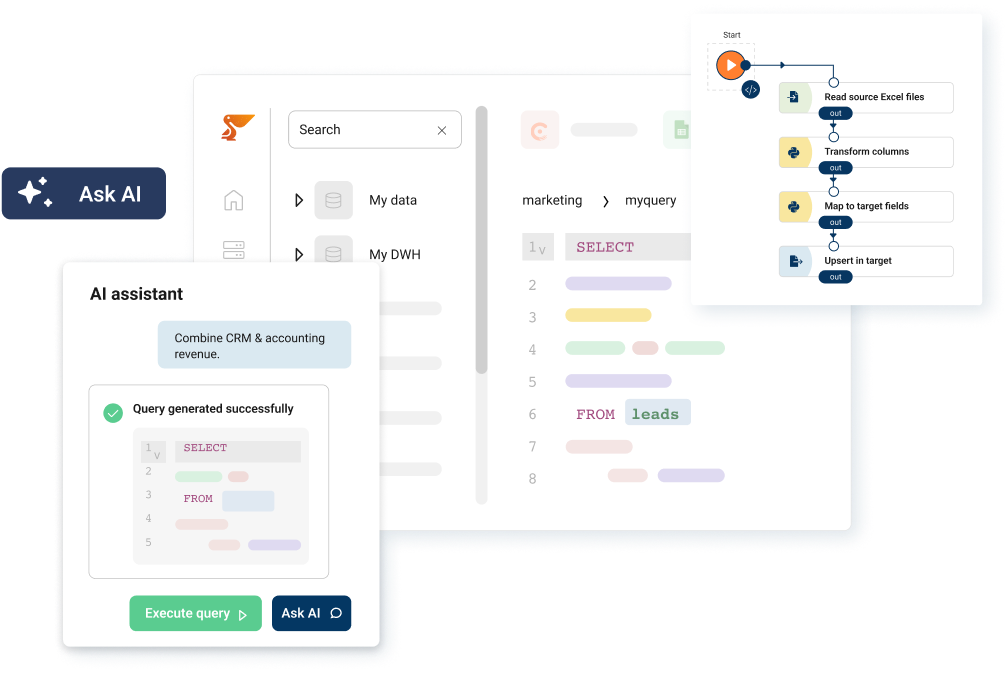
Peliqan helps with that second part. To be clear, Peliqan does not send or receive Peppol invoices, because that is the job of your invoicing or accounting software. Instead, Peliqan reads and syncs the invoice data from those tools into a data warehouse, on a schedule you set.
Peliqan has connectors for tools that many Belgian businesses use, such as Billit, Exact Online, Yuki and Odoo. Once the data is in the data warehouse, you can combine invoices with data from your CRM and other apps. Then you can build reports in Power BI or Excel, or ask questions in an AI assistant such as Claude.
For example, a finance team could track overdue invoices by customer across several companies in one view. If you use Billit, our guide to the Billit API shows how to get its invoice data out.
Conclusion
Peppol e-invoicing is now part of doing business in Belgium. The rule applies to almost every VAT-registered company, and the tolerance period is over, so fines now start at EUR 1,500. For most businesses, the fix is simple. Use invoicing software with a Peppol connection, and then make sure you can both send and receive.
More change is coming, with e-reporting on the agenda for 2028 and EU rules from 2030. So treat e-invoicing as a foundation, and start using the structured data it gives you.