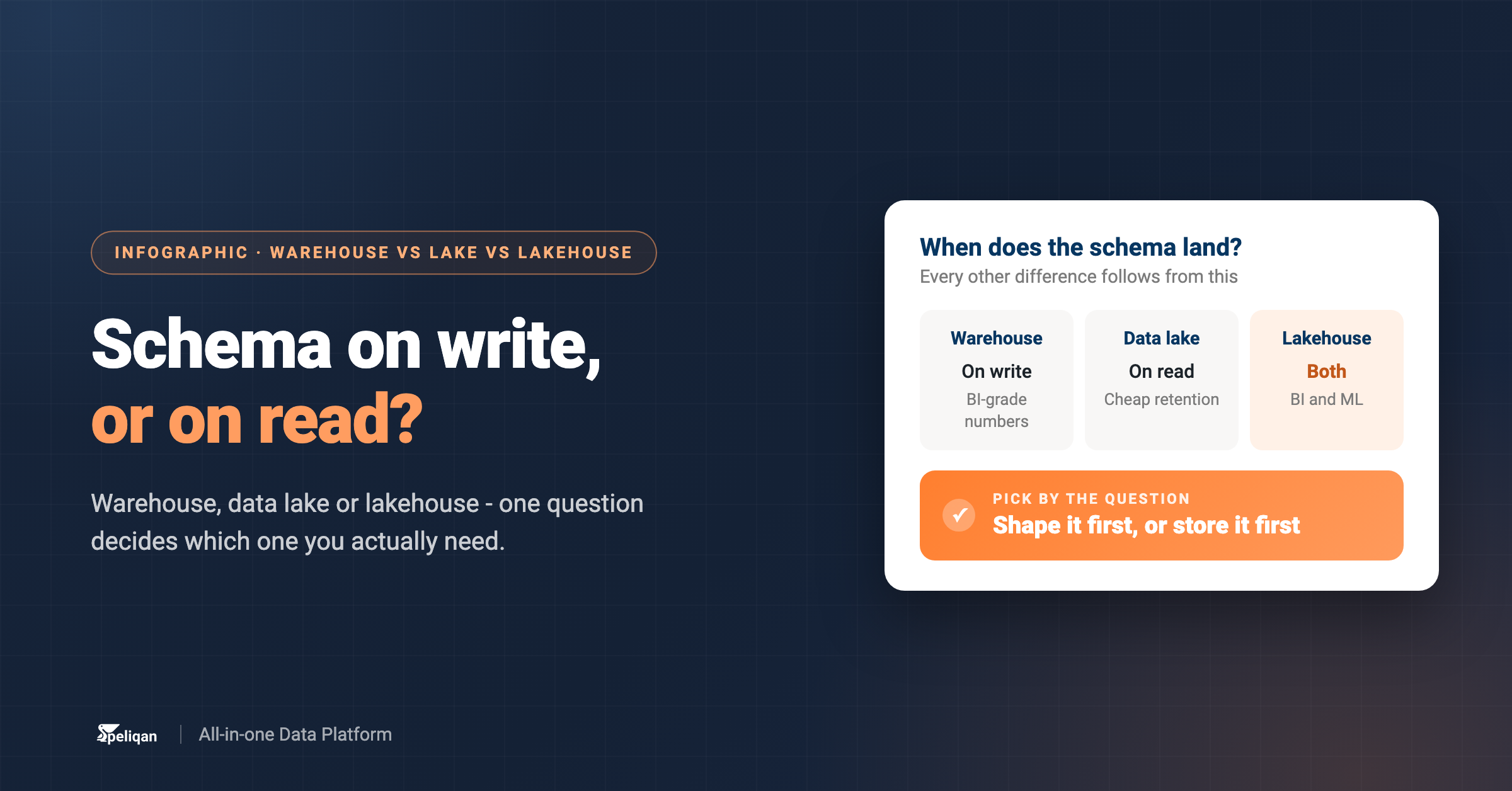



The three are usually compared on cost or scale. The difference that actually decides which one you want is when you commit to a schema, because that determines what you can still ask later.
The three, side by side
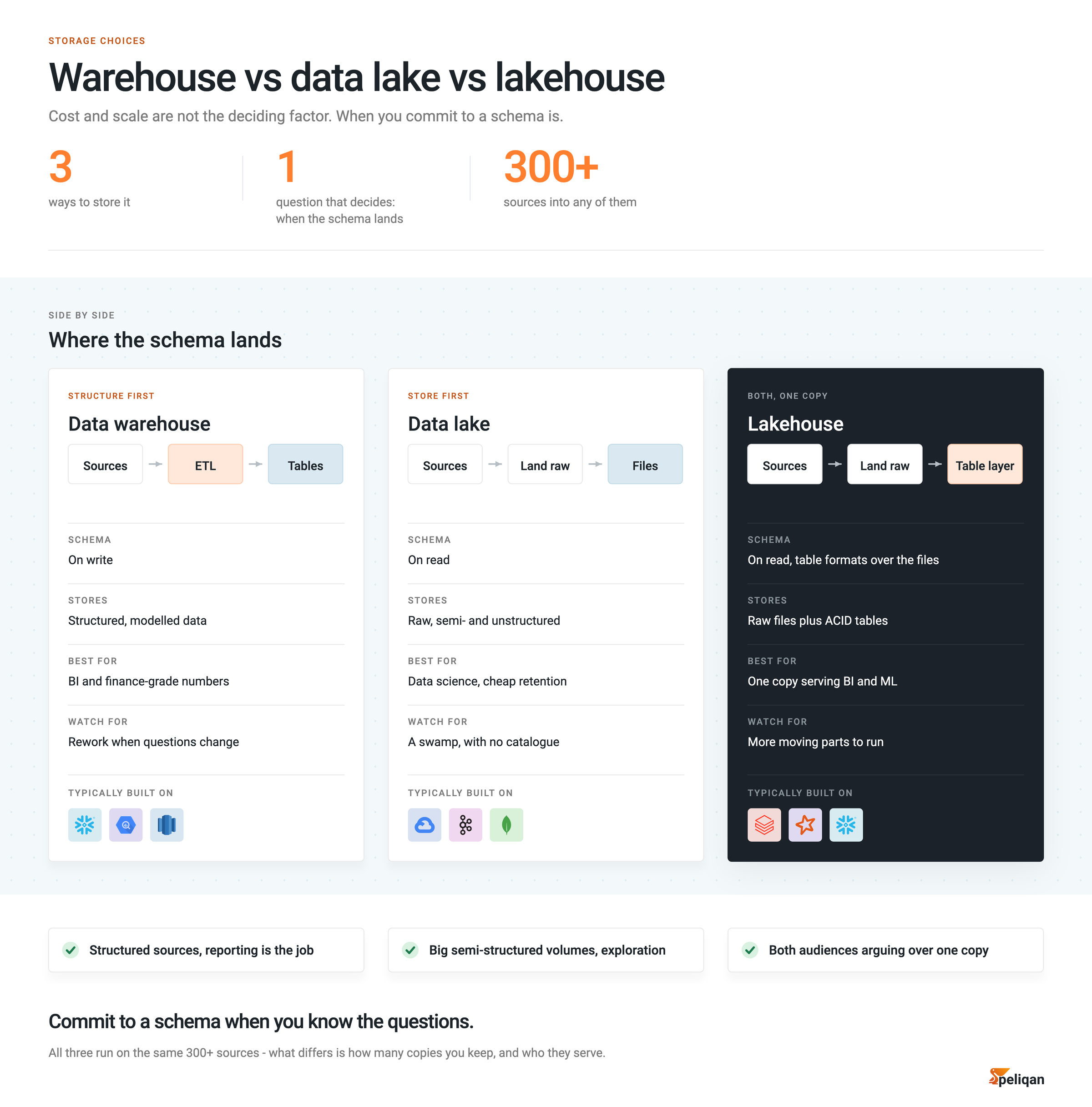
- 1Data warehouse – structure first. Schema is applied on write, so only structured, modelled data gets in. Best for BI and finance-grade numbers. Watch out for the rework when the questions change, because reshaping means reloading.
- 2Data lake – store first. Schema is applied on read, so anything can land: raw, semi-structured and unstructured. Best for data science and cheap long retention. Watch out for it becoming a swamp, which is what happens without a catalogue.
- 3Lakehouse – both, on one copy. Raw files with table formats layered over them, giving ACID tables on top of open storage. Best when one copy has to serve BI and machine learning together. Watch out for the extra moving parts you now operate.
How to choose
- Structured sources and reporting as the main job – warehouse
- Large volumes of semi-structured data and exploratory work – lake
- Both audiences arguing over one copy of the data – lakehouse
- Not sure yet – start with a warehouse and keep a raw layer, which gets you most of the lake’s optionality without the operational load
Schema on write versus schema on read
Schema on write buys you trust: anything in the warehouse has already passed a shape check. Schema on read buys you optionality: you keep everything and decide later. Because the first is easier to govern and the second is easier to change, the lakehouse exists to try to get both, at the price of more machinery to run.
Where Peliqan sits
Peliqan loads from 300+ sources into a warehouse it can provide or into one you already run, and keeps a raw layer alongside the modelled tables. Consequently you get the replayability people usually reach for a lake to get, without operating a second system. The layer view is drawn out on our data warehouse architecture diagram.
Use this diagram wherever you like
The diagram is free to use, including commercially, as long as there is a visible link back to this page. Download the PNG for slides and documents, or the SVG if you want to edit the labels. No email required. You can browse the rest of the set in the Peliqan diagram library.
Ready to build this on your own data? Get started with Peliqan.