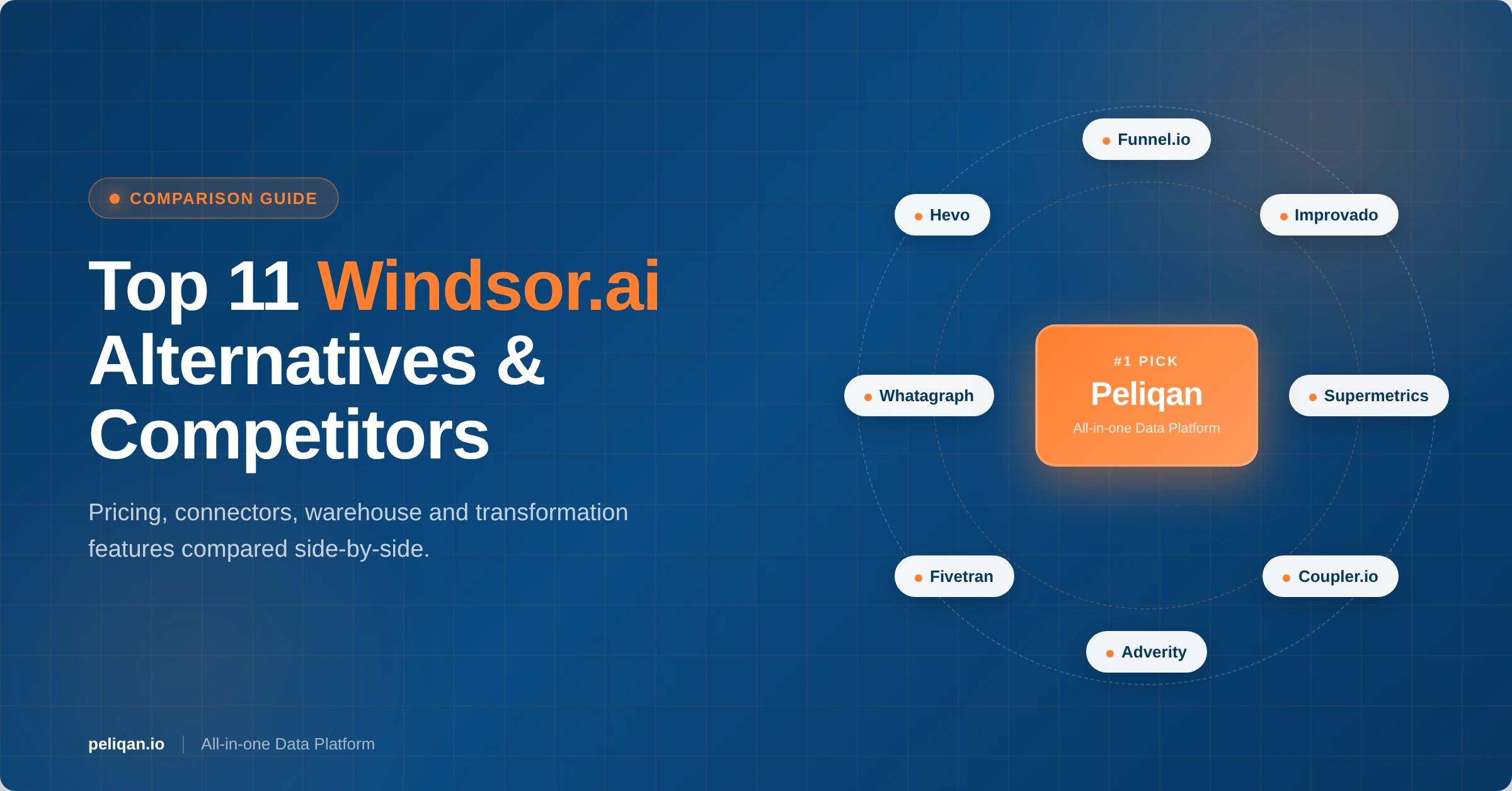





Windsor.ai built its reputation on transparent pricing for marketing data connectors – but tier jumps that triple your bill, billing surprises at renewal, and the missing data warehouse layer are pushing teams toward better Windsor.ai alternatives. Here is a complete comparison of the top Windsor.ai alternatives and competitors for 2026.
Windsor.ai is a no-code ELT/ETL platform that automates the extraction of marketing data from 325+ platforms – Google Ads, Meta Ads, GA4, HubSpot, Salesforce, LinkedIn Ads, TikTok and dozens more – into destinations like Looker Studio, Google Sheets, BigQuery, Snowflake, Power BI, Tableau and Excel. With a 4.6/5 rating on G2 and a free forever plan, it has become a popular budget pick for small marketing teams that need reporting connectors without a six-figure data engineering bill.
But once teams scale past three or four ad accounts, the cracks start showing. The jump from Basic ($19/month, 3 sources) to Standard ($99/month, 7 sources) to Plus ($249/month, 10 sources) feels steep. Trustpilot reviewers regularly call out unexpected renewal billing and refund difficulties. And because Windsor.ai is purely an extraction-and-load tool, you still need a separate warehouse, transformation layer, and BI tool to actually run a marketing analytics stack.
This guide compares the best Windsor.ai alternatives across three categories – all-in-one data platforms, marketing-focused intelligence tools, and developer-friendly data infrastructure – so you can pick the right replacement for your team’s budget, technical depth, and reporting needs. We start with Peliqan, the unified data platform built for teams that want to go beyond marketing connectors and own their entire data stack.
Windsor.ai: Platform overview and pricing breakdown
Windsor.ai launched in 2018 as a marketing-first ELT connector platform aimed at agencies and in-house performance teams. It positions itself as the budget-friendly alternative to Supermetrics, with all destinations – Google Sheets, Looker Studio, Power BI, BigQuery, Snowflake, Redshift, Databricks, Microsoft Fabric, Azure SQL, and even an MCP server – included on every paid plan.
Beyond raw extraction, Windsor.ai layers in multi-touch attribution modeling, schema matching, incremental loading, and scheduled refreshes. It is one of the few connector tools in this category that has shipped a native Model Context Protocol server for Claude, ChatGPT and Gemini integration. The catch: it does not include a warehouse, a transformation layer, a low-code Python runtime, or any reverse ETL capability. You bring your own warehouse, your own BI tool, and your own data quality stack.
Windsor.ai pricing in 2026
Compared with the per-destination tax that Supermetrics charges, Windsor.ai’s all-destinations-included model is a real advantage for small teams. But the source-count caps create the same scaling problem in a different shape: an agency with 6 platforms across 12 client accounts hits the Plus tier almost immediately, and a mid-market in-house team running 15+ ad platforms is pushed straight to Professional or Enterprise pricing where the per-source value evaporates.
Why teams are switching from Windsor.ai
Based on analysis of 200+ G2, Capterra, and Trustpilot reviews and the top 20 ranking pages for “Windsor.ai alternatives,” the reasons teams seek Windsor.ai alternatives cluster around six recurring themes. None of them are deal-breakers in isolation – but stacked together they explain why the Windsor.ai alternatives keyword has more search volume than the Windsor.ai brand keyword itself.
The six reasons teams move off Windsor.ai
- Steep tier jumps: The 3 – 7 – 10 – 14 source progression has no middle ground. Adding one extra ad platform on Basic forces a 5x price jump to Standard, and the same dynamic plays out at every tier above.
- No built-in data warehouse: Windsor.ai dumps data into your warehouse but does not include one. Teams without an existing BigQuery, Snowflake, or Redshift contract face an additional $300 – $2,000+/month bill before they can even query their marketing data.
- Renewal and refund friction: Trustpilot reviewers and Reddit threads describe surprise auto-renewals at higher tiers, slow refund processing, and difficulty downgrading mid-contract. Several reviewers explicitly call the support experience “frustrating.”
- No transformation layer: Windsor.ai is an EL tool. There is no SQL workbench, no Python runtime, and no built-in dbt-style modeling. Cleaning, blending, and normalizing cross-channel data has to happen in another tool.
- No reverse ETL or data activation: You can pull data in, but you cannot push curated audiences, scores, or attribution results back into HubSpot, Salesforce, or your ad platforms without bolting on a separate reverse ETL tool.
- Marketing-only scope: Windsor.ai’s 325+ connectors are heavily weighted toward ad platforms. If your team also needs ERP, finance, ticketing, e-commerce, or database connectors to build a complete picture, you will need a second tool alongside it.
The pattern is consistent across the SERP: Windsor.ai works beautifully when you stay inside its sweet spot of 3 – 7 ad platforms feeding Looker Studio. The moment you grow past that, you are paying for a connector tool but operating like a stitched-together data integration stack with three or four moving parts.
The top Windsor.ai alternatives for 2026
The 11 platforms below were selected based on search ranking data, G2 review volume, and direct feature overlap with Windsor.ai. Each section covers what the platform does, how it differs from Windsor.ai specifically, what it costs, and the team profile it fits best.
1. Peliqan
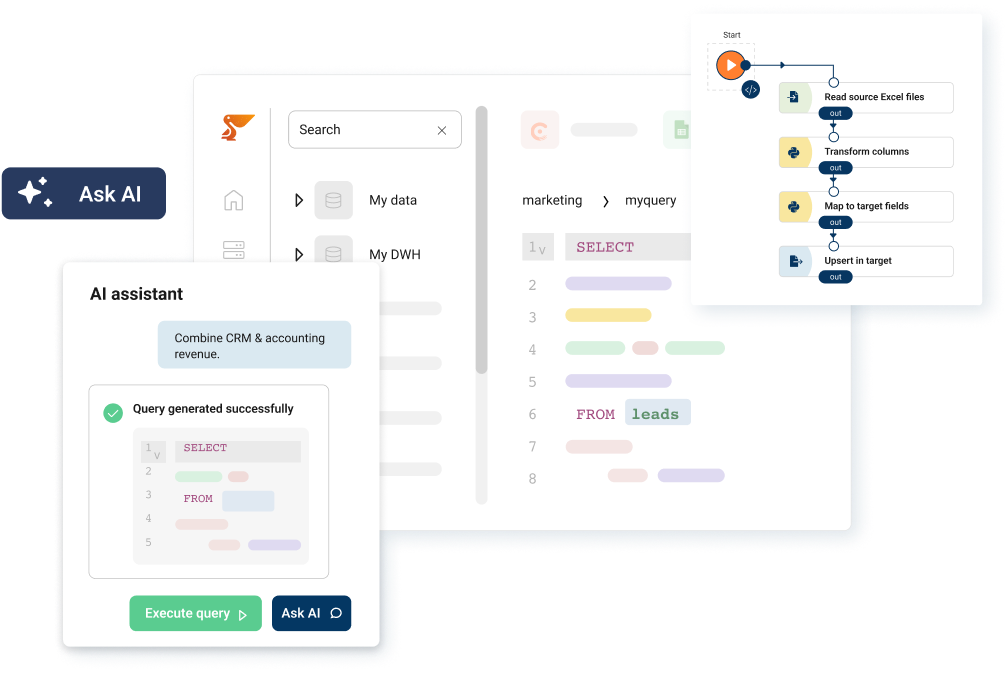
While Windsor.ai limits itself to extracting and loading marketing data, Peliqan is a unified data platform that handles the entire data lifecycle – ingestion, transformation, warehousing, activation, and AI – in a single interface. With 250+ pre-built connectors spanning marketing platforms, CRMs, ERPs, databases, finance tools, and SaaS apps, Peliqan goes far beyond marketing data to power the complete analytics stack that growing teams actually need.
The single biggest advantage over Windsor.ai is the built-in data warehouse. Where Windsor.ai loads raw data into spreadsheets or requires you to provision and pay for a separate Snowflake or BigQuery account, Peliqan ships with a managed Postgres + Trino warehouse out of the box. There is no second contract to negotiate, no warehouse autoscaling bill to forecast, and no IAM glue code to maintain.
Beyond the warehouse, Peliqan layers in SQL and low-code Python transformations, reverse ETL and data activation, federated queries via Trino (so you can join data across sources without copying), automatic data lineage, a semantic model layer, data quality monitoring with Slack alerts, and a spreadsheet UI that lets non-technical users explore data the same way they would in Excel.
For agencies, ERP consultants, and SaaS companies, Peliqan also includes white-label capabilities and multi-customer management – features Windsor.ai does not offer at any tier. You can spin up a branded data cockpit per client, manage permissions per tenant, and deliver embedded analytics inside your own product without rebuilding a data stack from scratch.
Peliqan is SOC 2 Type II certified, ISO 27001 compliant, GDPR-ready, and EU-hosted – matching enterprise security expectations that Windsor.ai’s lighter compliance posture does not always satisfy. For AI-first teams, Peliqan also ships an open-source MCP server (pip install mcp-server-peliqan) plus connector-specific MCP repos for Exact Online, Teamleader, AFAS, Odoo and PowerOffice, supporting full read/write across every connector.
Real-world example: Skindr
Skindr – a dermatology advice app – replaced a fragmented stack of marketing connectors and manual spreadsheets with Peliqan, consolidating data from HubSpot, Helpscout, Apple App Store and Google Play into one unified data repository. Peliqan’s transformation layer let them establish clear campaign attribution and tie ad spend to actual app downloads, building a 360-degree advertising and RevOps view their previous tooling could not produce. Read the full Skindr case study.
Key features:
- 250+ connectors across marketing, CRM, ERP, databases, finance, and SaaS – with a 48-hour custom connector SLA
- Built-in managed data warehouse (Postgres + Trino) – no separate warehouse contract
- Full ETL, reverse ETL, and SQL/Python transformation in one platform
- Spreadsheet UI for business users; SQL on anything federated queries for analysts
- White-label and multi-tenant support for agencies and SaaS companies
- SOC 2 Type II, ISO 27001, GDPR, EU-hosted; open-source MCP server
- Transparent fixed pricing from ~$199/month – no per-source or per-destination fees
Best for: Agencies, ERP and Odoo consultants, SaaS companies, and in-house teams that want to graduate beyond marketing-only connectors and operate a complete data pipeline with warehousing, transformation, and reverse ETL under one predictable price.
2. Funnel.io
Funnel.io is a marketing intelligence platform that pulls performance data from 590+ marketing, analytics and sales platforms into a centralized Data Hub where it is stored and harmonized. Unlike Windsor.ai – which moves raw, unprocessed metrics into your warehouse – Funnel automatically normalizes naming conventions, currency mismatches, and metric definitions across platforms. For teams running campaigns in 8+ markets and 15+ platforms, that data harmonization is genuinely valuable.
Funnel stores up to two years of historical data, supports custom calculated metrics, and pushes cleaned data into BI tools, warehouses, and its own native dashboards. The trade-off is price. Founded in 2014 in Stockholm and backed by $131M in funding from Balderton Capital and Eight Roads Ventures, Funnel.io now starts around $400/month for the Starter plan, with Business plans landing at $2,250/month and Enterprise pricing custom.
Key features:
- 590+ marketing platform connectors (largest in this category)
- Automatic data normalization and currency conversion
- Two-year historical data storage with full reprocessing
- Built-in dashboards plus warehouse and BI delivery
Best for: Mid-market and enterprise marketing teams running multi-market campaigns who need automated cross-channel data harmonization and can absorb premium pricing.
3. Improvado
Improvado is an enterprise marketing analytics platform built for B2B teams managing complex multi-channel attribution. It addresses Windsor.ai’s biggest gap by offering a full ETL engine with AI-powered data mapping, marketing-specific data models, and pre-built schemas for cross-channel reporting – rather than just dumping raw data into a warehouse.
With 500+ connectors, Improvado covers ad platforms, programmatic networks, CRMs, and industry-specific tools. The no-code transformation layer lets marketers clean and blend data without involving engineering, and the platform now ships AI agents for analysis and optimization. Pricing is custom and volume-based across Growth, Advanced, and Enterprise tiers – typically targeting organizations processing 200M to 1B+ rows annually, which puts it in a different budget category than Windsor.ai.
Key features:
- 500+ marketing and sales connectors
- AI-powered data mapping and pre-built marketing data models
- Marketing-specific governance, budget validation, and historical data preservation
- Volume-based pricing (no per-source caps) – 4.5/5 G2 rating
Best for: Enterprise B2B marketing teams managing complex multi-touch attribution and large agencies with mature analytics operations.
4. Supermetrics
Supermetrics is the original marketing data connector. With 150+ integrations, $50M+ in ARR, and 800+ G2 reviews, it is the most established name in the category – and the most direct philosophical opposite to Windsor.ai. Where Windsor.ai includes all destinations on every plan, Supermetrics charges per destination: a license each for Looker Studio, Google Sheets, Power BI, BigQuery, and so on.
Pricing starts at €29/month and scales aggressively with extra destinations (€149-177 each), users (€29-99 each), and additional sources (€29-69 each). All plans require annual commitments. For teams that already have a single destination locked in and value Supermetrics’ polished UI, the entry price is competitive – but value-for-money complaints are the most cited issue across recent G2 reviews. Read the full Supermetrics alternatives breakdown if Supermetrics is the actual incumbent on your team.
Key features:
- 150+ marketing connectors with the most polished setup UX in the category
- Native integrations for Looker Studio, Google Sheets, Excel, Power BI, BigQuery
- Connector Builder (launched February 2026) for custom integrations
- Annual contracts only – no monthly billing
Best for: Single-destination, single-team users who value brand recognition and polished UX over multi-destination flexibility.
5. Coupler.io
Coupler.io is a no-code data integration and AI analytics platform that targets the same budget-conscious segment as Windsor.ai – but with broader connector coverage. With 400+ data sources, 1,800+ ready-made integrations, and all sources unlocked on every paid plan, Coupler.io removes the source-count tier gating that frustrates Windsor.ai users at the Standard and Plus levels.
Beyond connectors, Coupler.io ships AI-powered features: AI insights, 200+ ready-made dashboard templates, and 100+ dataset templates for common marketing reporting workflows. Destinations include Google Sheets, Looker Studio, Power BI, BigQuery, and Claude/ChatGPT for AI workflows. Pricing starts at $49/month for Starter and scales to $199/month for Pro – all with full source access and a 7-day Pro trial.
Key features:
- 400+ sources, all available on every paid plan (no per-tier source gating)
- 1M+ users including Uber, Netflix, and Airbus
- 200+ dashboard templates and AI-powered insights
- Destinations across spreadsheets, BI tools, warehouses, and AI agents
Best for: Small to mid-sized marketing teams that need broad connector coverage, ready-made dashboards, and predictable monthly pricing without source-count limits.
6. Adverity
Adverity is the enterprise-grade Windsor.ai alternative built for regulated industries. With 600+ pre-built connectors, AI-powered custom scripting for transformations, automatic data mapping, and built-in dashboards, it covers the complete marketing data integration workflow inside a single platform – and adds the compliance posture that Windsor.ai cannot match.
Adverity has raised $162M from SoftBank and Sapphire Ventures, employs roughly 288 people, and holds ISO 27001, SOC 2 Type II, and GDPR certifications – the security trifecta that healthcare, finance, and pharmaceutical marketing teams require. The trade-off is opaque pricing: enterprise contracts typically start around $30,000/year per verified G2 reviews, with Azure Marketplace listings showing $200,000+/year for large deployments. There is no published self-serve tier.
Key features:
- 600+ pre-built connectors across marketing, sales, and finance
- AI-powered custom scripting for transformations
- Built-in dashboards plus warehouse and BI delivery
- ISO 27001, SOC 2 Type II, GDPR for regulated industries
Best for: Regulated industries (healthcare, pharma, finance) and large enterprises that need extensive connector coverage with enterprise governance.
7. Whatagraph
Whatagraph is the AI-powered marketing reporting alternative aimed squarely at agencies. It plugs into 55+ marketing platforms via native connectors, then layers cleaning, organization, branding, and presentation into a single workspace – effectively combining the connector role that Windsor.ai plays with the visualization role that Windsor.ai pushes to Looker Studio or Power BI.
The platform’s drag-and-drop report builder is consistently praised in reviews for saving time on recurring client reporting, and the white-label capabilities let agencies deliver branded dashboards without standing up a separate BI stack. Pricing is credit-based and not publicly listed, with Professional estimated at ~$199/month and Premium ~$299/month according to third-party sources. G2 rating sits at 4.5/5.
Key features:
- 55+ marketing connectors with built-in visualization and reporting
- White-label, branded client reports with scheduled delivery
- AI-powered data cleaning and presentation
- Source-credit pricing model (variable cost across clients)
Best for: Agencies that need automated, branded client reporting in one tool and do not want to maintain a separate BI stack.
8. Fivetran
Fivetran is the market leader in managed ELT, with 700+ connectors and automated schema management. Following its October 2025 merger with dbt Labs, Fivetran spans both data ingestion and transformation – making it a much stronger foundation than Windsor.ai for teams building a modern data stack. The catch: Fivetran is data infrastructure, not a marketing tool. It will not answer marketing questions on its own and assumes you already own a warehouse, a BI tool, and an analytics engineering practice.
Fivetran’s January 2026 pricing changes – per-connector MAR billing and a $5 minimum charge per connection – have been controversial, with roughly a third of recent G2 reviewers flagging cost as their top concern. Standard connectors typically run $1,200/month and database connectors $1,500/month, with MAR usage stacked on top. There is a free tier for low-volume use cases.
Key features:
- 700+ connectors with automated schema migration and historical sync
- Integrated dbt transformation post-merger with dbt Labs
- Enterprise security: SOC 2 Type II, GDPR, HIPAA, ISO 27001
- Reverse ETL via Census integration
Best for: Engineering-led organizations with data teams building a centralized warehouse who need reliable, broad-coverage pipelines and have separate BI and visualization tools.
9. Hevo Data
Hevo Data is a cloud-native ELT platform focused on real-time data pipelines, with 150+ connectors and a no-code interface. It covers both marketing sources and operational systems (databases, e-commerce, finance), making it a useful Windsor.ai alternative for teams that need more than ad platforms in their pipeline. Hevo includes data transformation, real-time CDC replication, and auto-schema management – none of which Windsor.ai offers.
Hevo’s 2026 architecture refresh promises 20-40x faster replication and 50-80% lower TCO compared to legacy ELT tools. Pricing starts free (1M events/month), with the Starter plan at $239/month and scaling on event volume rather than connector count. SOC 2 Type II, GDPR, and HIPAA certifications make it viable for regulated industries on a budget. We covered Hevo in depth in our Hevo alternatives breakdown.
Key features:
- 150+ connectors covering marketing and operational sources
- Real-time CDC replication and auto-schema management
- Free tier (1M events) plus event-based transparent pricing
- SOC 2, GDPR, HIPAA certifications
Best for: Teams that need real-time pipelines combining marketing and operational data on event-based rather than connector-based pricing.
10. Dataslayer.ai
Dataslayer.ai is the closest direct Windsor.ai alternative for Looker Studio and Google Sheets users. With 56 marketing connectors covering Google Ads, Meta, LinkedIn, TikTok, GA4, Search Console, HubSpot, and YouTube Analytics, it deliberately scopes itself narrower than Windsor.ai but matches the price-conscious positioning. Recent additions include MCP integration for Claude and ChatGPT, an AI Analyzer for natural-language queries, and pre-built Looker Studio templates.
Pricing under the new February 2026 structure is connector-based: Starter at €29/month for 1 user and 3 sources, Advanced at €99/month for 10 users and 7 sources, with all destinations priced identically across plan levels. That structure is similar to Windsor.ai’s but with smaller per-tier source caps – which works well for solo marketers but limits agency use cases.
Key features:
- 56 marketing connectors focused on ad platforms and analytics
- MCP integration for Claude and ChatGPT (launched 2026)
- Pre-built Looker Studio templates and AI Analyzer
- All destinations priced identically across plan levels
Best for: Solo marketers and small teams primarily reporting in Looker Studio who want lower entry pricing than Windsor.ai’s Standard tier.
11. Airbyte
Airbyte is the leading open-source data integration platform with 600+ connectors and a developer community of 230,000+ members. For technically capable teams who want full control over their data pipelines, Airbyte’s free self-hosted option makes it the most cost-effective Windsor.ai alternative on this list. Airbyte Cloud starts at $10/month for teams that prefer a managed experience.
The caveat: only about 15% of Airbyte’s connectors are vendor-managed – the rest are community-built with variable quality, especially for marketing platforms with rapidly changing APIs. Airbyte requires more technical expertise than Windsor.ai, does not include visualization, transformation modeling, or marketing-specific schemas, and assumes you bring your own warehouse and BI stack. For a deeper comparison of how managed vs. self-hosted approaches play out, see our ETL vs ELT breakdown.
Key features:
- 600+ connectors with a Connector Builder (CDK)
- Cloud and open-source/self-hosted deployment
- Free self-hosted; Cloud from $10/month
- Expanding into AI/vector database connectors
Best for: Engineering-heavy teams that want maximum flexibility, open-source control, and minimal cost – and are comfortable without built-in marketing analytics or visualization.
Feature comparison table
Quick reference comparison across the 11 Windsor.ai alternatives. Use this to shortlist before booking demos. Numbers reflect publicly published pricing and feature documentation as of May 2026.
What real users actually say on G2, Capterra, and Trustpilot
Peer review platforms reveal a clear pattern about Windsor.ai and its competitors. Across G2, Capterra, and Trustpilot, three signals dominate: ease-of-use praise from solo marketers, support friction complaints from agencies, and price-tier frustration from teams that scaled past the Standard plan.
Windsor.ai across review platforms
The competitive landscape on G2 is concentrated. Coupler.io leads value perception at 4.9/5, AgencyAnalytics dominates volume with 1,200+ reviews and a 4.7/5 average, and Funnel.io and Improvado both sit at 4.5/5 with established mid-market traction. Fivetran’s 4.2/5 reflects its 2026 pricing controversy more than its product quality. Peliqan does not yet have G2 review volume but holds a 5.0/5 on SourceForge based on early customer reviews.
The recurring theme across review platforms is consistent: connector tools win on ease of use and lose on value as teams scale. Alternatives that bundle a data warehouse, transformation, and predictable pricing into one product score higher on long-term value.
Enterprise security and compliance comparison
For organizations handling marketing data alongside customer PII – which is most modern marketing teams – compliance certifications matter as much as connector counts. Windsor.ai is GDPR compliant but has not published SOC 2 Type II or ISO 27001 attestations, which is a deal-breaker for some regulated buyers.
Compliance posture by platform
For agencies and ERP consultants delivering reports to multiple clients under their own brand, the white-label and multi-tenant capability is often more important than the absolute connector count. CIC Hospitality consolidated 50+ data sources and saved 40+ hours per month on board reporting using Peliqan’s white-label data cockpit – the kind of agency-grade workflow Windsor.ai’s product simply does not address.
Decision framework: choosing the right Windsor.ai alternative
Most decisions in this category boil down to four variables: do you need a warehouse, do you need transformation, do you need reverse ETL, and how technical is your team. Map your situation to the right shortlist below.
Quick decision guide
- Need a unified data platform with built-in warehouse and predictable pricing: Peliqan
- Need automatic marketing data normalization at enterprise scale: Funnel.io
- Need enterprise marketing analytics with AI-powered transformation: Improvado
- Need maximum connector reliability for a modern data stack: Fivetran
- Need an affordable all-in-one with AI analytics and broad connector access: Coupler.io
- Need regulated-industry compliance with deep transformation: Adverity
- Need branded, automated client reporting in one tool: Whatagraph or AgencyAnalytics
- Need real-time pipelines combining marketing and operational data: Hevo Data
- Need lowest-cost Looker Studio reporting: Dataslayer.ai
- Need open-source control with engineering ownership: Airbyte
If you are picking your second tool to bolt onto Windsor.ai, you probably do not need a Windsor.ai alternative – you need a platform replacement. Most teams who add a warehouse, a transformation tool, and a reverse ETL tool around Windsor.ai end up paying more in aggregate than they would for a unified platform that includes all four. Running the math on total cost of ownership (warehouse + transformation + reverse ETL + BI + connector tool) is the single most useful exercise in this category.
The market context: where marketing data tooling is heading in 2026
Three structural shifts are reshaping the marketing data category this year, and they all point in the same direction: away from single-purpose connector tools and toward integrated platforms.
First, AI agents and MCP integration have become table-stakes. Windsor.ai, Coupler.io, Dataslayer.ai, and Peliqan have all shipped Model Context Protocol servers in the last six months, letting Claude, ChatGPT and Gemini query data directly. The platforms that paired MCP with a real AI agent layer and writeback – rather than read-only chat – are pulling ahead of the rest.
Second, the dbt + Fivetran merger in October 2025 collapsed the ELT and transformation categories into one. Standalone connector-only tools without a transformation story now look incomplete by comparison, and buyers increasingly evaluate connector vendors on their transformation capabilities rather than just connector counts.
Third, fixed-price challengers are taking share from usage-based incumbents. Fivetran’s per-connector MAR billing and Funnel.io’s $400 – $2,250 tier jumps have created an opening for predictable pricing models. The platforms growing fastest in the mid-market – Coupler.io, Hevo, Peliqan – all lead with transparent flat-rate pricing rather than connector or row-based meters.
Conclusion
Windsor.ai remains a solid choice for solo marketers and small teams running 3 – 7 ad platforms into Looker Studio with simple reporting needs. The free forever plan, all-destinations-included model, and 4.6/5 G2 rating are real advantages at the entry tier. But for growing teams, agencies managing multiple clients, and organizations that need data transformation, reverse ETL, or a built-in warehouse, the limitations show up fast – and the tier jumps make scaling painful.
Peliqan stands out as the most comprehensive Windsor.ai alternative for teams that want to graduate beyond marketing-only connectors entirely. With 250+ connectors, a built-in Postgres + Trino warehouse, full ETL and reverse ETL, SQL and low-code Python transformations, white-label multi-tenant management, EU-hosted SOC 2 + ISO 27001 compliance, and a transparent fixed price starting around $199/month, it replaces what would otherwise be a four-tool stack with one platform and one bill. Funnel.io and Improvado lead the marketing-specific intelligence category. AgencyAnalytics and Whatagraph dominate agency reporting. Fivetran and Airbyte own the engineering-led infrastructure tier.
When evaluating Windsor.ai alternatives, run the total-cost-of-ownership math (warehouse + transformation + reverse ETL + BI + connector tool), audit your need for white-label and compliance certifications, and pressure-test pricing at the source counts and account volumes you will actually be running 12 months from now – not the ones you have today.
Ready to see what a unified data platform looks like compared to a connector-only tool? Try Peliqan free or book a demo to walk through your specific marketing data stack.