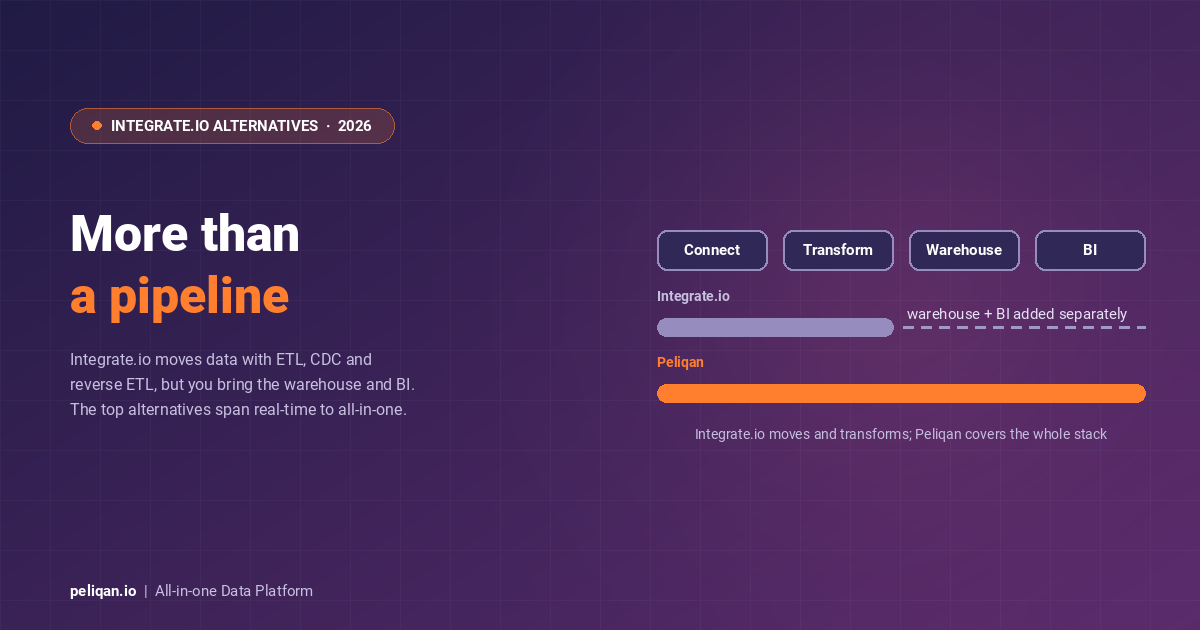





Integrate.io is a capable low-code ETL, ELT, CDC, and reverse ETL platform, but cost at higher volumes, limited customization, the lack of a built-in warehouse or BI, and US-based hosting push many teams to evaluate Integrate.io alternatives. Here is a current comparison of the top 10 Integrate.io alternatives and competitors for 2026.
Integrate.io is a cloud-based data integration platform that bundles ETL, ELT, change data capture, reverse ETL, and API management behind a low-code visual builder. With 150+ connectors and sub-60-second CDC replication, it moves data from databases, SaaS apps, and APIs into your warehouse without deep engineering, and its fixed-fee pricing model is a genuine draw for teams that dislike volume-based bills.
It is also a movement-and-transformation layer rather than a complete stack. Integrate.io does not include a warehouse, BI, or analytics, so you assemble those separately, and reviewers note costs climb for larger volumes, customization is constrained, and data lineage is limited. For EU teams, US-based hosting adds a residency consideration. This guide compares the 10 best Integrate.io alternatives across real-time platforms, managed ELT, and all-in-one tools, so you can match the right one to your data stack and budget.
Why consider alternatives to Integrate.io?
Integrate.io is a solid fit for mid-sized teams that want low-code pipelines with CDC and reverse ETL in one tool. But a few recurring limits send growing teams looking elsewhere.
Common reasons teams move off Integrate.io
- Cost at higher volumes: the fixed-fee model is attractive in principle, but reviewers report it gets expensive for larger data volumes and smaller teams alike.
- No built-in warehouse, BI, or analytics: Integrate.io moves and transforms data into a warehouse you bring, so the stack still needs storage, dashboards, and modeling added separately.
- Scaling and real-time limits: teams pushing into high-volume or always-on streaming environments hit latency and throughput ceilings.
- Constrained customization: the low-code builder is approachable but limits the deeper, code-level control some engineering teams need.
- Limited data lineage: lineage and observability are thinner than in platforms built around governance.
- US-based hosting: EU teams weighing GDPR and data residency increasingly prefer an EU-hosted option.
The top Integrate.io alternatives for 2026
Each entry below covers what the tool is, how it differs from Integrate.io, and the team profile it fits best, starting with the most consolidated option.
1. Peliqan
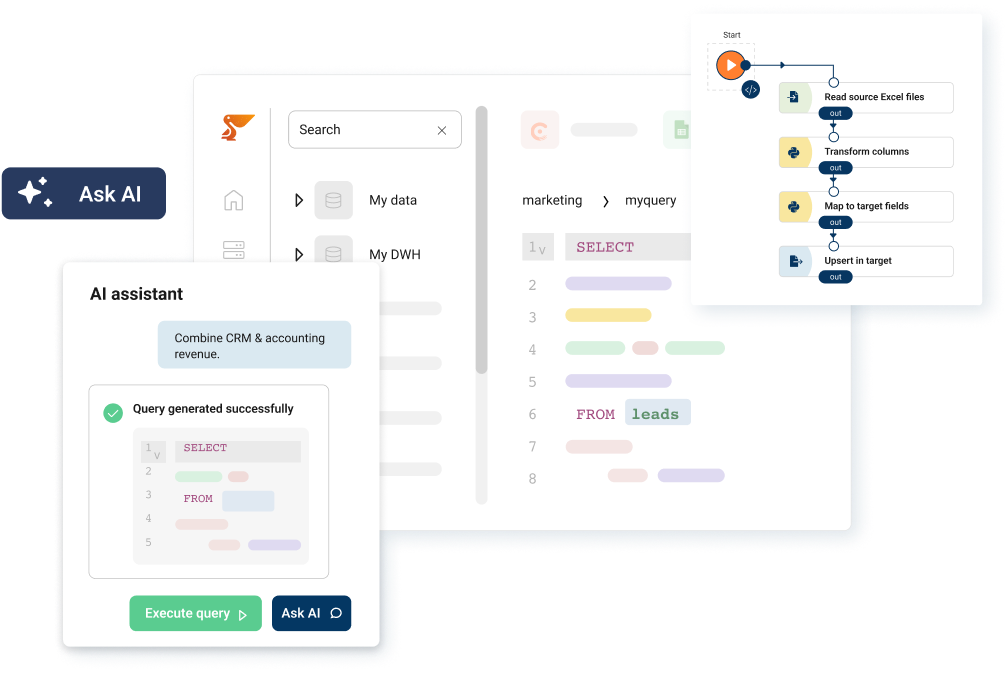
Integrate.io moves and transforms data into a warehouse you provide; Peliqan bundles the warehouse, transformations, analytics, and activation into the same platform. For teams using Integrate.io as their pipeline layer and stitching a warehouse and BI tool around it, Peliqan collapses that into one place with predictable pricing and EU hosting.
It pairs 250+ pre-built connectors across databases, APIs, SaaS tools, and files with a built-in Postgres and Trino warehouse, so ingestion and storage are handled in one place rather than billed and managed separately. A federated query engine runs SQL across cloud and on-prem sources.
Like Integrate.io, Peliqan covers reverse ETL and writeback. But it adds SQL and low-code Python transformations, built-in dashboards, and API publishing, the warehouse and BI layers Integrate.io leaves you to assemble.
Those SQL and low-code Python transformations run with an AI-assisted assistant, and a native MCP server exposes governed data to LLMs.
Pricing is transparent and fixed, with current tiers on the pricing page. Peliqan is SOC 2 Type II, ISO 27001, GDPR, HIPAA, and CCPA certified, EU-hosted on AWS Frankfurt for data residency, builds custom connectors within 2 weeks when a source is missing, and supports white-label, multi-customer management for consultancies.
Real-world example: CIC Hospitality
CIC Hospitality unified data from 50+ sources into Peliqan and now saves 40+ hours per month by fully automating board reports that were previously built by hand, replacing what would otherwise be a pipeline plus a separate warehouse and BI layer. Read the case studies.
Best for: teams that want a unified ELT, warehouse, BI, and reverse ETL stack with predictable pricing and EU data residency, rather than a pipeline layer plus a warehouse and BI assembled around it. The trade-off is that Peliqan is newer than legacy vendors and optimized for cloud-native workflows.
2. Fivetran
Fivetran is the premium managed-ELT option, with 700+ connectors, automated schema drift handling, change data capture, and near-zero maintenance. Following its completed 2026 merger with dbt Labs, it now spans ingestion and transformation, where Integrate.io keeps transformation in its own low-code builder.
Setup is easy and reliability is high, but its Monthly Active Rows pricing scales quickly and there is less visual transformation than Integrate.io offers. Best for: teams that want zero-maintenance ingestion into a warehouse and can absorb volume-based pricing.
3. Airbyte
Airbyte is the open-source data integration leader, with 600+ connectors, an AI connector builder, vector database support for AI workloads, and both self-hosted and cloud deployment. Where Integrate.io is a managed low-code product, Airbyte gives full control and no vendor lock-in.
It is highly customizable and cost-effective for engineering-driven teams, but self-hosting needs DevOps effort and community connector quality varies. Our Airbyte alternatives guide compares the field. Best for: engineering teams that want open-source flexibility and long-tail connectors over a fully managed product.
4. Hevo Data
Hevo is a no-code, fully managed pipeline platform with real-time syncing from 150+ sources, automated schema handling, and dbt-based transformations. It overlaps closely with Integrate.io on ease of use, with a free tier that lowers the barrier to entry.
It is quick to deploy with strong automation, but event-based pricing can be hard to forecast and there is no built-in warehouse or BI. Our Hevo Data alternatives guide goes deeper. Best for: teams that want no-code managed ingestion with real-time syncing and a free starting tier.
5. Stitch
Stitch, owned by Talend (now part of Qlik), is a developer-friendly ETL tool for small to medium teams, with 130+ connectors, Singer-standard extensibility, batch loads to cloud warehouses, and a simple cloud UI.
It is quick to onboard and affordable, with a free tier and paid plans from around $100/month, but the connector catalog is smaller and there is no built-in transformation engine. Best for: small to medium teams that want simple, affordable batch ingestion.
6. Matillion
Matillion is a cloud-native ELT platform that optimizes processing inside warehouses like Snowflake, BigQuery, and Redshift, with a visual builder, pushdown execution, and its newer Data Productivity Cloud and Maia agentic AI assistant. It is a stronger fit than Integrate.io for warehouse-heavy transformation work.
It delivers warehouse-native performance with an intuitive UI, but it is tied to specific warehouses and its credit-based pricing can get complex. Our Matillion alternatives guide goes deeper. Best for: teams standardized on a cloud warehouse that want visual, pushdown ELT inside it.
7. Estuary
Estuary Flow is a real-time data integration platform built around streaming and change data capture, and a direct answer to Integrate.io’s CDC use case at higher scale. It captures changes once and delivers them to multiple destinations with low latency, combining streaming and batch in one pipeline.
It is a strong fit when real-time freshness and high-volume CDC matter more than a visual ETL builder, though its connector catalog is narrower than the largest platforms. Best for: teams that need real-time CDC and streaming at scale.
8. Skyvia
Skyvia is a no-code cloud integration platform covering ETL, ELT, reverse ETL, data migration, and one-way or bi-directional sync, which makes it the closest functional match to Integrate.io’s breadth. It is browser-based with no infrastructure to run and a free starting tier.
It is easy for non-engineers and flexible across sync patterns, but it is less suited to very high-volume engineering workloads and lacks a built-in warehouse. Best for: teams that want no-code ETL plus bi-directional sync across SaaS and databases.
9. Keboola
Keboola is a data operations platform combining ELT, built-in transformation and orchestration, Git integration, and data sharing in a component-based, API-first architecture. It offers more end-to-end data ops than Integrate.io’s pipeline focus.
It provides strong automation and transparent usage-based pricing with a free tier, but it is less intuitive for non-engineers and has a smaller connector catalog than the largest vendors. Best for: data teams that want an all-in-one data ops platform with both low-code and developer paths.
10. Informatica
Informatica is the enterprise platform for data integration, quality, governance, and master data management, with 500+ connectors and the CLAIRE AI engine. Acquired by Salesforce in late 2025, it suits large, regulated organizations far beyond Integrate.io’s mid-market focus.
It is proven at enterprise scale with deep governance, but it is expensive, complex to implement, and brings long rollout timelines. Best for: large enterprises that need governance and MDM well beyond pipeline ingestion.
Integrate.io alternatives compared
A quick side-by-side of the 10 Integrate.io alternatives on type, strengths, pricing model, and limitations. Confirm current pricing with each vendor before deciding.
How the data integration landscape is shifting in 2026
Three shifts are reshaping the space Integrate.io competes in. First, ownership is consolidating: Fivetran completed its merger with dbt Labs, Informatica was acquired by Salesforce, and Stitch sits inside Qlik via Talend, so the lines between ingestion, transformation, and governance keep blurring.
Second, real-time and CDC are moving from nice-to-have to default, which rewards platforms like Estuary built for streaming and pressures batch-leaning tools. Third, AI agents and Model Context Protocol endpoints are becoming a first-class workload, so platforms that expose governed SQL over a warehouse are pulling ahead of pure pipeline layers. For EU buyers, data residency under GDPR has become a procurement axis in its own right, which favours data integration platforms hosted inside the EU.
How to choose the right Integrate.io alternative
Match the choice to how much of the stack you want in one place, whether you need real-time CDC, and how predictable and EU-aligned your costs and hosting need to be.
Quick decision guide
- One platform for ELT, warehouse, BI, and reverse ETL with EU hosting: Peliqan
- Zero-maintenance managed ingestion: Fivetran
- Open-source flexibility and long-tail connectors: Airbyte
- No-code managed pipelines with a free tier: Hevo Data
- Simple, affordable batch ingestion: Stitch
- Pushdown ELT inside a cloud warehouse: Matillion
- Real-time CDC and streaming at scale: Estuary
- No-code ETL plus bi-directional sync: Skyvia
- All-in-one data ops with developer paths: Keboola
- Enterprise governance and MDM: Informatica
Integrate.io vs an all-in-one platform: what changes
The biggest practical difference is scope. Integrate.io is a pipeline layer: it connects sources, transforms data in a low-code builder, runs CDC, and pushes data back out, but it expects you to bring the warehouse, the BI tool, and the modeling. A working setup usually means Integrate.io plus a warehouse contract plus a BI tool, each with its own pricing and console.
Moving to an all-in-one platform collapses that into one place to build and watch pipelines, with ingestion, the warehouse, transformation, dashboards, and writeback included rather than assembled. The trade-off is specialization: a dedicated streaming engine will still beat a general platform on sub-second CDC at very high volume, so teams whose single hard requirement is that should weigh a purpose-built tool. When evaluating, audit what your Integrate.io pipelines actually do, separate the movement from the warehouse and BI around it, and pressure-test the alternative on a representative pipeline before committing.
Conclusion
Integrate.io is a capable low-code platform for ETL, ELT, CDC, and reverse ETL, and for mid-sized teams that want those pipeline modes in one tool it still earns its place. But it is a movement layer, not a full stack, and cost at volume, scaling limits, and the lack of a built-in warehouse or BI are decisive for many teams. Fivetran, Hevo, Stitch, and Skyvia lead the managed-ingestion bucket, Airbyte and Keboola cover open-source and data ops, Estuary owns real-time CDC, Matillion handles warehouse-native ELT, Informatica covers enterprise governance, and Peliqan consolidates the most into one platform.
For teams whose Integrate.io usage is mostly moving data into a warehouse plus a few transformations, a platform that bundles ingestion, storage, modeling, and activation removes the most moving parts at once, and EU-hosted residency closes the compliance gap. To see what that looks like compared to a pipeline-only layer, you can try Peliqan free or book a demo to walk through your specific pipelines.