





Uniconta to Power BI – if you’ve tried building a Power BI dashboard from Uniconta data, you’ve probably hit a wall somewhere between OData endpoints and refresh limits. Here’s how to actually make it work.
Uniconta is a cloud-based ERP used by over 45,000 companies across 67 countries, with especially strong adoption in Denmark, Germany, the Netherlands, and Iceland. Founded in 2015 by Erik Damgaard – the same mind behind Navision and Axapta – Uniconta packs serious accounting, inventory, project management, and CRM functionality into a modern cloud platform.
But when finance teams need to move beyond Uniconta’s built-in dashboards and into Power BI for cross-source reporting, things get complicated fast. The OData feed works in theory. In practice, it comes with refresh caps, query limitations, and zero support for combining Uniconta data with your CRM, marketing tools, or other accounting systems.
This guide walks through three approaches to getting Uniconta data into Power BI – from the native OData route to a data warehouse approach that actually scales.
What data lives in Uniconta
Uniconta stores the financial and operational backbone of your business. That includes general ledger entries, accounts receivable and payable, journal postings, VAT reporting data, bank reconciliations, and multi-company consolidation records. Beyond pure accounting, you’ll find sales orders, purchase orders, inventory movements, production planning data, project time entries, and CRM contacts.
For Power BI reporting, the most valuable tables are typically debtor (customer) transactions, creditor (supplier) transactions, inventory valuations, project profitability data, and the general ledger itself. Uniconta exposes these through its OData endpoints at odata.uniconta.com, but the structure isn’t always BI-ready – transaction tables support only basic query operations, and relationships between entities often need manual modeling.
Why the direct OData connection falls short
Uniconta offers an OData feed that Power BI can consume directly. You navigate to Get Data, select OData Feed, enter the endpoint URL, and authenticate with your Uniconta credentials. It works – for about a week. Then the limitations start stacking up.
Common pain points with direct OData connections
For a single-user dashboard with a few hundred transactions, the direct connection is fine. But the moment you need multi-company consolidation, cross-source analytics, or reliable daily reporting for a finance team, the OData-to-Power-BI path starts breaking down.
The data warehouse approach – connect Uniconta to Power BI through a central hub
Instead of pointing Power BI directly at Uniconta’s OData feed, the more robust approach is to replicate Uniconta data into a data warehouse first, then connect Power BI to the warehouse. This decouples your reporting layer from your source system and gives you a clean, query-optimized dataset to work with.
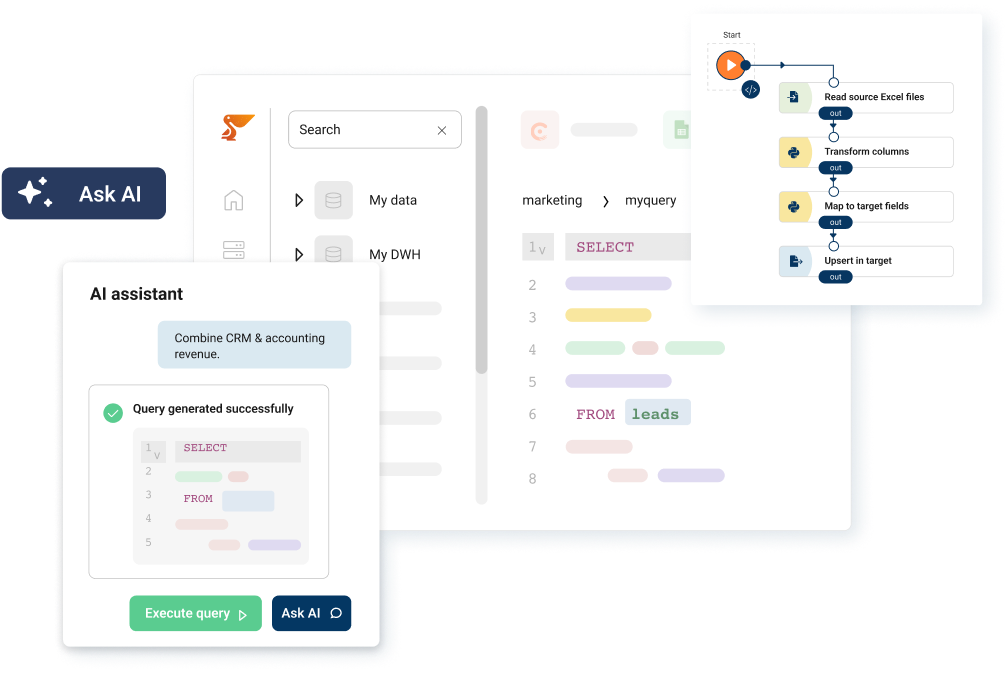
With Peliqan, the setup takes about 10 minutes. The platform includes a pre-built Uniconta connector that handles authentication, schema mapping, and incremental syncs automatically.
How it works with Peliqan
Because Peliqan handles the sync and transformation layer, Power BI only needs to query a well-structured Postgres database. Refreshes are faster, data models are cleaner, and you’re not dependent on Uniconta’s OData API availability or rate limits.
Peliqan’s built-in warehouse runs on Postgres with Trino for federated queries, supports materialized tables for heavy reporting workloads, and includes 250+ connectors with a 48-hour custom connector SLA. Pricing starts at roughly $199/month – often less than the engineering time you’d spend maintaining a custom OData pipeline.
Connecting Power BI to the Peliqan warehouse
Once your Uniconta data is syncing to Peliqan, connecting Power BI is straightforward. In Power BI Desktop, select Get Data, choose PostgreSQL Database, and enter the connection credentials from your Peliqan Power BI settings. You’ll see all your Uniconta tables plus any transformed views you’ve built – ready for drag-and-drop dashboard creation.
This approach also opens up Peliqan’s reverse ETL capabilities. Need to push Power BI insights back into Uniconta – like updating customer segments or flagging overdue invoices? Peliqan supports writeback to Uniconta, including creating invoices, updating debtor records, and managing creditor data through low-code Python scripts.
Real-world example: CIC Hospitality
CIC Hospitality unified fragmented data from 50+ sources into real-time, board-level reports using Peliqan – eliminating manual Excel consolidation and saving 30+ hours per month on reporting. The same warehouse-first approach works for Uniconta users who need consolidated financial dashboards across multiple companies or data sources. Read the full case study.
Skip Power BI entirely – query Uniconta data with AI
Not every question needs a dashboard. With MCP (Model Context Protocol), you can connect Uniconta data directly to AI assistants like Claude or ChatGPT and ask questions in plain English.
Peliqan provides an MCP server that connects to your Uniconta data through the same warehouse sync. You can set up the Uniconta MCP connection in minutes. Once running, you can ask questions like:
- “What’s our total revenue this quarter compared to last quarter?”
- “Which debtors have outstanding invoices over 60 days?”
- “Show me the top 10 products by sales volume this month”
- “What’s our cash position across all three companies?”
The AI agent queries your warehouse directly, so you’re always working with the same governed, quality-checked data your Power BI dashboards use. For ad hoc finance questions that don’t warrant a full dashboard build, this approach saves hours of report creation time.
Comparing your options
Combine Uniconta with other data sources in one dashboard
The real power of the warehouse approach shows up when you start combining Uniconta data with other systems. Finance teams rarely work with ERP data in isolation – they need CRM pipeline data to forecast revenue, marketing spend data to calculate ROI, and sometimes data from a second ERP when managing multiple entities.
With Peliqan’s 250+ connectors, you can bring Uniconta and Excel data together, sync Uniconta with your CRM, or consolidate multiple Uniconta companies into a single reporting layer. Everything lands in the same warehouse, governed by the same access controls and transformation logic.
Popular Uniconta combinations in Power BI
- Uniconta + HubSpot: Match invoice data with deal stages to see actual vs. projected revenue by sales rep
- Uniconta + Exact Online: Consolidate financials across entities using different ERPs into one Power BI report
- Uniconta + Google Ads: Calculate true customer acquisition cost by joining marketing spend with Uniconta revenue data
- Uniconta + Sharepoint: Combine financial data with project documentation for complete project profitability views
Getting started
If you’re currently struggling with Uniconta’s OData feed in Power BI – slow refreshes, missing relationships, or the inability to combine sources – the warehouse approach solves these problems without requiring any API development work.
Peliqan offers a free trial with the Uniconta connector included. Connect your Uniconta instance, explore your data in Peliqan’s spreadsheet-style UI, build your transformations, and plug in Power BI – all within a single platform. SOC 2 Type II certified, fixed pricing from ~$199/month, and a 2-week SLA for custom connector requests if you need something beyond the standard 250+ integrations.
For teams already using Power BI with other data sources, adding Uniconta to an existing Peliqan-to-Power-BI setup is just one more connector toggle. Your existing data models and dashboards stay intact – you’re simply adding another source to the warehouse.