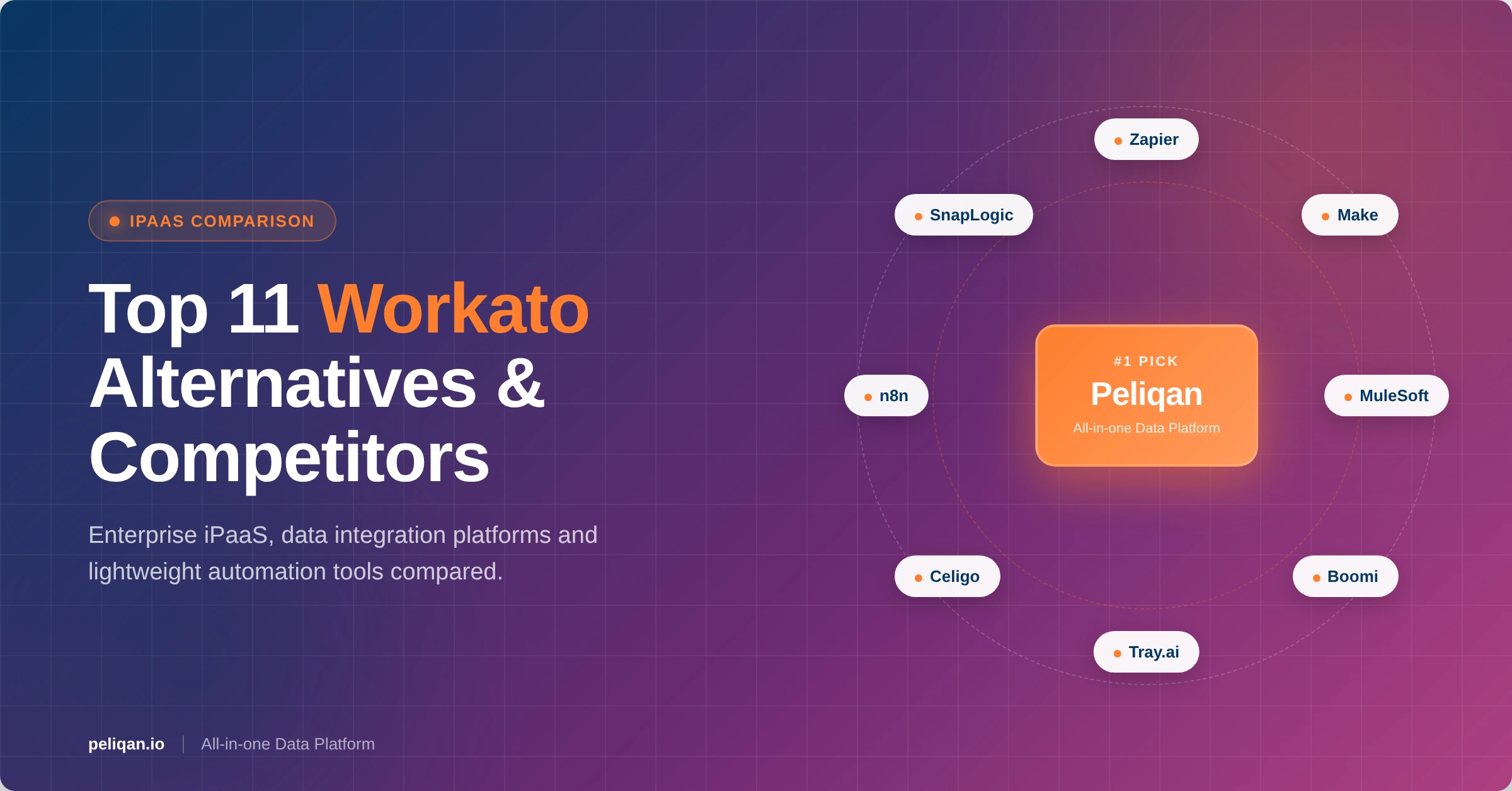





Workato has been the iPaaS poster child for almost a decade – but $15,000-$25,000 entry pricing, opaque recipe-based billing, vendor lock-in concerns, and a steep learning curve despite the “low-code” branding are pushing teams to evaluate Workato alternatives. Here is a complete comparison of the top Workato alternatives and competitors for 2026.
Workato is one of the most highly rated iPaaS platforms in the world, with a 4.7/5 G2 rating across 751+ reviews and recognition as a Leader in the Gartner Magic Quadrant for iPaaS for the eighth consecutive year in March 2026. With 14,000+ pre-built connectors, a maturing AI copilot, best-in-class enterprise governance, and 45 #1 G2 category rankings in Winter 2026, the product itself is rarely the problem. The pricing is.
Entry-level Workato pricing starts at roughly $15,000-$25,000 per year. The popular Team plan lands around $2,000/month, and enterprise contracts commonly run high five or six figures annually depending on recipe count, connection count, and AI feature usage. For mid-market teams, mid-size SaaS companies, and operations teams that just need to move data between a CRM, a warehouse, and a few SaaS tools, those numbers are tough to justify – especially when the cheaper alternatives have closed most of the feature gap in the last 24 months.
This guide compares the 11 best Workato alternatives across three categories – data-first integration platforms, general-purpose iPaaS, and lightweight automation tools – so you can pick the right replacement for your team’s budget, governance needs, and primary use case. We start with Peliqan, the all-in-one data platform that wins for teams using Workato primarily to move and unify data rather than orchestrate general business workflows.
Workato: Platform overview and why teams look for alternatives
Workato launched in 2013 and grew into the dominant low-code iPaaS for enterprise teams that wanted to automate cross-system workflows without writing custom integration code. The “Recipe” is the core unit: a trigger plus a series of actions wired together through Workato’s visual editor. With 14,000+ connectors covering every major SaaS, database, ERP, and HRIS, plus enterprise features like role-based access, audit logs, environment separation, and approval flows, Workato can genuinely run mission-critical automations at scale.
The platform sits firmly in the enterprise-iPaaS bucket. It is built for IT teams and integration specialists, not for marketing operations admins or revops analysts. Launching a basic Workato automation is fairly straightforward, but anything complex – cross-system data harmonization, event-driven flows, AI-powered routing – typically takes weeks or months of development. Pricing is fully custom, scales on recipes, connections, and tasks, and rarely shows up on a published price list.
Why teams move off Workato in 2026
- Entry pricing of $15,000-$25,000/year: The cheapest credible Workato deployment lands at $1,250+/month, and most mid-market contracts come in at $40,000-$120,000+/year. For teams running a handful of integrations, the per-recipe economics rarely pencil out.
- Pricing opacity: Workato does not publish list prices. Every deal is custom-negotiated, and reviewers consistently flag billing surprises at renewal as recipe and task counts grow.
- Built for IT, not business users: Despite the “low-code” branding, Workato recipes require integration expertise to author and maintain. Revops, marketing ops, and finance teams routinely build initial recipes only to hand them back to IT within 90 days.
- Recipe vendor lock-in: Recipes are proprietary to Workato. There is no clean export path to another iPaaS, and rebuilding 50-100 production recipes on a competing platform is a 6-12 month project for most teams.
- Slow time-to-value for complex flows: Cross-system orchestration that spans data normalization, conditional branching, and AI-powered decisions typically takes weeks to months on Workato, even with the AI copilot.
- Data integration is a poor fit: Workato is great at moving small payloads between SaaS tools. It is not designed for high-volume data movement into a warehouse, batch ELT, or analytical transformation – which is what 40%+ of Workato customers actually use it for.
None of these are deal-breakers if you are running a Fortune 500 IT operation with hundreds of recipes spanning 50+ systems and a dedicated integration team. But for the much larger population of teams using Workato primarily for data movement or for a few dozen mid-complexity automations, the alternatives below close most of the feature gap at a fraction of the cost.
The top Workato alternatives for 2026
The 11 platforms below were selected based on SERP ranking data, G2 review volume, and direct feature overlap with Workato’s scope. Each section covers what the tool does, how it differs from Workato specifically, current pricing, and the team profile it fits best.
1. Peliqan
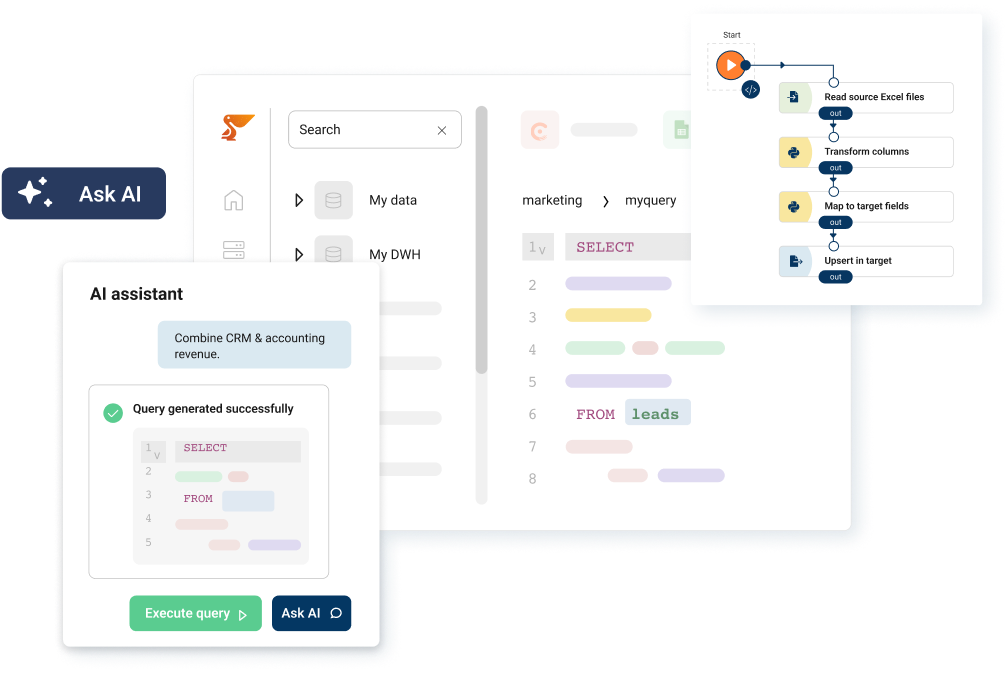
While Workato is a general-purpose iPaaS that treats every workflow the same, Peliqan is purpose-built for the subset of integration work that revolves around data: moving data between SaaS apps and a warehouse, transforming it with SQL or low-code Python, and pushing curated outputs back into business apps via reverse ETL. For teams whose Workato bill is mostly spent on data pipelines, customer 360 builds, and revops automation, Peliqan is a meaningfully better fit at a fraction of the cost.
The core advantage is the platform footprint. Where Workato sits as a pure orchestration layer that requires you to bring a warehouse, a transformation tool, and a reverse ETL solution separately, Peliqan bundles them. 250+ pre-built connectors spanning ERPs, CRMs, marketing tools, databases, and finance systems handle ingestion.
A built-in Postgres + Trino warehouse holds the data. SQL and low-code Python transformations clean and blend it. A native scheduler and event-driven triggers run the pipelines. And reverse ETL pushes the curated outputs back to HubSpot, Salesforce, Odoo, or wherever the operational team needs them.
Critically, Peliqan is positioned for the integration use cases Workato struggles with most. Federated SQL queries across multiple sources eliminate the manual joining that Workato recipes have to script step-by-step.
Automatic data lineage shows exactly which downstream apps consume each field. And data quality monitoring with Slack alerts catches the silent failures that Workato’s task-success model misses entirely.
Pricing is the other major differentiator. Where Workato starts at $15,000-$25,000/year with custom recipe-based billing, Peliqan starts at ~$199/month flat with a transparent published price list. SOC 2 Type II, ISO 27001, GDPR compliance, and EU hosting come standard. White-label and multi-customer management make it a strong fit for agencies and ERP consultants who need to deliver branded data integration to multiple clients – which Workato charges separately per customer for.
Real-world example: Ziggu
Ziggu built a plug-and-play data marketplace on Peliqan to offer turnkey integrations to their real estate customers – replacing what would have required either a custom Workato deployment per customer or 6-12 months of internal integration engineering. The result: 200+ hours saved per integration and a productized integration offering they can scale without a corresponding linear increase in engineering cost.
Key features:
- 250+ data-focused connectors (ERP, CRM, finance, marketing, databases) with a 48-hour custom connector SLA
- Built-in managed warehouse (Postgres + Trino) – no separate Snowflake or BigQuery contract
- SQL + low-code Python transformations, native scheduler, event triggers, reverse ETL
- Federated queries via Trino; automatic data lineage and semantic models
- White-label, multi-tenant, on-prem connectivity; built-in AI agent layer with MCP server
- SOC 2 Type II, ISO 27001, GDPR, EU-hosted
- Transparent fixed pricing from ~$199/month
Best for: Teams that use Workato primarily for data movement, customer 360 builds, revops, or warehouse-centric integration who want to collapse the orchestrator + warehouse + transformation + reverse ETL stack into one platform at predictable cost.
2. Zapier
Zapier is the antithesis of Workato in almost every dimension. Where Workato is built for IT teams to govern enterprise integrations, Zapier is built for business users to deploy their own automations in minutes. With 8,000+ app connectors (the largest library in this category by a wide margin), task-based transparent pricing, and a 4.5/5 G2 rating from over 6,000 reviewers, Zapier has become the default automation tool for anyone who is not an integration specialist.
Pricing is task-based and predictable: Free (100 tasks/month), Starter at $19.99/month (750 tasks), Professional at $49/month (2,000 tasks with multi-step Zaps), Team at $69.50/user/month, and Company at custom pricing from ~$103.50/user/month. The trade-off is governance: Zapier connectors are community-managed, premium app connectors require paid plans, and enterprise controls (RBAC, audit, SSO) only show up at the Company tier. For revops and marketing teams that want to skip the IT queue, Zapier is genuinely the right answer at a tiny fraction of Workato’s cost.
Key features:
- 8,000+ app connectors (largest library in category)
- Transparent task-based pricing from $0 to ~$1,000+/month
- AI Copilot for natural-language Zap creation
- Designed for business users, not IT teams
Best for: Business teams (sales, marketing, HR, ops) that want to ship automations themselves without involving IT or paying enterprise iPaaS rates.
3. Make
Make (formerly Integromat, now owned by Celonis) sits between Zapier’s simplicity and Workato’s enterprise depth. The visual scenario builder uses a drag-and-drop canvas with routers, filters, iterators, aggregators, and error handling that give Make significantly more flexibility for complex multi-step automations than Zapier – while keeping pricing dramatically lower than Workato.
Pricing starts at $9/month for the Core plan (10,000 credits, unlimited active scenarios), $16/month Pro (full-text execution log search, custom variables), $29/month Teams (multi-user collaboration), and custom Enterprise tiers. With 3,000+ pre-built app integrations, an HTTP module for any REST API, Make AI Agents and the Maia AI builder, plus SOC 2 Type II and GDPR compliance, Make has closed most of the governance gap with Workato for mid-market teams. The watch-out: operation-based pricing scales unpredictably for high-volume, complex workflows.
Key features:
- 3,000+ integrations with visual drag-and-drop scenario builder
- Advanced flow control: routers, iterators, aggregators, error handling
- Make AI Agents and Maia AI builder for natural-language automation
- Transparent pricing from $9/month, SOC 2 Type II compliant
Best for: Mid-market teams that need more flexibility than Zapier for complex scenarios but want to skip Workato’s enterprise pricing.
4. MuleSoft Anypoint Platform
MuleSoft Anypoint Platform is the heavyweight enterprise iPaaS, acquired by Salesforce in 2018 for $6.5B and built for the largest organizations running hundreds of integrated systems. Where Workato leads on time-to-value for mid-complexity automations, MuleSoft leads on API management, large-scale data integration, and centralized governance at the Fortune 500 level. If you have a chief integration officer, MuleSoft is probably already on your shortlist.
Pricing is capacity-based, opaque, and expensive: the median customer pays $55,150/year per Vendr data, with annual contracts ranging from low five figures for small deployments to $150,000+/month for the largest enterprise installs. The recently launched entry SKU is more affordable than ever, but MuleSoft remains the wrong answer for any team that does not have a dedicated integration practice. For Salesforce-heavy shops with complex API governance needs, the integration with the rest of the Salesforce stack is genuinely best-in-class.
Key features:
- Best-in-class API management, governance, and design-first development
- Deep Salesforce integration (Sales Cloud, Service Cloud, Data Cloud)
- Capacity-based pricing on Mule Flows and Mule Messages
- Enterprise-grade security, compliance, and multi-region deployment
Best for: Large enterprises with dedicated integration teams, complex API management needs, and existing Salesforce footprint.
5. Boomi
Boomi is a 12-time Gartner Magic Quadrant Leader for iPaaS and one of the earliest cloud integration platforms on the market. With 1,500+ application and technology connectors, support for application integration, data integration, API management, and EDI across cloud and on-prem, Boomi covers a similar feature surface to Workato with a more developer-leaning posture. Boomi recently launched an AI agent management platform that already has 75,000+ agents in production.
Pricing structure: Pay-as-you-go at $99/month plus usage is publicly listed. Professional starts around $550/month for up to 5 connections. Enterprise typically lands at $1,200/month minimum and scales to mid-six-figures annually for large deployments. G2 rating is 4.4/5 across 466 reviews. The platform is operationally heavier than Workato but more flexible for complex hybrid cloud + on-prem deployments.
Key features:
- 1,500+ connectors covering app, data, API, and EDI integration
- AI agent management platform with 75,000+ agents in production
- Hybrid cloud + on-prem deployment via Atom architecture
- Pay-as-you-go at $99/month plus usage; Enterprise from $1,200/month
Best for: Mid-market and enterprise teams with hybrid cloud + on-prem needs and a more technical integration practice than typical Workato customers.
6. Tray.ai
Tray.ai sits between lightweight automation and heavyweight iPaaS, with mid-market and enterprise teams using it to wire up back-office systems with more flexibility than Workato. The platform offers enterprise-grade power but with a developer-friendly visual workflow builder and 600+ connectors. The 2024 rebrand to Tray.ai signaled a push into AI-native integration with the Merlin AI agent platform.
Pricing: Pro at $595/month (250,000 starter task credits, 3 workspaces), Team and Enterprise tiers with custom pricing (500,000+ credits, more workspaces, advanced security). G2 rating is 4.5/5 across 157 reviews, with Gartner Peer Insights at 4.5/5 from 165+ ratings. The value metric is the task – similar to Workato’s recipe model – but more transparent. For teams that find Workato too IT-heavy but need more than Zapier or Make, Tray.ai is the closest direct competitor.
Key features:
- 600+ connectors with developer-friendly visual builder
- Merlin AI agent platform for AI-native integration
- Tiered task-based pricing from $595/month
- Mid-market and enterprise focus with strong governance
Best for: Mid-market and enterprise teams that want enterprise iPaaS depth without Workato’s IT-only posture.
7. Celigo
Celigo is a 2025 Gartner Peer Insights Customers’ Choice for iPaaS, consistently ranked #1 on G2 for multiple consecutive quarters. The platform’s differentiator is the Integration App: pre-built, pre-configured integration packages for common SaaS combinations (NetSuite + Salesforce, Shopify + NetSuite, HubSpot + Salesforce) that ship as turnkey products rather than DIY recipes. For teams running standard SaaS pairings, Celigo can be live in days versus Workato’s typical weeks-to-months.
Pricing structure: Free Edition (2 Endpoints), Professional (5 Endpoints, 4 Integration Apps, 100 flows), Premium (10 Endpoints, 9 Integration Apps, unlimited flows), Enterprise (20 Endpoints, 19 Integration Apps). Pricing starts around $1,000/month and scales based on Endpoints and Integration Apps. Celigo’s NetSuite and Shopify expertise is particularly strong – if you are running either, it should be on your shortlist.
Key features:
- Pre-built Integration Apps for common SaaS combinations (NetSuite, Shopify, Salesforce, HubSpot)
- Free Edition for 2 endpoints; paid plans from ~$1,000/month
- Strong B2B EDI and trading partner management
- 2025 Gartner Customers’ Choice for iPaaS
Best for: Mid-market teams running standard SaaS combinations (especially NetSuite, Shopify, Salesforce) who want pre-built integration apps rather than DIY recipes.
8. SnapLogic
SnapLogic Intelligent Integration Platform (IIP) is the leader in AI-led integration, with 700+ pre-built “Snaps” (connectors) and a strong focus on generative integration patterns. The Iris AI assistant suggests integration designs based on natural-language descriptions, and the platform handles application integration, data integration, B2B integration, and API management from a single canvas.
Pricing starts at approximately $1,000/month per user and scales based on data volumes, snap nodes, and feature tiers. SnapLogic is positioned for enterprises that want an AI-first integration approach without the price tag of MuleSoft – though both real-world pricing and feature parity for the most complex workloads still favor MuleSoft for the largest deployments.
Key features:
- 700+ Snaps with AI-led integration via Iris assistant
- Application, data, B2B, and API integration on one canvas
- Enterprise pricing typically $1,000/month minimum scaling on volume
- Strong focus on generative integration patterns
Best for: Enterprises that want AI-first integration without MuleSoft pricing or complexity.
9. n8n
n8n is the open-source workflow automation platform that has emerged as the developer favorite among Workato alternatives. The self-hosted Community Edition is free forever with unlimited executions – which makes n8n potentially 10-20x cheaper than Workato for complex multi-step workflows. n8n Cloud handles infrastructure for teams that prefer SaaS: €24/month Starter, €60/month Pro, €800/month Business.
The platform supports 500+ integrations, custom Python and JavaScript code blocks, AI agent nodes, and a visual workflow builder that genuinely competes with Workato on flexibility. The trade-off: self-hosting means you take on the operational burden (servers, backups, SSL, version updates), and the AI features are less mature than Workato’s. For technically capable teams – especially those wary of vendor lock-in – n8n is the most compelling open-source alternative on this list.
Key features:
- Open-source self-hosted edition (free, unlimited executions)
- 500+ integrations plus custom Python and JavaScript code nodes
- n8n Cloud from €24/month for managed SaaS
- AI agent nodes and natural-language workflow building
Best for: Technical teams that want open-source control, want to avoid vendor lock-in, or have high-volume automation needs where Workato’s recipe-based pricing becomes prohibitive.
10. Microsoft Power Automate
Microsoft Power Automate is the end-to-end automation platform built into the Microsoft Power Platform. It covers cloud flows, desktop flows (RPA), business process flows, and AI Builder for intelligent document processing. For organizations already on Microsoft 365, Dynamics 365, or Azure, Power Automate is included with relevant enterprise SKUs and integrates natively with everything in the Microsoft ecosystem.
The platform is used by enterprises like Uber, Aon, and Komatsu for large-scale process automation. Pricing for standalone use ranges from $15/user/month (Premium) to $150/user/month (Process) plus AI add-ons. The trade-off: Power Automate is most valuable inside the Microsoft stack and less natural for heterogeneous environments where Salesforce, NetSuite, or HubSpot are the systems of record. If you are not already a Microsoft shop, Workato is usually a better fit.
Key features:
- End-to-end automation: cloud flows, desktop RPA, business process flows
- AI Builder for intelligent document processing
- Native integration with Microsoft 365, Dynamics 365, Azure
- Standalone pricing from $15/user/month; bundled with M365/D365 SKUs
Best for: Microsoft-stack enterprises that want automation tightly integrated with M365, Dynamics 365, and Azure.
11. Jitterbit
Jitterbit is the iPaaS that evolved from an on-premises integration tool into a broader cloud offering including API integration, EDI, and citizen integrator capabilities. It is commonly used by mid-market and enterprise organizations for ERP and CRM integration (especially Salesforce, NetSuite, and SAP), data synchronization, and exposing APIs. The platform offers Harmony for general iPaaS and Vinyl for low-code app development.
Pricing starts at approximately $1,000/month for 1-10 users on the entry tier. Enterprise contracts typically run in the mid-five to six figures annually. Jitterbit’s strength is technical integration expertise around ERPs – if you have a complex NetSuite, SAP, or Microsoft Dynamics deployment, Jitterbit is a credible alternative to Workato at lower entry pricing.
Key features:
- Strong ERP integration heritage (NetSuite, SAP, Microsoft Dynamics)
- Harmony iPaaS plus Vinyl low-code app development
- API integration, EDI, and citizen integrator capabilities
- Entry pricing around $1,000/month, scaling on volume
Best for: Mid-market teams with complex ERP integration needs (NetSuite, SAP, Dynamics) who want technical depth at lower entry pricing than Workato.
Feature comparison table
Quick reference across the 11 Workato alternatives. Use this to shortlist before booking demos. Numbers reflect publicly published pricing and product documentation as of May 2026.
How the iPaaS category is evolving in 2026
Three structural shifts are reshaping the iPaaS category this year, and all three are pulling teams away from classic Workato-style platforms.
First, AI agents and MCP are eating the integration layer. Workato, Tray.ai, Make, Boomi, Peliqan, and n8n have all shipped AI agent capabilities or MCP servers in the last six months. The platforms that paired AI agents with real data integration and writeback are pulling ahead – read-only chat over integration metadata is no longer differentiated. Workato’s AI copilot is genuinely strong, but the rate of progress at smaller competitors has compressed the lead.
Second, the data integration use case is being decisively unbundled from general iPaaS. Teams that bought Workato to move data between SaaS apps and a warehouse are increasingly realizing that purpose-built data platforms – with built-in warehouses, transformation layers, reverse ETL, and ELT-native pricing – do the data subset of iPaaS work better and cheaper than Workato. The general iPaaS category still owns process automation; data integration is splitting out.
Third, transparent pricing is becoming a real competitive vector. Workato, MuleSoft, Boomi, SnapLogic, and Jitterbit all keep pricing opaque and force a sales-led motion. Make, Zapier, n8n, and Peliqan publish prices openly and run product-led-growth motions. The transparent-pricing camp is winning the mid-market segment Workato historically dominated.
Decision framework: choosing the right Workato alternative
Most decisions in this category boil down to four variables: what you primarily integrate (data vs. business process), how technical your team is, what cloud or ecosystem you live in, and how much governance overhead you can absorb. Map your situation to the right shortlist below.
Quick decision guide
- Using Workato primarily for data integration, customer 360, or revops: Peliqan (built for data, ~$199/mo flat)
- Business users wanting to ship automations without IT involvement: Zapier
- Mid-market needing more flexibility than Zapier at lower price than Workato: Make
- Large enterprise with API governance and Salesforce footprint: MuleSoft
- Hybrid cloud + on-prem mid-market with EDI requirements: Boomi
- Mid-market wanting enterprise iPaaS depth without IT-only posture: Tray.ai
- Running standard SaaS combinations (NetSuite + Shopify + Salesforce): Celigo
- Wanting AI-first enterprise integration without MuleSoft pricing: SnapLogic
- Open-source, vendor-lock-in-averse, technically capable team: n8n
- Microsoft-stack enterprise (M365, Dynamics 365, Azure): Power Automate
- Mid-market with complex ERP integration (NetSuite, SAP, Dynamics): Jitterbit
The pattern worth noticing: Workato is genuinely the best answer for a narrow band of large IT-led teams running 50+ enterprise integrations with strict governance requirements. Outside that band, almost every team would be better served by something else – the question is which something else, not whether to consider alternatives at all.
Migration considerations: moving off Workato in practice
Migrating off Workato is harder than migrating off most SaaS tools because the recipes you have built are proprietary to the platform. There is no clean export path. Plan for a 6-12 month phased migration if you have more than 50 recipes in production.
Start by auditing what your recipes actually do. Most teams find that 30-50% of their Workato recipes are data movement (extract from source -> load to warehouse, sync customers between SaaS systems, push curated audiences to ad platforms). This subset migrates cleanly to Peliqan or a similar low-code integration platform and often becomes 5-10 well-modeled pipelines rather than 30+ separate recipes. The remaining 50-70% is true process orchestration, where the choice between Zapier, Make, Tray.ai, Boomi, or n8n depends on technical depth and governance needs.
Watch out for hidden Workato dependencies: lookup tables stored in Workato’s data store, recipe-to-recipe call chains, and proprietary connector configurations that do not translate cleanly. Budget 2-3x the time you initially estimate. Run the new platform in parallel with Workato for 60-90 days before cutting over, and use the migration window to delete the 20-30% of recipes that nobody has touched in 18 months.
Conclusion
Workato remains a credible iPaaS for the largest IT-led integration teams, and the 4.7/5 G2 rating and eight-time Gartner Leader recognition are not noise. For that narrow band of customers, staying on Workato is probably the right call. But for the much larger population using Workato as a general-purpose integration tool at $20,000-$120,000/year, the alternatives in this guide are not just acceptable replacements – they are categorically better fits at a fraction of the cost.
Peliqan stands out for teams that primarily use Workato for data integration. With 250+ connectors, a built-in Postgres + Trino warehouse, SQL and low-code Python transformations, reverse ETL, white-label multi-tenant management, and EU-hosted SOC 2 + ISO 27001 compliance for ~$199/month flat, it replaces what would otherwise be Workato plus a warehouse contract plus a transformation tool plus reverse ETL with a single platform. Zapier and Make dominate the business-user and mid-market automation categories. MuleSoft, Boomi, Celigo, and SnapLogic serve the enterprise iPaaS bucket. n8n leads the open-source camp. Power Automate is the right Microsoft-stack answer.
When evaluating Workato alternatives, audit what your existing recipes actually do, split the data integration work from the business process automation work, and pressure-test the alternative on a representative workload before committing. Most teams find the migration math pencils out at a much smaller scale than they expected.
Ready to see what a purpose-built data integration platform looks like compared to a general-purpose iPaaS? Try Peliqan free or book a demo to walk through your specific integration workload.