




CData is one of the best-known names in data connectivity, but driver-by-driver and product-by-product pricing, a developer-heavy learning curve, and manual maintenance for schema changes are pushing teams to evaluate CData alternatives. Here is a current comparison of the top CData alternatives and competitors for 2026.
CData has built its reputation on real-time connectivity, with 300+ data sources and more than 7,000 customers relying on its drivers and sync tooling. The product is rarely the problem on capability. What sends teams looking for alternatives is the shape of the platform: connectivity-first, priced per product, and built for developers rather than analysts or business teams.
This guide compares the top 10 CData alternatives across all-in-one platforms, enterprise ETL, cloud-native ELT, and open-source tooling, so you can match the right replacement to your connectivity needs, budget, and team. We start with Peliqan, the all-in-one data platform that fits teams using CData mainly to move and unify data rather than to ship raw driver connectivity into other applications.
What is CData?
CData Software, founded in 2016, specializes in data access and connectivity. Rather than a single product, it is a family of tools: CData Drivers provide ODBC, JDBC, and ADO.NET connectivity to hundreds of sources; CData Connect Cloud offers cloud data virtualization and live connectivity; CData Sync handles ETL/ELT replication and reverse ETL into databases and warehouses; CData API Server publishes data as REST APIs; CData Arc covers B2B, EDI, and managed file transfer; and the newer Connect AI provides live, governed access to enterprise data for AI without moving it off source systems.
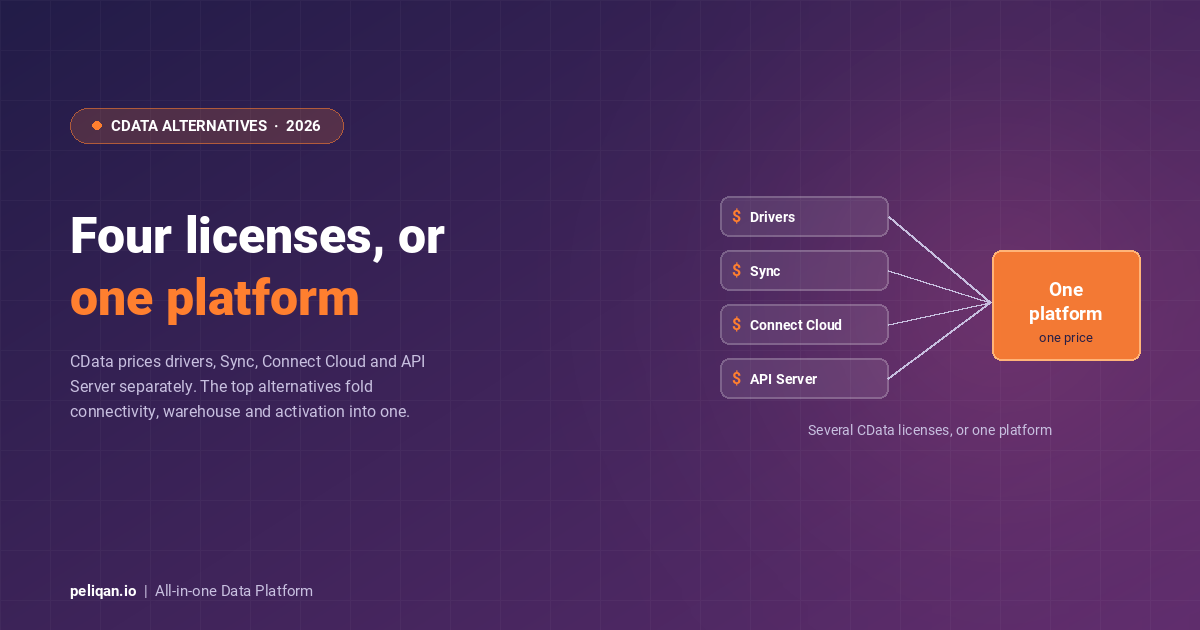
That breadth is also the catch. Each product is licensed separately, so a team that needs connectivity, replication, and API publishing ends up assembling and paying for several CData tools. CData Sync, for example, starts around $4,999/year for up to five connectors and 100 million rows per month, and the well-known 90-day custom-integration offer, while useful, is a long wait when a single missing source blocks a project.
Why consider CData alternatives?
CData is a strong fit for developers who want raw driver-level connectivity to embed in their own applications. For teams whose real goal is a clean, analytics-ready data stack, several friction points come up repeatedly.
Common reasons teams seek CData alternatives
- Per-product, per-connector pricing: drivers, Sync, Connect Cloud, and API Server are licensed separately, so total cost climbs as you add capabilities and sources.
- Developer-first learning curve: reviewers consistently flag complex setup and documentation that assumes technical expertise, which puts most work back on engineering.
- Manual maintenance: schema changes and error handling often need hands-on attention, where modern managed platforms automate schema drift.
- Connectivity, not a full stack: CData moves and exposes data well, but you still bring your own warehouse, transformation layer, BI, and orchestration.
- Performance on large or real-time workloads: some teams report slowdowns on very large datasets or high-frequency replication.
- Lock-in concerns: driver-level dependencies can be hard to unwind when you want to move to a modern, consolidated platform.
The top CData alternatives for 2026
1. Peliqan – all-in-one data platform
Peliqan is the strongest CData alternative for teams that want connectivity, a warehouse, transformation, BI, and reverse ETL in one platform rather than buying CData’s drivers, Sync, and Connect Cloud separately and wiring them together. Where CData is connectivity-first and prices each product on its own line, Peliqan consolidates the modern data stack into a single platform that business teams, data teams, and developers can all use.
Ingestion runs on 250+ pre-built connectors across SaaS apps, databases, ERPs, and finance systems, landing data in a built-in Postgres and Trino warehouse.
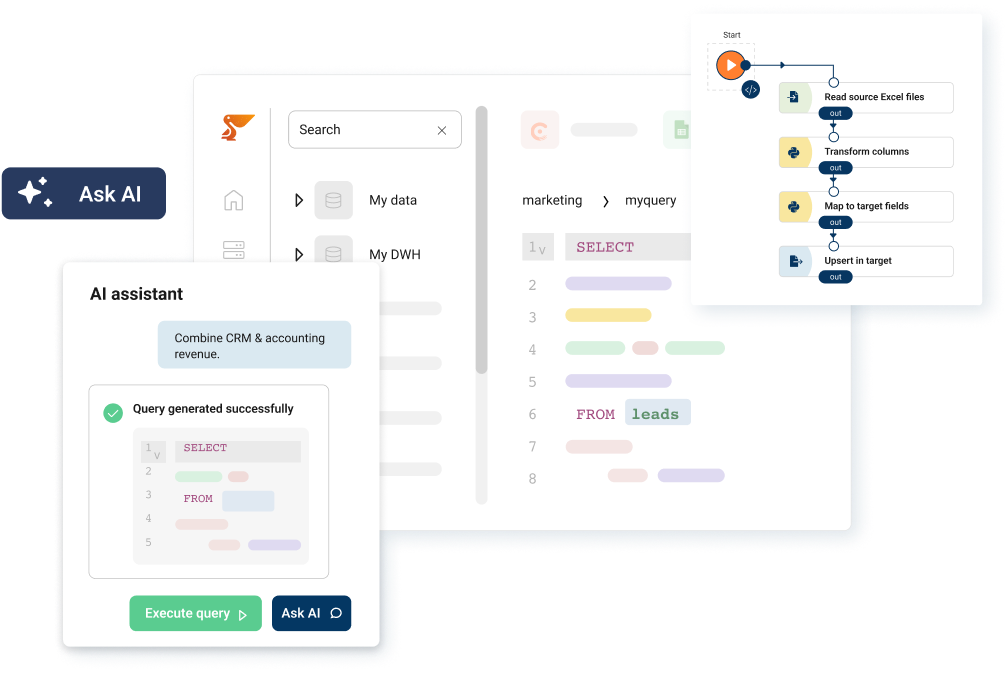
From there, SQL and low-code Python transformations clean and model the data, and AI-assisted “Magical SQL” helps write queries for users who do not live in SQL all day.
On the activation side, reverse ETL and API publishing push curated data back into the business apps and endpoints that consume it, covering the same outbound use cases teams reach for CData Sync and API Server to handle. A Trino-powered federated query engine runs live queries across multiple sources without first replicating everything into one place.
Pricing is transparent and fixed, published on the pricing page rather than assembled from separate per-product licenses, which makes budgeting predictable. The platform is SOC 2 Type II, ISO 27001, GDPR, HIPAA, and CCPA certified, EU-hosted on AWS Frankfurt, with role-based access and audit logging built in.
When a source is missing, Peliqan builds custom connectors within 2 weeks, a sharp contrast with CData’s 90-day custom-integration timeline, and white-label, multi-tenant deployment makes it a fit for agencies and consultants delivering branded data integration to multiple clients.
Real-world example: CIC Hospitality
CIC Hospitality unified data from 50+ sources into Peliqan and now saves 40+ hours per month by fully automating board reports that were previously assembled by hand, replacing what would otherwise be a stack of connectivity, warehouse, and reporting tools. Read the case studies.
Best for: organizations that want predictable costs, fast implementation, and one platform for connectivity, warehousing, transformation, BI, and reverse ETL instead of stitching together several CData products.
2. Informatica IICS
Informatica Intelligent Cloud Services is the cloud arm of Informatica’s Intelligent Data Management Cloud, acquired by Salesforce in late 2025, and is built for enterprise-grade integration with deep governance. It offers 600+ connectors across cloud and legacy systems, the CLAIRE AI engine for automation, integrated cataloging and lineage, and flexible hybrid deployment alongside PowerCenter.
It scales to the full data lifecycle with strong metadata management, but entry-level cost is high and implementation is complex, with IICS typically running $1,000-$5,000/month usage-based and PowerCenter starting around $50,000/year. Best for: large enterprises that need end-to-end integration across cloud and on-premise with deep metadata and governance, well beyond raw connectivity.
3. IBM DataStage
IBM DataStage, part of IBM Cloud Pak for Data, delivers high-performance ETL with a parallel processing engine, strong mainframe and z/OS support, and integration with IBM Watson and Db2. It is a battle-tested choice for regulated industries and IBM-centric stacks that need high-throughput, low-latency pipelines.
The trade-offs are a steep learning curve and high total cost of ownership, with pricing from roughly $35,000/year via Cloud Pak plus the DataStage license. On-premise and legacy connectivity is where it shines. Best for: companies with mainframes, legacy systems, or IBM-centric stacks that need enterprise-grade, high-volume ETL.
4. Fivetran
Fivetran is a fully managed ELT platform known for hands-off ingestion. It offers 700+ managed connectors, automatic schema evolution, a 99.9% uptime SLA, and reverse ETL, and integrates tightly with Snowflake, Redshift, BigQuery, and dbt. Following its completed 2026 merger with dbt Labs, it now spans both ingestion and transformation.
The catch is cost: usage-based Monthly Active Rows pricing scales quickly, commonly landing anywhere from $25,000 to $200,000/year, and there is no advanced pre-load transformation engine. If Fivetran is on your list, our Fivetran alternatives guide compares it in depth. Best for: cloud-native teams that want hands-off ingestion into a modern warehouse and can absorb volume-based pricing.
5. Airbyte
Airbyte is an open-source data integration platform with one of the largest connector catalogs in the industry, a connector builder for custom sources, and modular self-hosted or cloud deployment. Its open-source option removes vendor lock-in and appeals to developer-heavy teams that want maximum customization.
The trade-off is operational: self-hosting requires technical setup, and the monitoring tooling is still maturing. Pricing is free for open-source, credit-based for Cloud, and custom for Enterprise. Best for: technical teams that prefer open-source flexibility and long-tail connectors over a fully managed experience.
6. Matillion
Matillion is a cloud-native ETL/ELT platform purpose-built for modern warehouses like Snowflake, Redshift, and Databricks. Its visual drag-and-drop builder supports SQL and Python transformations and uses pushdown architecture to run transformations inside the warehouse for performance.
It is optimized for cloud warehouse performance and works for analysts and engineers alike, though its credit-based pricing can be complex and the interface feels heavy for simple jobs. Best for: cloud-first teams running large-scale transformations who want visual design and warehouse pushdown.
7. Apache Airflow
Apache Airflow is the leading open-source orchestration tool, giving engineering teams full control over complex workflows through Python-based DAGs, an extensive operator library, and a large ecosystem. There are no licensing costs, and managed options are available via Astronomer, Google, and AWS.
It is highly customizable but carries a high setup and maintenance burden and assumes Python and DevOps skills. Airflow orchestrates pipelines rather than providing connectivity itself, so it is usually paired with ingestion tools. Best for: data engineering teams that need advanced orchestration logic and are comfortable owning the infrastructure.
8. MuleSoft Anypoint Platform
MuleSoft Anypoint Platform is a complete API integration platform with full API lifecycle management, high availability, deep Salesforce integration, and enterprise governance. It is the heavyweight choice for API-led architecture, especially in Salesforce-native organizations and regulated industries.
Pricing is subscription-based with custom enterprise quotes, and it can be overkill and expensive for simple ETL/ELT tasks.
For a broader look at this category, our MuleSoft alternatives guide goes deeper. Best for: large organizations that need strong API-led integration and centralized governance.
9. Workato
Workato is a leading iPaaS offering recipe-based automation accessible to both business users and IT, with a visual builder, real-time triggers, AI-assisted suggestions, governance and RBAC, and support for over a thousand applications. It delivers fast time-to-value for cross-functional workflow automation.
It can become costly as workflows scale and offers less low-level control for deeply technical use cases, with pricing starting around $15,000-$25,000/year. Our Workato alternatives guide compares the field. Best for: mid-market and enterprise teams automating cross-functional workflows without deep technical resources.
10. Rivery
Rivery is a SaaS data platform combining ELT, orchestration, and reverse ETL with credit-based, pay-as-you-go pricing and no per-connector fees. It offers change data capture for real-time pipelines, a custom API builder, Python scripting, and a unified UI for ingestion, orchestration, and data ops.
The interface can feel heavy for simple use cases and community support is thinner than the larger players, with credit-based pricing from roughly $0.75 to $1.25 per credit. Best for: API-heavy workflows and teams that want cost control across ingestion, transformation, and activation in one tool.
CData alternatives compared
A quick side-by-side of the top CData alternatives on focus, strengths, pricing model, and limitations. Confirm current pricing with each vendor before deciding.
How to choose the right CData alternative
Start with what you actually use CData for. If it is raw driver connectivity embedded in other applications, your shortlist looks different than if you are using CData Sync to populate a warehouse. Map your primary use case to the right pick below.
Quick decision guide
- One platform for connectivity, warehouse, transform, BI, and reverse ETL: Peliqan
- Enterprise governance and metadata at scale: Informatica IICS
- Mainframe, legacy, and IBM-centric high-volume ETL: IBM DataStage
- Hands-off managed ingestion into Snowflake or BigQuery: Fivetran
- Open-source, long-tail connectors, no lock-in: Airbyte
- Visual ELT with warehouse pushdown: Matillion
- Python-native orchestration of complex workflows: Apache Airflow
- API-led integration and Salesforce ecosystems: MuleSoft
- Business-user workflow automation: Workato
- Credit-based ELT with CDC and reverse ETL: Rivery
Moving off CData in practice
Because CData is a family of products rather than one tool, the first migration step is an inventory: list which CData products you actually run and what each one does. Most teams find the footprint splits into three buckets, and each maps to a different part of a modern platform.
Driver-level connectivity (ODBC, JDBC, ADO.NET) embedded in BI tools or applications is the hardest to replace one-for-one, since some downstream tools expect a live driver; here, a federated query engine that exposes governed data to those tools is the cleaner long-term path. CData Sync replication jobs map directly to a managed connector and warehouse, and usually collapse from many separate sync configurations into a handful of well-modeled pipelines. CData API Server endpoints map to built-in API publishing and reverse ETL.
Run the new platform in parallel with CData for a few weeks on a representative workload before cutting over, validate row counts and schema handling against the existing jobs, and retire CData products one bucket at a time rather than all at once. Most teams find the consolidated platform replaces three or four separate CData licenses with a single predictable subscription.
Conclusion
CData remains a capable connectivity layer, especially for developers who need driver-level access to embed in their own applications. But for teams whose real goal is an analytics-ready data stack, paying per product and maintaining driver-level plumbing is more overhead than the job requires. Peliqan leads for organizations that want connectivity, a warehouse, transformation, BI, and reverse ETL in one platform with transparent, fixed pricing and a 2-week custom connector SLA.
Beyond that, Fivetran and Matillion suit cloud-native ELT, Airbyte and Apache Airflow serve open-source and engineering-led teams, Informatica and IBM DataStage cover enterprise governance and legacy ETL, and Workato and MuleSoft handle workflow automation and API-led integration. The right choice comes down to your connectivity needs, budget, and how much of the stack you want to own yourself. For most teams replacing CData, an all-in-one platform like Peliqan removes the most moving parts.