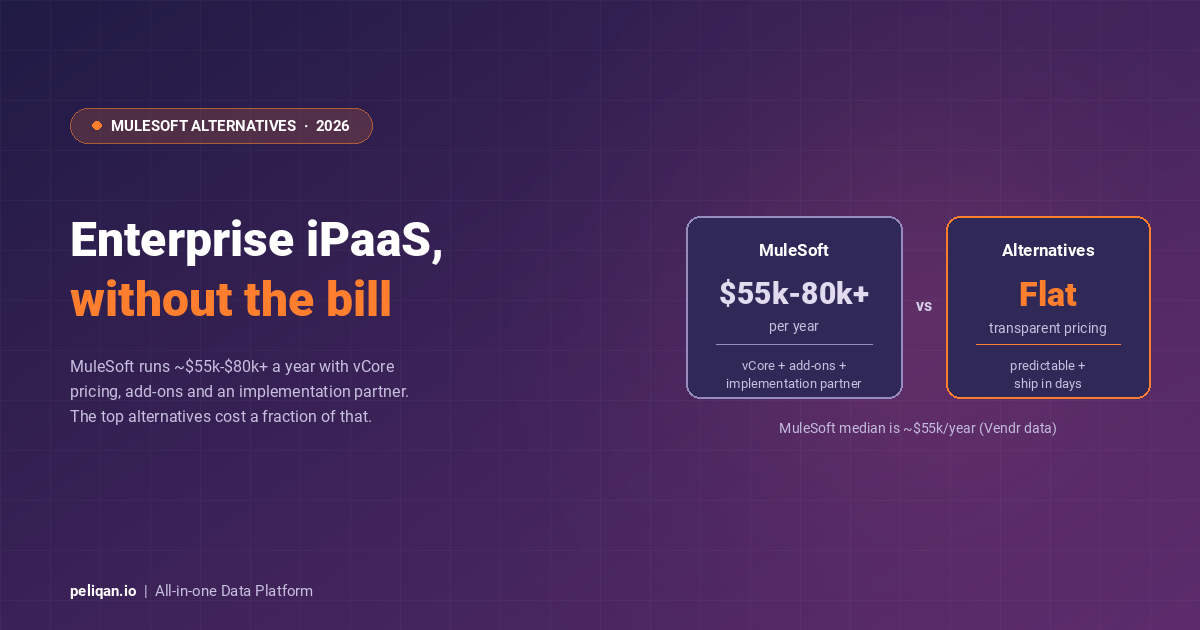





MuleSoft Anypoint Platform is the gold standard for enterprise API management – but $55,000+ median contracts, vCore-based pricing surprises, a steep learning curve that often requires an implementation partner, and growing concerns about Salesforce vendor lock-in are pushing teams to evaluate MuleSoft alternatives. Here is a complete comparison of the top MuleSoft alternatives and competitors for 2026.
MuleSoft Anypoint Platform was acquired by Salesforce in 2018 for $6.5 billion and remains a 12-time Gartner Magic Quadrant Leader for iPaaS. The platform combines API design and management, application integration, ETL, B2B integration, and event-driven architecture into a single product that is genuinely best-in-class for the largest enterprise deployments. If you have a dedicated integration team of 5-20 engineers running hundreds of governed APIs across Salesforce, SAP, Workday, and dozens of other systems, MuleSoft is rarely the wrong answer.
The problem is that this profile fits a small fraction of the teams currently paying for MuleSoft. The median Anypoint customer pays $55,150/year per Vendr data, with entry pricing around $80,000/year and large enterprise deals running well into seven figures. The vCore-based pricing model penalizes non-production environments, the Mule application architecture creates real vendor lock-in, and the learning curve is so steep that most successful deployments rely on a $200-$500/hour implementation partner for the first 6-12 months.
This guide compares the 11 best MuleSoft alternatives across three categories – data-first integration platforms, modern iPaaS, and dedicated API management tools – so you can pick the right replacement for your team’s actual scope, budget, and technical depth. We start with Peliqan, the all-in-one data platform that replaces MuleSoft for the large subset of customers using Anypoint primarily for data integration and warehouse-centric workflows rather than enterprise API governance.
MuleSoft Anypoint: platform overview and why teams look for alternatives
MuleSoft was founded in 2006, went public in 2017, and was acquired by Salesforce a year later. The Anypoint Platform combines Anypoint Studio (the developer IDE), CloudHub (the managed runtime), API Manager (governance and lifecycle), Flex Gateway (the modern API gateway), Exchange (the reusable asset catalog), and the new Anypoint AI Agent capabilities into a unified enterprise integration stack. With 250+ certified connectors, deep Salesforce integration, and a mature ecosystem of trained MuleSoft developers, the platform powers integration backbones at most Fortune 500 companies.
The platform sits firmly in the enterprise-IT-led bucket. Anypoint is designed around the API-led connectivity model that assumes you have a multi-year integration strategy, a dedicated platform team, and a tolerance for a Mule-flavored development workflow. Building a single API on Anypoint is a multi-step process: design in API Designer, mock in Exchange, develop in Anypoint Studio, deploy to CloudHub, govern in API Manager, monitor in Anypoint Monitoring. That rigor is genuinely valuable at scale, and genuinely overkill for the median team.
Why teams move off MuleSoft in 2026
- Median pricing of $55k/year, entry around $80k/year: MuleSoft is one of the most expensive iPaaS platforms on the market. vCore-based pricing scales aggressively with non-production environments, and add-on capabilities (Flex Gateway, advanced security, AI agents) stack on top of the base subscription.
- Steep learning curve that demands an implementation partner: most successful Anypoint deployments rely on a paid implementation partner for the first 6-12 months. Without one, mid-market teams routinely under-deliver on their initial business case.
- Designed for IT, not business users: despite low-code claims, building real Anypoint integrations requires MuleSoft-specific expertise. Revops, marketing ops, and finance teams cannot meaningfully contribute without an integration developer in the loop.
- Salesforce vendor lock-in concerns: since the 2018 acquisition, the MuleSoft roadmap has tilted increasingly toward Salesforce-centric integrations, and non-Salesforce shops question anchoring their integration platform to a Salesforce-owned product.
- Feature overhead for mid-sized projects: the platform bundles a full enterprise stack (API design, governance, monitoring, B2B, EDI, MDM) that mid-market teams routinely pay for but never use.
- Slow time-to-value: even with the AI assistant, building a production-grade API on Anypoint typically takes weeks. Modern alternatives ship the same workflow in days, and AI-native platforms can produce a working draft in hours.
None of these are deal-breakers for the largest enterprise IT teams running hundreds of governed APIs across global business units. But they are decisive for the much larger population of teams that bought MuleSoft because it was the “safe” choice and now find themselves paying enterprise iPaaS rates for use cases that simpler platforms handle better. The alternatives below give you a real choice across the price-complexity-capability spectrum.
The top MuleSoft alternatives for 2026
The 11 platforms below were selected based on SERP ranking data, G2 review volume, and direct feature overlap with MuleSoft Anypoint’s scope. Each section covers what the tool does, how it differs from MuleSoft specifically, current pricing, and the team profile it fits best.
1. Peliqan
MuleSoft was built for enterprise IT teams that need to expose, govern, and monitor APIs across hundreds of systems. Peliqan was built for the opposite end of the spectrum: data and operations teams that need to move, transform, and activate data without standing up a multi-quarter Anypoint implementation. For the substantial subset of MuleSoft customers using Anypoint primarily for data integration, warehouse loading, customer 360 builds, or revops sync flows, Peliqan replaces a six-figure MuleSoft contract with a transparent, fixed-price platform that ships in days.
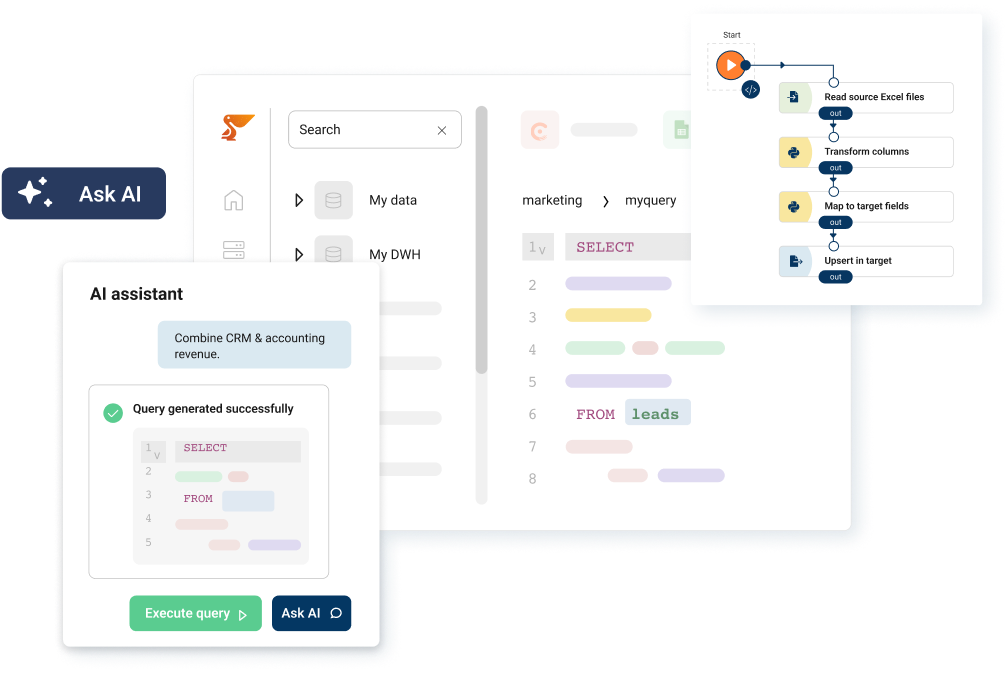
The structural difference is the platform footprint. Where MuleSoft is a pure integration layer that assumes you bring a warehouse, a transformation tool, an analytics stack, and a reverse ETL solution separately, Peliqan bundles them. 250+ pre-built connectors spanning ERPs, CRMs, finance systems, marketing tools, and databases handle ingestion. A built-in Postgres and Trino warehouse holds the data, eliminating the separate Snowflake or BigQuery contract that most MuleSoft deployments require.
SQL and low-code Python transformations clean and blend the data without DataWeave-style learning curves, and federated SQL queries across multiple sources eliminate the manual joining that Anypoint flows have to script step by step. A native scheduler and event-driven triggers run the pipelines, and reverse ETL pushes the curated outputs back to HubSpot, Salesforce, Odoo, NetSuite, or wherever the operational team needs them, the use case Anypoint customers most often build custom Mule flows for.
For teams that need real API publishing, Peliqan also publishes REST and webhook APIs directly from any pipeline or data model. It is not a replacement for MuleSoft API Manager at the Fortune 500 governance level, but for the much larger population of teams that need to expose a few dozen well-modeled APIs over their data, it covers the use case at a fraction of the cost.
SOC 2 Type II, ISO 27001, GDPR, HIPAA, and CCPA compliance, EU hosting on AWS Frankfurt, white-label and multi-customer management are all included in the base price.
Real-world example: Globis
Globis replaced what would have been a custom MuleSoft-style integration project with Peliqan, consolidating real-time API feeds, container arrival data, and ML predictions into one operational data layer. The result: production ML predictions and live operational dashboards in weeks, not the 6-12 months a comparable MuleSoft deployment would have required. Read more case studies.
Key features:
- 250+ data-focused connectors (ERP, CRM, finance, marketing, databases) with a 2-week custom connector SLA
- Built-in managed warehouse (Postgres + Trino), no separate Snowflake or BigQuery contract
- SQL and low-code Python transformations, native scheduler, event triggers, reverse ETL
- Publish REST and webhook APIs directly from pipelines and data models
- Federated queries via Trino; automatic data lineage and semantic models
- White-label, multi-tenant, on-prem connectivity; built-in AI agent layer with MCP server
- SOC 2 Type II, ISO 27001, GDPR, HIPAA, CCPA, EU-hosted on AWS Frankfurt
- Transparent, fixed monthly pricing on the pricing page
Best for: teams currently using MuleSoft primarily for data integration, customer 360, revops sync, or warehouse-centric workflows who want to collapse the integration, warehouse, transformation, and reverse ETL stack into one predictable-cost platform.
2. Boomi
Boomi is the closest direct competitor to MuleSoft at the enterprise iPaaS level, with 1,500+ application and technology connectors, full coverage of application integration, data integration, API management, EDI, and master data management, and a 12-time Gartner Magic Quadrant Leader recognition that matches MuleSoft’s. The platform recently launched an AI agent management capability that already has 75,000+ agents in production, and customers consistently rate it as friendlier to mid-market teams than MuleSoft.
Pricing is meaningfully more accessible than MuleSoft: pay-as-you-go starts at $99/month plus usage, Professional around $550/month for up to five connections, and Enterprise typically begins at $1,200/month and scales to mid-six figures, still expensive but typically 30-50% cheaper than the equivalent MuleSoft contract. The hybrid Atom architecture supports cloud, on-prem, and edge deployments, which makes Boomi a natural fit for regulated industries and hybrid environments. Best for: mid-market and enterprise teams that need MuleSoft-level scope but want a friendlier, less expensive platform with strong hybrid deployment options.
3. Workato
Workato is the AI-first iPaaS that has emerged as the strongest mid-market and enterprise alternative to MuleSoft for teams prioritizing speed of automation over deep API governance. With 14,000+ pre-built connectors, an AI copilot for natural-language recipe building, and a 4.7/5 G2 rating across 751+ reviews, Workato has become the default iPaaS for IT-business collaboration use cases.
The trade-offs versus MuleSoft are real: Workato is genuinely faster to value for simple-to-mid-complexity automations, but it does not match MuleSoft on API design-first development, full API lifecycle governance, or capacity-based pricing transparency at the largest deployments. Pricing typically lands at $15,000-$25,000/year entry, with mid-market deals at $40,000-$120,000/year, usually 30-40% cheaper than the equivalent MuleSoft contract for the same use cases. Our iPaaS tools guide covers the broader category. Best for: mid-market and enterprise teams that prioritize speed of automation and AI-powered building over MuleSoft’s deep API governance.
4. Celigo
Celigo is consistently ranked at the top of G2 for iPaaS and named a 2025 Gartner Peer Insights Customers’ Choice. Its standout differentiator versus MuleSoft is the Integration App: pre-built, pre-configured integration packages for common SaaS combinations (NetSuite plus Salesforce, Shopify plus NetSuite, HubSpot plus Salesforce) that ship as turnkey products rather than DIY API designs. For teams running standard SaaS pairings, Celigo can be live in days versus MuleSoft’s typical weeks to months.
Pricing runs from a Free Edition for two endpoints through Professional, Premium, and Enterprise tiers from approximately $1,000/month, scaling with endpoint count and Integration Apps. Celigo’s NetSuite expertise is particularly strong, and the platform also includes JavaScript scripting, Git-based version control, and universal API connectors for custom integrations beyond the pre-built apps. Best for: mid-market teams running standard SaaS combinations (especially NetSuite, Shopify, Salesforce) who want pre-built integration apps rather than custom API designs.
5. SnapLogic
SnapLogic’s Intelligent Integration Platform is the closest direct architectural competitor to MuleSoft, with a similar enterprise integration model but a meaningfully AI-first stance. The Iris AI assistant suggests integration designs from natural-language descriptions, and the 700+ “Snaps” cover application integration, data integration, B2B integration, and API management from a single unified canvas. SnapLogic markets itself as a leader in generative integration, and the AI-led positioning has resonated with mid-market and enterprise buyers.
Pricing typically begins at $48,000/year for mid-market deployments and $100,000/year for enterprise tiers, meaningfully cheaper than MuleSoft at the largest deployments but still firmly enterprise-priced. The trade-off versus MuleSoft: SnapLogic is faster to value and less developer-heavy, but its API management capabilities are less mature than Anypoint API Manager and its certified-developer ecosystem is smaller. Best for: enterprises that want AI-first integration with a similar feature surface to MuleSoft but at 40-50% lower total cost.
6. Apigee (Google Cloud)
If your primary MuleSoft use case is API management rather than general iPaaS, Apigee is the canonical alternative. Now part of Google Cloud, Apigee is a heavyweight API management platform with strong capabilities in API monetization, advanced analytics, developer and partner ecosystem management, and AI-enriched API governance. For organizations that have decoupled API management from general iPaaS, a common pattern at large enterprises, Apigee versus MuleSoft is the canonical head-to-head decision.
A 60-day evaluation is free, pay-as-you-go is $20 per million API calls, Standard is $500/month with 15M calls included, and Enterprise starts at $2,500/month and typically lands at $25,000-$100,000/year in practice. The newer Standard API Proxy operates at a fraction of the cost of the Extensible Proxy, which materially improves price-performance for high-volume programs. The trade-off: Apigee is pure API management with no application integration, ETL, or EDI, so you typically pair it with a separate iPaaS. Best for: organizations decoupling API management from iPaaS, especially those already on Google Cloud or running large external developer programs.
7. Tray.ai
Tray.ai sits between lightweight automation and heavyweight iPaaS, with mid-market and enterprise teams using it to wire up back-office systems with more flexibility than MuleSoft but more depth than Zapier or Make. The 2024 rebrand from Tray.io to Tray.ai signaled a push into AI-native integration via the Merlin AI agent platform, and the visual workflow builder, 600+ connectors, and developer-friendly architecture appeal to teams that find MuleSoft too IT-heavy but need real enterprise capability.
Pricing is meaningfully more accessible than MuleSoft, with Pro at $595/month (250,000 starter task credits, three workspaces) and Team and Enterprise tiers scaling up with custom pricing, alongside a 4.5/5 G2 rating across 157 reviews. The trade-offs versus MuleSoft: less mature API governance and a smaller developer ecosystem, but dramatically faster to deploy and significantly less expensive across all tiers. Best for: mid-market and enterprise teams that want enterprise iPaaS capability without MuleSoft’s IT-only posture or six-figure entry pricing.
8. Jitterbit
Jitterbit is the iPaaS that evolved from an on-premises integration tool into a broader cloud offering combining API integration, EDI, and citizen-integrator capabilities. It is commonly chosen by mid-market and enterprise teams with complex ERP integration needs, especially Salesforce, NetSuite, SAP, and Microsoft Dynamics deployments. The Harmony platform handles general iPaaS, Vinyl handles low-code app development, and the platform is consistently rated easier to learn than MuleSoft.
Pricing starts at roughly $1,000/month for entry tiers, with enterprise contracts typically running mid-five to six figures annually. The no-code and low-code ETL pipeline builders are meaningfully more accessible than DataWeave on MuleSoft. Best for: mid-market teams with complex ERP integration needs that do not require MuleSoft-level API governance.
9. IBM API Connect
IBM API Connect is the API management platform built into IBM’s broader integration stack alongside webMethods, App Connect, and DataPower. It offers full API lifecycle management with strong security, deep integration with IBM Cloud Pak for Integration, and a free production plan tier for limited use cases. For organizations already standardized on IBM infrastructure, especially regulated industries running on mainframes, AS/400s, or IBM Cloud, API Connect is often the path of least resistance versus introducing MuleSoft.
Pricing is not publicly listed and runs in the enterprise tier for production use. The platform is generally regarded as feature-rich but operationally heavy, with the same “needs an implementation partner” caveat that applies to MuleSoft, while the 2025 IBM AI Foundry integration adds AI-powered API governance that is closing the gap with Apigee and SnapLogic. Best for: IBM-standardized enterprises (especially regulated industries on mainframes or AS/400s) that want API management inside their existing IBM stack.
10. Azure API Management
Azure API Management is the API management platform built into Microsoft Azure, naturally paired with Logic Apps for application integration and Data Factory for ETL. For Microsoft-stack organizations, especially those on M365, Dynamics 365, or Azure Synapse, APIM is the path of least resistance versus standing up MuleSoft as a separate enterprise platform.
Pricing is tier-based: the Consumption tier is pay-per-call and scales to zero, Basic and Standard tiers offer fixed monthly pricing per environment, and the Premium tier supports multi-region and SLA-backed deployment. Each environment requires a separately billed APIM instance with provisioning times that can run 30+ minutes, a real operational watch-out, but for most Microsoft-stack teams APIM remains the natural choice over MuleSoft. Best for: Microsoft-stack enterprises that want API management tightly integrated with M365, Dynamics 365, and Azure.
11. Kong
Kong is the leading open-source API gateway and a fundamentally different architectural choice than MuleSoft. Where Anypoint is an enterprise platform with bundled developer tooling, runtime, and governance, Kong is a lightweight, cloud-native API gateway that you deploy and operate yourself, typically on Kubernetes. The platform powers API traffic at scale at companies like SoundCloud, Glassdoor, and Honeywell.
Kong Gateway is fully open source and free for self-hosted use, while Kong Konnect is the managed control plane with paid tiers for advanced governance, developer portal, and AI gateway capabilities. The trade-off versus MuleSoft is large: Kong is a primitive, not a finished product, so you bring your own integration layer, developer portal customization, and observability stack. Best for: platform engineering teams running Kubernetes-first infrastructure who want a lightweight, cloud-native API gateway and the option to avoid enterprise iPaaS lock-in.
Feature comparison table
Quick reference across the 11 MuleSoft alternatives. Use this to shortlist before booking demos. Numbers reflect publicly published pricing and product documentation as of 2026.
How the integration category is evolving in 2026
Three structural shifts are reshaping enterprise integration this year, and all three are pulling teams away from monolithic platforms like MuleSoft.
First, the unbundling of API management from iPaaS is accelerating. Teams that historically bought MuleSoft for its all-in-one promise are increasingly splitting the workload: Kong or Apigee for API gateway and developer portal, a modern iPaaS or data integration platform for application integration and ETL, and a separate purpose-built tool for B2B and EDI if needed. The unbundled stack typically costs 40-60% less than equivalent MuleSoft coverage and ships in weeks rather than quarters.
Second, AI agents and MCP servers are becoming table stakes for integration platforms. Workato, Boomi, Celigo, SnapLogic, Tray.ai, and Peliqan have all shipped AI agent capabilities or Model Context Protocol servers in the last six months. MuleSoft’s Anypoint AI Agent is competitive at the top end, but the rate of progress at smaller competitors has compressed the lead significantly.
Third, transparent pricing is becoming a real competitive vector. MuleSoft, Boomi, SnapLogic, and Workato all keep pricing opaque and force a sales-led motion, while Kong, Tray.ai, Peliqan, and the cloud-native API gateways publish prices openly and run product-led-growth motions. The transparent-pricing camp is winning the mid-market segment that MuleSoft historically dominated.
Decision framework: choosing the right MuleSoft alternative
Most decisions in this category boil down to four variables: what you primarily integrate (data, apps, or APIs), how complex your API governance needs are, what cloud or ecosystem you live in, and how much enterprise IT footprint you can absorb. Map your situation to the right shortlist below.
Quick decision guide
- Using MuleSoft primarily for data integration, customer 360, or warehouse loading: Peliqan (built for data, flat pricing)
- Need MuleSoft-level scope at 30-50% lower cost: Boomi
- Mid-market wanting AI-first iPaaS without MuleSoft pricing: Workato
- Running standard SaaS combinations with NetSuite at the center: Celigo
- Want similar architecture to MuleSoft with AI-led design: SnapLogic
- Decoupling API management from iPaaS: Apigee or Kong
- Mid-market with strong AI agent and automation needs: Tray.ai
- Complex ERP integration (NetSuite, SAP, Dynamics): Jitterbit
- Already on IBM Cloud or regulated industry with mainframes: IBM API Connect
- Microsoft-stack enterprise (M365, Dynamics 365, Azure): Azure API Management
- Kubernetes-first platform team avoiding enterprise lock-in: Kong
The pattern worth noticing: MuleSoft is genuinely the best answer for a narrow band of Fortune 500 IT teams running hundreds of governed APIs at the highest scale. Outside that band, almost every team would be better served by something else, and the question is which something else, not whether to consider alternatives at all.
Migration considerations: moving off MuleSoft in practice
Migrating off MuleSoft is the most complex migration in the iPaaS category because the platform owns more of the integration surface than its competitors. Mule applications, DataWeave transformations, Anypoint Studio projects, and CloudHub deployment configurations are all proprietary. Plan for a 12-24 month phased migration if you have a large Anypoint estate.
Start by auditing what your Mule applications actually do. Most enterprise teams find that 30-40% of their MuleSoft workload is data movement (extract from source, load to warehouse, sync customer records, push curated data to downstream systems). This subset migrates cleanly to Peliqan or a similar data integration platform and often consolidates 30+ Mule applications into 5-10 well-modeled pipelines. Another 30-40% is process automation that maps well to Workato, Boomi, Tray.ai, or Celigo, and the remaining 20-30% is true API management work that maps to Apigee, Kong, or your cloud-native API gateway.
Watch out for hidden MuleSoft dependencies: shared DataWeave libraries, MuleSoft Object Store usage, Salesforce-specific connector configurations, and CloudHub-only runtime features. Budget two to three times the time you initially estimate, especially for the API governance portion. Run the new platforms in parallel with Anypoint for 90-180 days before cutting over, and use the migration window to delete the 20-30% of Mule applications that are no longer business-critical.
Conclusion
MuleSoft Anypoint remains the most complete enterprise integration platform on the market, and for the largest Fortune 500 IT-led integration teams, the answer is still MuleSoft. The 12-time Gartner Leader recognition and deep API governance capabilities are not noise. But for the much larger population of teams using MuleSoft at $55,000-$500,000+/year for workloads that simpler platforms handle better, the alternatives in this guide are not just acceptable replacements, they are categorically better fits at a fraction of the cost.
Peliqan stands out for teams that primarily use MuleSoft for data integration. With 250+ connectors, a built-in Postgres + Trino warehouse, SQL and low-code Python transformations, reverse ETL, native API publishing, white-label multi-tenant management, and EU-hosted SOC 2 Type II and ISO 27001 compliance at transparent, fixed pricing, it replaces what would otherwise be a multi-product MuleSoft plus warehouse plus transformation plus reverse ETL stack with a single platform. Boomi and Workato lead the broad enterprise iPaaS replacement bucket, Celigo dominates for NetSuite-centric stacks, Apigee, IBM API Connect, Azure API Management, and Kong cover the dedicated API management category, and SnapLogic, Tray.ai, and Jitterbit provide mid-priced MuleSoft-style alternatives.
When evaluating MuleSoft alternatives, audit what your existing Anypoint workload actually does, split the data integration work from the application integration work from the API management work, and pressure-test the alternative on a representative production workload before committing. Most teams find the migration math pencils out at a much smaller scale than their original MuleSoft business case suggested. To see what a purpose-built data integration platform looks like compared to a multi-product enterprise iPaaS, you can try Peliqan free or book a demo to walk through your specific MuleSoft workload.