- MCP Server
- Fortnox
Query Fortnox with AI and write back
to your books
Connect Fortnox to Claude, ChatGPT, or any MCP client through Peliqan. Ask questions across your Swedish accounting data in plain English, join Fortnox with HubSpot, Visma E-conomic, or any of 300+ apps, and post audited journal entries back to your books with BFN-compliant guardrails.
Most Fortnox MCPs are SQL-only or read-only.
There are several Fortnox MCP options today – Zapier and Pipedream wrappers, community GitHub projects, generic iPaaS-style adapters. They handle a few READ endpoints and a handful of writes. But the moment you need cross-source joins, BFN-compliant audit trails, or one MCP that covers your whole Nordic stack, the gaps show up fast.
Single-source MCPs miss the join
You can query Fortnox invoices, but you cannot join them with HubSpot deal stages, Klarna payouts, or Visma E-conomic books in the same prompt without ELT-ing everything into one place first
Raw Fortnox credentials end up in AI client configs
DIY Fortnox MCP setups usually paste OAuth refresh tokens or legacy access tokens directly into Claude Desktop, Cursor, or n8n environment files - real credentials, real audit headaches
One MCP per source means sprawl
Running Fortnox MCP plus Visma E-conomic MCP plus Yuki MCP plus Silverfin MCP plus HubSpot MCP separately means many auth flows, many credentials, many things to break in production for a Nordic accountancy firm
- What you get
Query invoices, vouchers, GL accounts, customers, and VAT data in plain English
Write changes back to Fortnox with audit logging and BFN-compliant guardrails
Join Fortnox with HubSpot, Visma E-conomic, Yuki, Silverfin, and 300+ apps in one query
SOC 2 Type II, ISO 27001, GDPR-native, HIPAA, CCPA - all certified
Type
Swedish cloud accounting platform
Auth
OAuth 2.0 + customer-side integration activation
Website
- The solution
One MCP server. Fortnox plus your whole Nordic stack, with audited writebacks.
Peliqan connects to your Fortnox account via OAuth 2.0, exposes it through MCP alongside 300+ other sources, and routes every read and write through a governance layer with column masking, role-based access, and full audit logging.
Cross-source joins federated via Trino
Fortnox-only MCPs need every other source ELT-ed into Fortnox before joining. Peliqan lets AI join Fortnox with HubSpot, Visma E-conomic, Klarna, Stripe, or any of 300+ sources directly. One SQL statement, federated by Trino, no ELT required for one-off questions.
Audited writeback to Fortnox
Post invoices, create vouchers, update customers, register payments through Fortnox Update Connectors. Every write logged with user, agent, timestamp, and the exact API payload, so Swedish accountants and auditors get a clean trail aligned with BFN and K2/K3 expectations.
Fortnox, Visma E-conomic, Yuki, Silverfin in one MCP
For Nordic accountancy practices running clients across Sweden, Denmark, the Netherlands, and Belgium - one Peliqan MCP server covers Fortnox, Visma E-conomic, Yuki, Silverfin, Exact Online, and Billit. One auth flow, one governance layer, one set of audit logs.
Found 47 customers with overdue invoices totalling SEK 2,840,000. 12 accounts have a silent CS owner this month.
- Nordica Bygg AB - SEK 412,000 (45 days)
- Malmo Logistik AB - SEK 287,000 (38 days)
- Stockholm Tek AB - SEK 218,000 (62 days)
- Data access
What AI can do with your Fortnox data
Peliqan exposes Fortnox accounts, invoices, vouchers, customers, and VAT data through MCP – with granular controls on what AI can read, where it can write, and how it federates with other sources.
| Capability | What your AI can do | Writeback |
|---|---|---|
| Schema introspection | List Fortnox entities, fields, voucher series, and account plan structure | Read |
| Invoices and AR | Outstanding invoices, aging, customer payment patterns, AR drill-down by period | ✓ Opt-in |
| Vouchers and journals | Search vouchers, post BFN-compliant journal entries, K2/K3 reporting prep | ✓ Opt-in |
| Customers and suppliers | Lookup, segment, update contact and payment terms, sync to and from CRM | ✓ Opt-in |
| VAT and tax reporting | VAT period totals, momsdeklaration prep, Skatteverket reconciliation | ✓ Opt-in |
| Cross-source joins | Join Fortnox with HubSpot, Visma E-conomic, Klarna, Stripe, 300+ more | Read |
| Column masking | Hide personnummer, bank account numbers, salaries from AI per role | Policy |
| Multi-tenant access | Scope AI to specific Fortnox client accounts in a partner setup | Policy |
| Audit logging | Every query and writeback logged with user, agent, timestamp, payload | Always on |
| SQL + RAG combined | Mix structured Fortnox SQL with semantic search across PDFs, contracts, receipts | Read |
- How it works
One MCP. Fortnox plus your business stack.
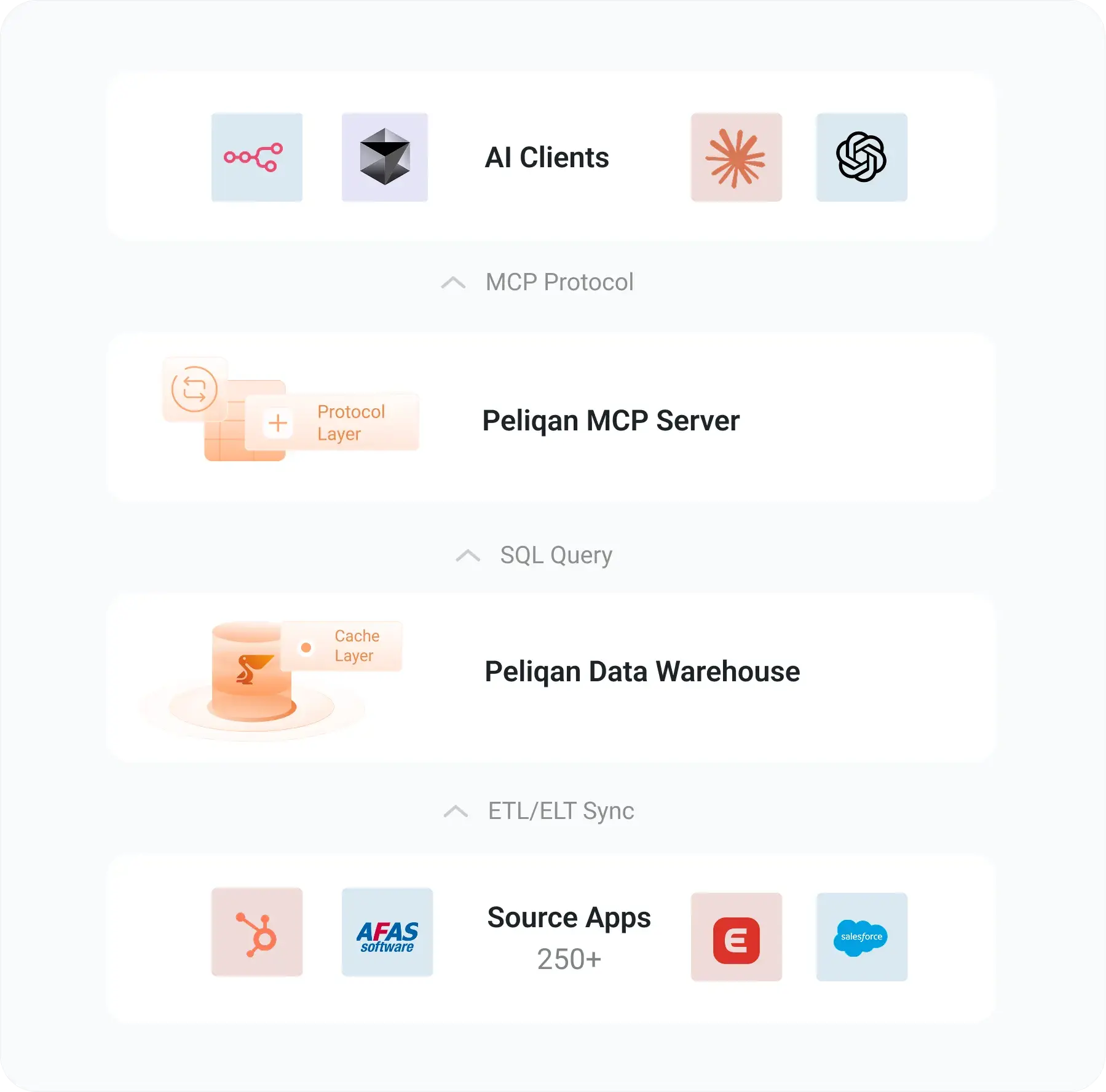
Peliqan connects to Fortnox via OAuth 2.0, exposes it through MCP alongside 300+ other sources, and federates cross-source queries through Trino. Writebacks route to the right system (Fortnox itself or your CRM, billing, or messaging tools) through Peliqan’s connector layer.
OAuth 2.0 with stored tokens
Peliqan stores your Fortnox refresh tokens server-side and rotates access tokens automatically. AI clients never see raw Fortnox credentials. Rotate or revoke a Peliqan token without touching Fortnox.
Rate-limit aware sync
Fortnox API allows 300 requests per minute per tenant on a sliding 5-second window. Peliqan paces sync and writeback traffic to stay within budget, so your other Fortnox integrations and your accountant's tools never get rate-limited.
Smart writeback routing
When AI says "post a Fortnox voucher and notify the controller in Slack," Peliqan reads from Fortnox, writes the voucher through Fortnox's API, and sends the Slack message. One prompt, three systems, one audit trail.
EU-hosted, BFN-aware
Peliqan is EU-hosted with SOC 2 Type II, ISO 27001, and GDPR-native compliance. Audit policies and column masking can mirror Swedish bokforingslagen and BFN requirements - relevant for accountancy firms with reviewer responsibilities.
- Setup
Connect Fortnox to Claude in under 30 minutes
No DIY MCP server to host, no stored procedures to write, no extra ELT vendor. Activate the integration on the Fortnox account, authorise in Peliqan, and your MCP server is live.
1
Activate the Peliqan integration in Fortnox
A Fortnox system administrator logs in to the customer’s Fortnox account, opens “Manage Integrations,” finds the Peliqan integration and activates it. This is the customer-side step Fortnox requires before any external app can call the API. Setup guide →
2
Authorise Peliqan via OAuth 2.0
In Peliqan, go to Connections, add Fortnox, and complete the OAuth 2.0 flow. Peliqan stores the access token and refresh token server-side – tokens never land in Claude Desktop, Cursor, or any AI client config.
3
Create your MCP API handler
Use Peliqan’s built-in MCP template to choose which Fortnox entities your AI agents can read and write. Apply column masking for personnummer or salary data. Set per-agent role-based access for partner setups managing many client accounts. AI agents docs →
4
Connect Claude or ChatGPT
Run pip install mcp-server-peliqan, add your Peliqan API credentials (not your Fortnox tokens), and start querying Fortnox with natural language. Open source on GitHub.
Peliqan vs other Fortnox MCP options
Fortnox MCP options come in a few flavours: task-quota-capped iPaaS wrappers, community open-source repos, and managed adapters. Here is where Peliqan fits for Swedish accountants and Nordic accountancy firms that need more than basic SELECT plus a few writes.
| Zapier Fortnox MCP | PulseMCP / community repos | Pipedream Fortnox MCP | Boost.space · viaSocket | Peliqan MCP | |
|---|---|---|---|---|---|
| Read Fortnox data | ✓ | ✓ | ✓ | ✓ | ✓ |
| Audited writeback to Fortnox | Limited, task-capped | Community / DIY | Action-based | Action-based | ✓ Full audit trail |
| Cross-source SQL joins | ✗ | ✗ | ✗ | ✗ | ✓ 300+ sources |
| Task / call quotas | Per-task pricing | Self-hosted limits | Per-action pricing | Per-operation pricing | Flat plan |
| Governance for AI | Workflow-level | ✗ | Workflow-level | Workflow-level | ✓ Per-agent policy |
| EU hosting | ✗ US | Self-hosted | ✗ US | Varies | ✓ EU-hosted |
| SOC 2 + ISO 27001 + GDPR | SOC 2 | ✗ | SOC 2 | Varies | ✓ All three |
| BI + ELT + reverse ETL bundled | ✗ MCP only | ✗ MCP only | ✗ MCP only | ✗ MCP only | ✓ Full data platform |
- Beyond MCP
The full Peliqan Fortnox integration
MCP is one way to use your Fortnox in Peliqan. The full integration gives you a complete data platform for AI agents, ELT into your warehouse, BI on Fortnox plus other sources, and reverse ETL back into Fortnox – all in one workspace.
Connect your favourite BI tool, write data transformations in SQL or Python, and set up data quality checks on your Postgres tables.
ELT to your warehouse
Fortnox data into Postgres, Snowflake, BigQuery
MCP server
Claude, ChatGPT, n8n, Make
Text-to-SQL
Plain English Fortnox queries
Reverse ETL
Push data back into Fortnox
Cross-source joins
Fortnox + 300+ sources via Trino
Data quality
SQL checks + Slack alerts on Fortnox data
Your AI agents. 300+ business apps. One MCP server.
Connect Fortnox, Exact Online, AFAS, Salesforce, and more to any MCP client – without writing API code, managing rate limits, or sacrificing governance.
Live in minutes - pip install, paste your token, query.
Read + write - pull data and push updates back to source.
Governed by default - SOC 2 Type II · GDPR · EU-hosted.
Fortnox MCP, answered
What is the Fortnox MCP server?
A Fortnox MCP server is a Model Context Protocol endpoint that lets AI agents like Claude, ChatGPT, and Cursor query a Fortnox account in plain English and post audited writebacks. Peliqan’s Fortnox MCP server adds cross-source joins (Fortnox plus 300+ apps), writeback routing to business apps like HubSpot or Slack, column masking for personnummer and salary data, and a single MCP endpoint that covers Fortnox alongside Visma E-conomic, Yuki, Silverfin, and Exact Online for Nordic accountancy practices.
How does Peliqan authenticate to Fortnox?
Peliqan uses OAuth 2.0, the current Fortnox standard since the legacy integration-token model was deprecated on 30 April 2025. A Fortnox system administrator first activates the Peliqan integration on the customer’s Fortnox account, then completes an OAuth flow inside Peliqan. Refresh tokens stay server-side in Peliqan and access tokens rotate automatically. Your AI clients never see Fortnox credentials directly.
Will AI workloads breach Fortnox's API rate limit?
Fortnox enforces 300 requests per minute per client-id and tenant, measured on a sliding 5-second window. Peliqan paces sync and writeback traffic to stay under that limit, so your other Fortnox integrations and the accountant’s tools keep their throughput. Heavy AI workloads do not directly hammer the Fortnox API – reads can serve from Peliqan’s warehouse cache where appropriate, and writes route through governed batching.
Can AI write to my Fortnox books?
Only if you allow it. Peliqan defaults to read-only access. You can enable invoice creation, voucher posting, customer updates, and other writebacks per role – and every write is logged with the user, agent, timestamp, and exact API payload. You can also restrict AI to specific voucher series or accounts, so it can post draft journal entries that an accountant reviews before final commit.
Does this work for accountancy firms running many Fortnox client accounts?
Yes – this is one of the strongest fits. A Swedish accountancy firm running 200+ Fortnox client accounts can connect each via OAuth 2.0 into one Peliqan workspace, expose them through a single MCP server, and scope each AI agent to specific clients. Cross-client analytics (which clients are behind on momsdeklaration, which need year-end attention) become natural-language queries instead of manual spreadsheet pulls. Pair with Visma E-conomic, Yuki, Silverfin, or Exact Online in the same MCP for cross-border Nordic practices.
How is Peliqan different from Zapier or Pipedream Fortnox MCPs?
Zapier and Pipedream wrappers are excellent for simple action-style flows (“when a Fortnox invoice is created, send a Slack message”). They are task-priced or action-priced, which gets expensive at AI scale, and they cannot join Fortnox with other sources in one SQL query. Peliqan is built around a federated query layer (Trino) plus an MCP server, so the same workspace covers cross-source joins, audited writebacks across many systems, ELT into your warehouse, BI on top, and reverse ETL back out. If your use case is a single Zap, use Zapier. If you are building AI agents that need to read across systems and act safely, Peliqan adds the missing layer.
What does Peliqan cost for a Fortnox setup?
Peliqan pricing is flat-rate, not task-priced. Connect starts at 75 EUR per month for small teams. Pro is 500 EUR per month with full MCP, governance, and cross-source features. Enterprise is custom for larger firms with multi-tenant needs. Whitelabel starts at 1,500 EUR per month if you want to offer a branded MCP to your own customers. Custom Fortnox-side adjustments or extra source connectors are covered by Peliqan’s 2-week custom connector SLA.