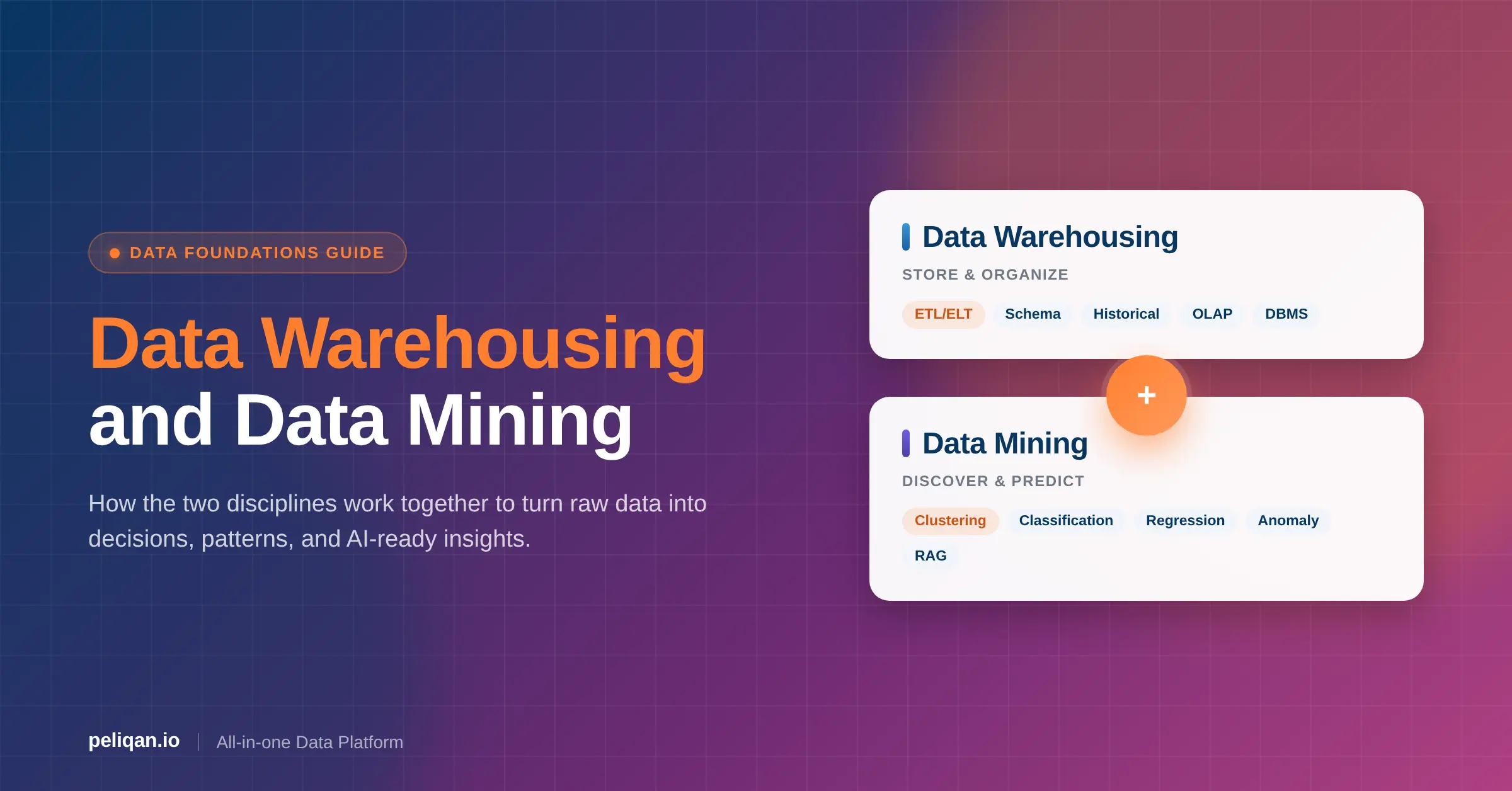





Data warehousing and data mining are the two disciplines that turn raw business data into decisions. Data warehousing is the practice of consolidating data from many sources into a single repository; data mining is the practice of extracting patterns, correlations, and trends from that repository. This guide covers how the two fit together in 2026, the techniques that drive measurable business outcomes, and how a unified platform like Peliqan handles both layers in one product.
Organizations now run more data than they can manually analyze – and the gap between “having data” and “extracting value from data” keeps widening. The two disciplines below close that gap. Data warehousing builds the foundation. Data mining is the activity that actually generates insight on top of it. Both depend on each other, and the teams that get the most out of either treat them as one system, not two.
The foundations of data warehousing in data mining
Data warehousing is the critical first step in the data mining process. It involves collecting, organizing, and storing large volumes of data from various sources into a centralized repository. This repository, known as a data warehouse, serves as the foundation for effective data mining operations.
Key features of data warehouses for mining
- Subject-oriented: Organized around specific business areas (customer, product, order) for focused analysis
- Integrated: Consolidates data from multiple sources for comprehensive mining
- Time-variant: Preserves historical data for trend analysis and predictive modeling
- Non-volatile: Provides stable datasets for consistent mining results
The role of data warehousing in the mining process
- Data consolidation: Gathering relevant information from diverse sources
- Data cleansing: Ensuring data quality for accurate mining outcomes
- Data structuring: Organizing information to facilitate efficient mining algorithms
- Data accessibility: Providing easy access to large datasets for mining operations
Data warehousing vs data mining: understanding the distinction
While data warehousing and data mining are closely related, they serve different purposes in the data analytics ecosystem. The comparison below clarifies their roles.
With a clear understanding of how data warehousing supports mining, the next section dives into the mining techniques themselves and how they operate on warehouse data.
Data mining: extracting insights from the data warehouse
Data mining is the process of discovering patterns, correlations, and trends within the large datasets stored in data warehouses. It involves applying algorithms and statistical techniques to extract meaningful information that can inform business strategies.
Data mining techniques utilizing the data warehouse
Association rule mining: Identifying relationships between variables in the warehouse
- Example: Discovering which products are frequently purchased together
- Applications: Market basket analysis, cross-selling strategies
Classification: Categorizing new data based on patterns found in the warehouse
- Example: Predicting customer churn based on historical behavior
- Applications: Customer segmentation, risk assessment
Clustering: Grouping similar data points within the warehouse
- Example: Identifying customer segments with similar purchasing habits
- Applications: Targeted marketing, customer profiling
Regression analysis: Modeling relationships between variables in the warehouse
- Example: Forecasting sales based on historical data and external factors
- Applications: Demand forecasting, financial modeling
Anomaly detection: Identifying unusual patterns in warehouse data
- Example: Detecting fraudulent transactions in financial data
- Applications: Fraud prevention, quality control
The data mining process in data warehouses
To illustrate how data mining works on top of the warehouse, the typical workflow:
OLAP operations in data warehouse and data mining
Online Analytical Processing (OLAP) is a key technology that bridges data warehousing and mining. OLAP enables multidimensional analysis of data stored in the warehouse, supporting the discovery of patterns and trends. Common OLAP operations include:
- Roll-up: Aggregating data to a higher level of granularity
- Drill-down: Navigating from summary data to more detailed information
- Slice and dice: Selecting and projecting data from different dimensions
- Pivot: Rotating the data view to gain new perspectives
These operations let analysts explore data from various angles, supporting the mining process through interactive exploration and hypothesis testing.
Practical applications of data warehousing and mining
The integration of data warehousing and mining drives measurable outcomes across industries. Some real-world examples:
Retail and e-commerce
Customer segmentation: Mining warehouse data to create targeted marketing campaigns
- Analyze purchase history, browsing behavior, and demographic information
- Develop personalized promotions and product recommendations
Market basket analysis: Identifying product associations to optimize store layouts
- Discover frequently co-purchased items
- Improve product placement and cross-selling strategies
Demand forecasting: Analyzing historical data to predict future sales trends
- Incorporate seasonal patterns, economic indicators, and marketing events
- Optimize inventory management and supply chain operations
Healthcare and life sciences
Disease pattern recognition: Mining patient data warehouses to improve diagnoses
- Identify risk factors and early warning signs for various conditions
- Develop predictive models for disease progression
Drug discovery: Analyzing molecular databases to identify potential treatments
- Screen compound libraries for potential drug candidates
- Predict drug interactions and side effects
Resource optimization: Using warehoused data to predict patient admissions
- Forecast hospital bed occupancy and staffing needs
- Improve emergency room management and resource allocation
Financial services
Fraud detection: Mining transaction warehouses to identify unusual patterns
- Develop real-time anomaly detection systems
- Create risk scores for transactions and accounts
Risk assessment: Analyzing historical data to evaluate credit risks
- Build credit scoring models based on customer attributes and behavior
- Assess portfolio risk and optimize investment strategies
Customer churn prediction: Mining customer databases to improve retention
- Identify early warning signs of customer dissatisfaction
- Develop targeted retention campaigns and personalized offers
Application of data warehouse and data mining in DBMS
Database Management Systems (DBMS) play a crucial role in supporting data warehousing and mining operations:
- Data storage: DBMS provides efficient storage and retrieval mechanisms for large volumes of data in the warehouse
- Query optimization: Advanced query processing techniques in DBMS enhance the performance of data mining operations
- Data integrity: DBMS ensures data consistency and accuracy, which is crucial for reliable mining results
- Security: Access control and encryption features in DBMS protect sensitive data during warehousing and mining processes
- Scalability: Modern DBMS solutions offer scalable architectures to handle growing data volumes in warehouses
While these applications show the power of data warehousing and mining, organizations need to navigate several challenges to maximize their benefits.
Overcoming challenges in data warehousing and mining
The challenges below show up in nearly every implementation. Tackling them upfront is the difference between an analytical program that delivers value and one that becomes a cost center.
Data quality
Ensuring accuracy and consistency in the warehouse is paramount for reliable mining outcomes. Organizations must implement data validation and cleansing processes throughout the data lifecycle.
This involves establishing comprehensive data governance policies and standards that define data quality metrics, ownership, and maintenance procedures. By prioritizing data quality, businesses build a solid foundation for trustworthy insights and decision-making.
Scalability
As data volumes continue to grow exponentially, managing this growth while maintaining mining performance becomes increasingly challenging. To address this, many organizations are turning to cloud-based solutions that offer flexible storage and computing resources.
Implementing distributed processing techniques for large-scale data mining can help handle massive datasets efficiently. By picking scalable architectures, businesses ensure their warehousing and mining capabilities grow in tandem with their data.
Security
Protecting sensitive information in the data warehouse during mining operations is essential given the modern cybersecurity environment. Organizations should use encryption and access control mechanisms to safeguard data at rest and in transit.
As large language models are increasingly embedded in analytical and data mining workflows, LLM security for enterprises becomes essential to mitigate risks such as training data exposure through VPN, prompt injection, and unauthorized inference over sensitive warehouse data.
Implementing data masking and anonymization techniques for sensitive information helps maintain privacy while still enabling valuable insights to be extracted. A comprehensive security strategy ensures data assets remain protected throughout the warehousing and mining processes.
Integration
Connecting warehousing and mining processes cleanly is essential for maximizing the value of both. This requires developing a unified data architecture that supports both operations together.
Implementing effective metadata management ensures consistency across systems and supports smooth data flow between warehousing and mining stages. By focusing on integration, organizations create a more efficient and streamlined data analytics ecosystem.
Skill gap
Developing expertise in both data warehousing and mining techniques is a significant challenge for many organizations. To address this, companies should invest in comprehensive training programs for their data professionals, covering both technical skills and business acumen.
Collaborating with academic institutions and industry partners for knowledge exchange can also help bridge the skill gap. By nurturing a skilled workforce, organizations can fully use the potential of their warehousing and mining initiatives.
How AI agents are reshaping data warehousing and mining in 2026
The traditional warehousing-and-mining model is being augmented by AI agents that read from the warehouse and generate insights autonomously. Three patterns worth knowing:
- RAG over warehouse data: Retrieval-augmented generation lets AI agents answer business questions by querying warehouse tables directly via Text-to-SQL or MCP. The data quality of the warehouse now determines the accuracy of the agent.
- Automated pattern discovery: Agents can run clustering, classification, and anomaly detection on demand without analyst-written code. The warehouse becomes the substrate, the agent becomes the analyst.
- Continuous mining: Instead of batch mining runs, agents continuously scan warehouse data for emerging patterns – churn signals, fraud anomalies, supply chain disruptions – and surface them to operators in real time.
Conclusion
Data warehousing and mining are inseparable components of modern business intelligence. The data warehouse serves as the foundation, providing a structured, integrated repository of information. Data mining works on top of this warehouse to uncover hidden patterns, trends, and insights that drive strategic decision-making.
As we continue to generate unprecedented volumes of data, the importance of effective warehousing and mining will only grow. Organizations that invest in these technologies and develop the skills to use them effectively will be well-positioned to thrive in an increasingly data-centric world.
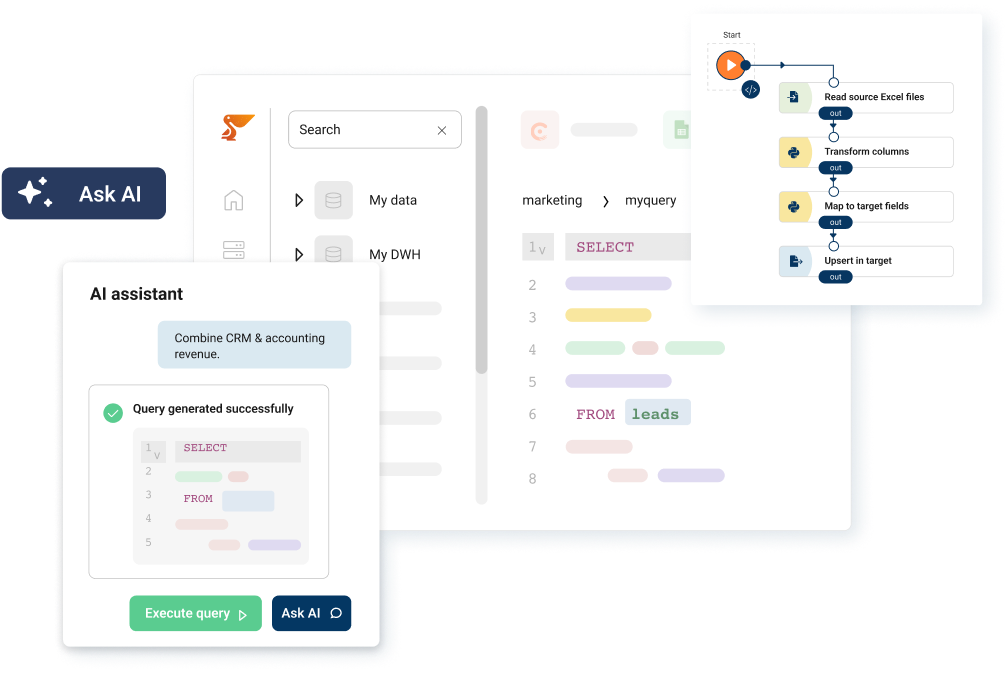
This is where Peliqan comes into play. As a platform designed to streamline data warehousing and mining processes, Peliqan offers a comprehensive solution to many of the challenges discussed in this article. With its data quality management tools, scalable cloud-based architecture, and strong security features, Peliqan helps organizations build and maintain high-performance data warehouses that serve as a solid foundation for sophisticated data mining operations.
Whether you’re just beginning your data journey or looking to enhance existing analytics capabilities, understanding the synergy between warehousing and mining is essential. With Peliqan, you can transform raw data into actionable insights, driving innovation and success in the digital age.