




Data quality best practices are the systematic processes, standards, and cultural habits that ensure your organization’s data is accurate, complete, consistent, and fit for its intended purpose – from operational reporting to AI model training.
Poor data quality costs the average organization $12.9 million per year, according to Gartner research. That number becomes even more alarming when you factor in the downstream effects: flawed dashboards, broken automations, failed AI projects, and eroded trust in analytics across leadership teams. A 2025 IBM Institute for Business Value study found that 43% of chief operations officers identify data quality as their most significant data priority – yet most organizations still treat it as a cleanup exercise rather than a strategic discipline.
The data quality tools market is valued at $2.78 billion in 2025 and is projected to reach $6.34 billion by 2030, according to Mordor Intelligence. That growth reflects a hard truth: organizations are finally acknowledging that no amount of sophisticated analytics, machine learning, or generative AI can compensate for unreliable data. In this guide, we break down the data quality best practices that separate high-performing data management teams from the rest.
What is data quality?
Data quality refers to the degree to which data meets the requirements for its intended use across operations, analytics, and decision-making. It is not a single metric but a combination of measurable dimensions that collectively determine whether your data is trustworthy enough to act on.
High-quality data is not just “clean” data. It is data that is accurate enough to reflect reality, complete enough to avoid blind spots, consistent across systems, timely enough to be relevant, valid according to business rules, and structurally intact so relationships between records hold up under analysis.
📐 The six dimensions of data quality
Understanding these dimensions is the first step toward implementing effective data quality best practices. Each dimension maps to specific metrics, tools, and processes – which we will cover in detail below.
Why data quality matters in 2026
Data quality has always mattered, but three converging forces have pushed it from a back-office concern to a board-level priority in 2026.
⚠️ Why data quality is now a board-level issue
- AI amplifies bad data: Gartner predicts that through 2026, organizations will abandon 60% of AI projects due to insufficient data quality. Every model you train inherits and amplifies the flaws in your data.
- The financial toll is escalating: Over 25% of organizations estimate losing more than $5 million annually due to poor data quality, with 7% reporting losses exceeding $25 million (IBM, 2025).
- Trust in data is declining: According to Precisely’s 2025 Data Integrity report, distrust in data for decision support has risen from 55% in 2023 to 67% – meaning leadership increasingly questions the numbers they see.
- Regulatory pressure is growing: EU CSRD, California SB-253, and SEC climate disclosures now require auditable, high-quality data trails across ESG reporting.
- Data volumes are outpacing quality: Approximately 181 zettabytes of data were created globally in 2025. Without quality controls, more data simply means more noise.
The 2025 DATAVERSITY Trends in Data Management survey found that 61% of respondents list data quality as their top challenge, yet only 50% have implemented quality initiatives. That gap between recognition and action is where most organizations lose ground. The data quality best practices outlined below are designed to close it.
The real cost of poor data quality
The costs of bad data are rarely visible at the point of failure. Instead, they compound downstream – surfacing as lost revenue, inefficient operations, compliance fines, and missed opportunities long after the root cause.
💰 The financial reality
Beyond the financial numbers, poor data quality erodes something harder to rebuild: organizational trust. When executives stop trusting dashboards, decision-making slows down. Manual reconciliation meetings multiply. Teams resort to maintaining shadow spreadsheets. The cultural cost of bad data often exceeds the financial one.
These costs are precisely why data quality best practices need to be embedded into your ETL pipelines, governance frameworks, and daily workflows – not bolted on after the fact.
12 data quality best practices for 2026
The following practices are ordered from foundational (start here) to advanced (scale here). Each builds on the previous one, and together they form a comprehensive data quality management strategy.
1. Define data quality standards and KPIs
You cannot improve what you do not measure. The first step in any data quality initiative is defining what “good” looks like for your organization – not in abstract terms, but as specific, measurable thresholds tied to business outcomes.
Start by identifying the most critical datasets in your organization (customer records, financial transactions, product data) and define acceptable quality levels for each dimension. For example: customer email accuracy must exceed 95%, order records must be 99.5% complete, and inventory data must be refreshed within 4 hours of a transaction.
Common data quality KPIs include error rate (percentage of incorrect records), completeness score (percentage of populated fields vs. total fields), duplication rate, freshness lag (time since last update), and conformity rate (percentage of records matching defined formats).
💡 Pro tip
Tie your data quality KPIs directly to business outcomes. “Email accuracy > 95%” is more actionable when framed as “reduce email bounce rate to under 5%, saving $X in wasted campaign spend per quarter.” When stakeholders see the business impact, quality standards get enforced.
2. Implement a data governance framework
Data governance provides the organizational structure that makes quality sustainable. Without governance, quality efforts become ad hoc – one team cleans their CRM data while another team’s pipeline continues producing duplicates.
A practical governance framework does not need to be bureaucratic. At its core, it requires three things: clear ownership (who is responsible for each dataset), defined policies (how data should be handled, stored, and accessed), and enforcement mechanisms (how violations are detected and resolved).
According to a Dun & Bradstreet report, around 41% of companies cite inconsistent data across technologies as their biggest challenge. Governance bridges this gap by establishing standards that apply across all systems – from CRM to ERP to your data warehouse.
Effective data governance does not happen in a vacuum. It needs executive sponsorship, cross-functional participation, and regular review cycles. The organizations that succeed treat governance as an ongoing service, not a one-time project.
3. Profile your data before you fix it
Data profiling is the diagnostic step that most organizations skip – and it is the reason many data quality initiatives fail. Profiling examines your data as it actually exists, revealing patterns, anomalies, distributions, and structural issues that would otherwise remain hidden.
A thorough profiling exercise answers questions like: What percentage of records have null values in critical fields? Are there unexpected data types or formats? What is the actual distribution of values in key columns? Are there outliers that suggest data entry errors or system bugs?
Think of profiling as a health check for your data. Without it, you are prescribing treatment without a diagnosis. You might spend weeks cleaning duplicates when the real problem is a broken integration feeding malformed records into your warehouse every night.
Modern data platforms handle much of this automatically. When you centralize your data in a warehouse, tools like schema detection, column statistics, and anomaly flagging give you a profiling baseline without writing custom scripts.
4. Validate data at the point of entry
Prevention is always cheaper than remediation. The “1-10-100” rule of data quality states that it costs $1 to prevent a data error, $10 to correct it after entry, and $100 to remediate the downstream consequences. Validation at the point of entry is the $1 investment.
Implement validation rules that enforce acceptable formats, value ranges, and required fields before data enters your systems. Real-time validation ensures only clean data flows into your data warehouse or analytics tools. This includes format checks (email addresses must contain @), range checks (order quantities cannot be negative), referential checks (a customer ID must exist before an order can be created), and uniqueness checks (no duplicate invoice numbers).
Validation should happen at multiple layers: the application UI, the API layer, and the database schema. Each layer catches different types of errors, and no single layer catches everything.
5. Automate data cleansing and standardization
Manual data cleaning does not scale. If your team is spending hours each week fixing formatting inconsistencies, deduplicating records, or reconciling mismatches between systems, you have a process problem, not a people problem.
Automated cleansing should cover standardization (converting “U.S.A.” / “United States” / “US” to a single canonical form), deduplication (identifying and merging duplicate records using fuzzy matching), enrichment (filling in missing fields from trusted external sources), and normalization (ensuring consistent data types, date formats, and units across all sources).
The key is building these automations into your data pipeline rather than running them as separate cleanup jobs. When cleansing is part of the transformation layer, every record that enters your warehouse is already standardized.
6. Monitor data quality continuously
Data quality is not a state you achieve and then maintain passively. Data degrades over time – B2B contact data decays at roughly 30% per year, schema changes break pipelines, and source system updates introduce new edge cases. Continuous monitoring is how you catch issues before they affect business decisions.
Effective monitoring tracks metrics across all six quality dimensions, runs automated checks on a schedule (after every pipeline run, daily, or weekly depending on criticality), sends alerts through channels your team actually monitors (Slack, email, PagerDuty), and maintains a historical baseline so you can detect trends and regressions.
📊 What to monitor
The goal is to shift from reactive (“the dashboard is wrong, what happened?”) to proactive (“we caught a spike in null values in the orders table at 3am, here is the fix”). This mindset shift is one of the most impactful data quality best practices you can adopt.
7. Establish data ownership and stewardship
A common mantra among data managers is that everyone in an organization is responsible for data quality. That is a nice sentiment – but without specific ownership, “everyone” quickly becomes “no one.”
Data stewardship assigns accountability for specific datasets to individuals or teams who understand both the technical and business context of that data. The marketing team owns CRM data quality. The finance team owns financial transaction data. The product team owns usage analytics.
Stewards are responsible for defining quality rules for their domain, investigating and resolving quality issues, approving changes to data structures, and serving as the point of contact when downstream consumers have questions. This distributed ownership model scales far better than a centralized “data quality team” trying to understand every dataset in the organization.
8. Build data lineage and documentation
When something goes wrong with your data – and it will – lineage is how you trace the issue back to its source. Data lineage tracks the origin of every dataset, every transformation applied to it, and every downstream system that depends on it.
Without lineage, debugging a data quality issue becomes a guessing game. With lineage, you can immediately see which source system introduced the bad data, what transformations were applied (and whether one of them caused the issue), and which reports, dashboards, and models are affected downstream. This is critical for impact analysis – understanding the blast radius of a data quality incident before it reaches end users.
Lineage also supports regulatory compliance, especially under frameworks like GDPR where organizations must demonstrate how personal data flows through their systems. Platforms that offer automatic lineage detection reduce the manual effort of mapping these flows significantly.
9. Integrate quality into your ETL/ELT pipelines
Data quality should not be a separate workstream from data integration. The most effective approach is embedding quality checks directly into your ETL or ELT pipelines, so data is validated, cleansed, and enriched as part of the standard flow from source to warehouse.
This means adding validation gates between pipeline stages (reject or quarantine records that fail checks), running data profiling on incoming source data before transformation, implementing schema enforcement to catch structural changes early, logging quality metrics for every pipeline run so you can track trends over time, and building alerting into the pipeline itself so failures trigger notifications rather than silently producing bad data.
The transformation layer is where most quality improvements happen in practice. It is where you standardize formats, resolve duplicates, apply business rules, and join data from multiple sources. Investing in robust data transformations directly improves your quality outcomes.
💡 Pro tip
Separate your data warehouse into layers – raw (landing zone), intermediate (cleansed and validated), and core (business-ready). Quality checks sit between each layer, ensuring that only validated data progresses. This “medallion” approach gives you auditability at every stage and makes it easy to pinpoint where quality breaks down.
10. Train teams on data literacy
The best data quality tools in the world do not drive adoption. People do. Organizations that invest in data literacy – the ability to read, understand, communicate with, and reason about data – consistently outperform those that rely on tooling alone.
As of 2025, only 36% of organizations have implemented data literacy programs, according to the DATAVERSITY survey. Yet IDC forecasts that 40% of all G2000 job roles in 2026 will involve working with AI agents – meaning more people than ever will need to understand data quality to do their jobs effectively.
Practical data literacy training covers how to identify common data quality issues in everyday workflows, how to use the organization’s data tools to investigate and resolve problems, when to escalate issues to data stewards vs. fixing them locally, and why data quality standards exist and how they connect to business outcomes. The goal is not to turn everyone into a data engineer. It is to create a shared language around data quality so that problems are caught and reported earlier.
11. Leverage AI for anomaly detection
Traditional rule-based quality checks catch known issues – records where a phone number has too few digits, or an order value is negative. But they miss unknown unknowns: subtle shifts in data distributions, emerging patterns that suggest a source system is misbehaving, or novel edge cases that no one anticipated.
AI-powered anomaly detection fills this gap by learning what “normal” looks like for your data and flagging deviations automatically. In January 2026, Oracle introduced Data Quality Studio with ML-based anomaly detection, adopted by over 50 US financial firms. IBM launched Watsonx.data Quality Suite with AI-driven profiling for enterprise data lakes. Precisely released AI agents for cloud data quality that speed up normalization and rule creation through natural language interaction.
You do not necessarily need a dedicated data observability platform to get started. Many data management tools now include basic anomaly detection capabilities, and custom checks can be built using SQL queries or Python scripts that compare current data distributions against historical baselines.
12. Treat data quality as a culture, not a project
The most important data quality best practice is also the most overlooked: data quality is not a project with a start and end date. It is a continuous discipline that must be embedded into your organization’s culture.
Organizations that succeed with data quality share several cultural traits. Leadership visibly prioritizes data quality in planning and resource allocation. Quality metrics are part of regular team reviews, not buried in technical dashboards. There are no “data janitors” – quality is everyone’s responsibility, with clear ownership. Incidents are treated as learning opportunities with blameless post-mortems. And investment in quality infrastructure is seen as a cost avoidance measure, not a cost center.
Building this culture takes time, but it starts with small, visible wins. Fix one high-profile data quality issue and publicize the business impact of the fix. Create a “data quality score” for key datasets and share it on a monthly cadence with leadership. Celebrate teams that catch and resolve issues proactively. These small signals compound over time into genuine cultural change.
Data quality dimensions – quick reference
Use this table as a reference when defining quality standards and KPIs for your organization. Each dimension maps to specific metrics you can track and automate.
Building a data quality framework – step by step
With the 12 best practices above as building blocks, here is a practical framework for implementing data quality management in your organization. This is not a waterfall plan – think of it as a maturity model where you progress through stages.
🎯 Quick decision guide – where to start
- Stage 1 – Assess: Profile your most critical datasets. Document current quality levels against the six dimensions. Identify the top 3 data quality issues costing the business money.
- Stage 2 – Foundation: Define standards and KPIs for your top 5 datasets. Assign data stewards. Set up basic monitoring and alerting on your ETL pipelines.
- Stage 3 – Automate: Embed validation and cleansing into your data pipelines. Implement automated quality checks that run on every pipeline execution. Build dashboards that track quality metrics over time.
- Stage 4 – Govern: Roll out a formal governance framework with defined policies, RACI matrices, and regular review cadences. Implement lineage and metadata management across all data assets.
- Stage 5 – Optimize: Layer in AI-powered anomaly detection. Expand quality coverage to secondary datasets. Build a data quality culture with literacy programs, incident reviews, and visible leadership commitment.
Start where the pain is greatest. If your sales team is working off outdated CRM data, that is Stage 1. If your data stack produces clean data but nobody trusts it, you have a Stage 4-5 problem. Meet your organization where it is, and progress iteratively.
Data quality and AI readiness
If your organization is investing in AI – and 40% of organizations are increasing AI investment due to generative AI advances, according to McKinsey – then data quality is not optional. It is a prerequisite.
The “garbage in, garbage out” principle applies with particular force to AI, because models do not just reflect data flaws – they amplify them. A recommendation engine trained on inconsistent product data will produce inconsistent recommendations at scale. A forecasting model trained on incomplete historical data will produce forecasts with systematic blind spots.
The organizations succeeding with AI in 2026 are not the ones with the most sophisticated models. They are the ones with the cleanest, most well-governed data foundations. Companies with strong data integration achieve 10.3x ROI from AI initiatives versus 3.7x for those with poor connectivity, according to MuleSoft’s 2025 Connectivity Benchmark. Investing in data quality best practices is the highest-leverage AI strategy available to most organizations today.
Common data quality challenges and how to solve them
Even with strong practices in place, certain data quality challenges recur across organizations. Here is how to address the most common ones.
Data silos across departments
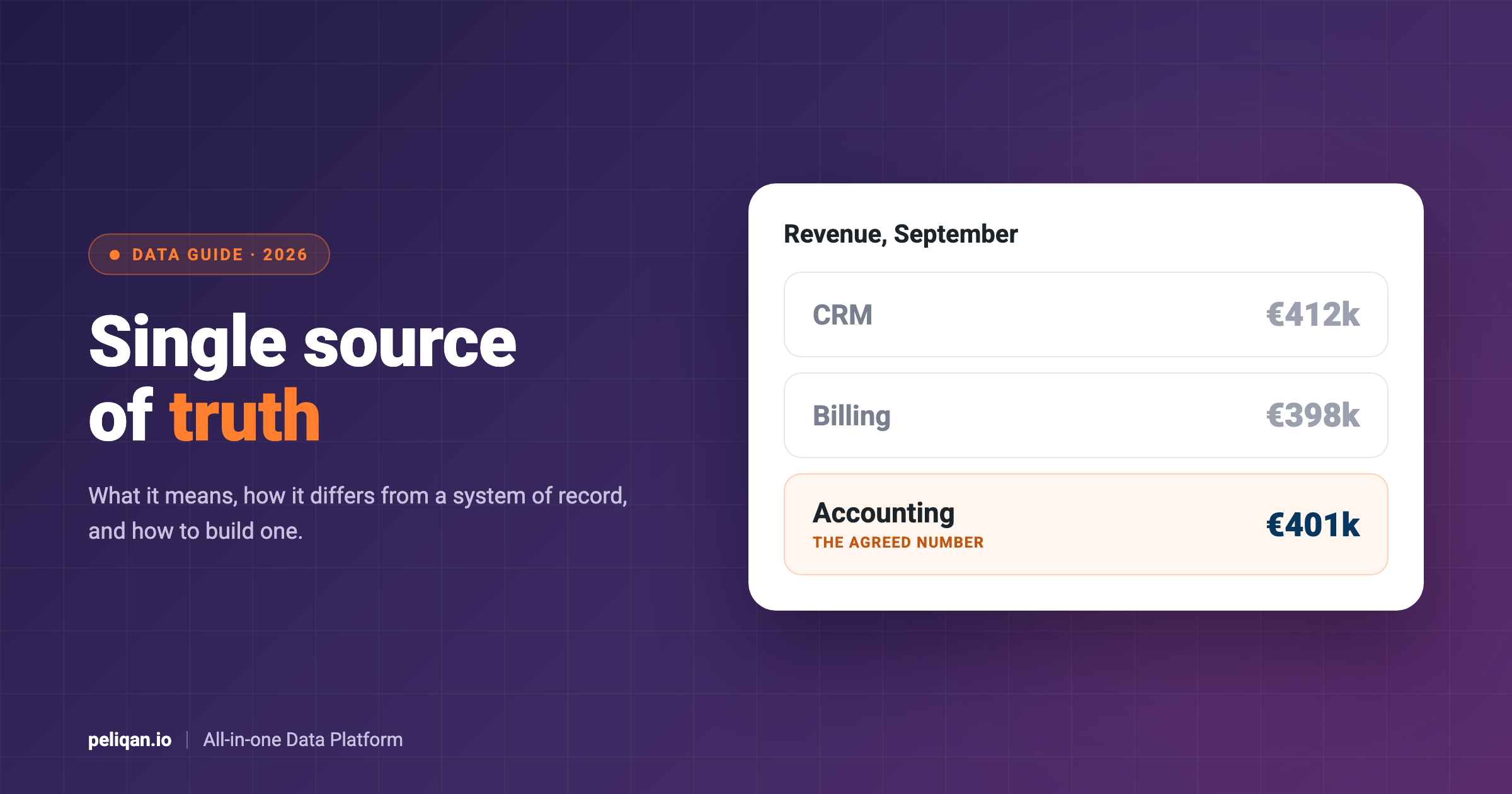
When each team maintains its own copy of customer data, inconsistencies multiply. The solution is centralizing data into a single warehouse where a single source of truth is maintained, with governed access for each team. Data integration tools that connect all your SaaS applications, databases, and files into one repository eliminate silos at the infrastructure level.
Schema drift from source systems
Source systems change their APIs, rename fields, or alter data types without warning. This breaks pipelines and introduces invalid data. Automated schema detection and monitoring catch these changes before they cascade downstream. Platforms that track schema changes and alert you to unexpected modifications prevent silent data corruption.
Duplicates across systems
A customer appears as “Acme Corp” in your CRM, “ACME Corporation” in your billing system, and “Acme” in your support tool. Without deduplication logic in your reverse ETL and integration layer, you end up with three customer records and fragmented insights. Fuzzy matching and entity resolution during the transformation layer solve this – but only if your pipeline is designed to catch it.
Lack of historical context
When data is overwritten rather than versioned, you lose the ability to audit changes or understand how data evolved over time. Implementing slowly changing dimensions in your warehouse design preserves historical context and supports both compliance requirements and trend analysis.
How Peliqan supports data quality across the pipeline
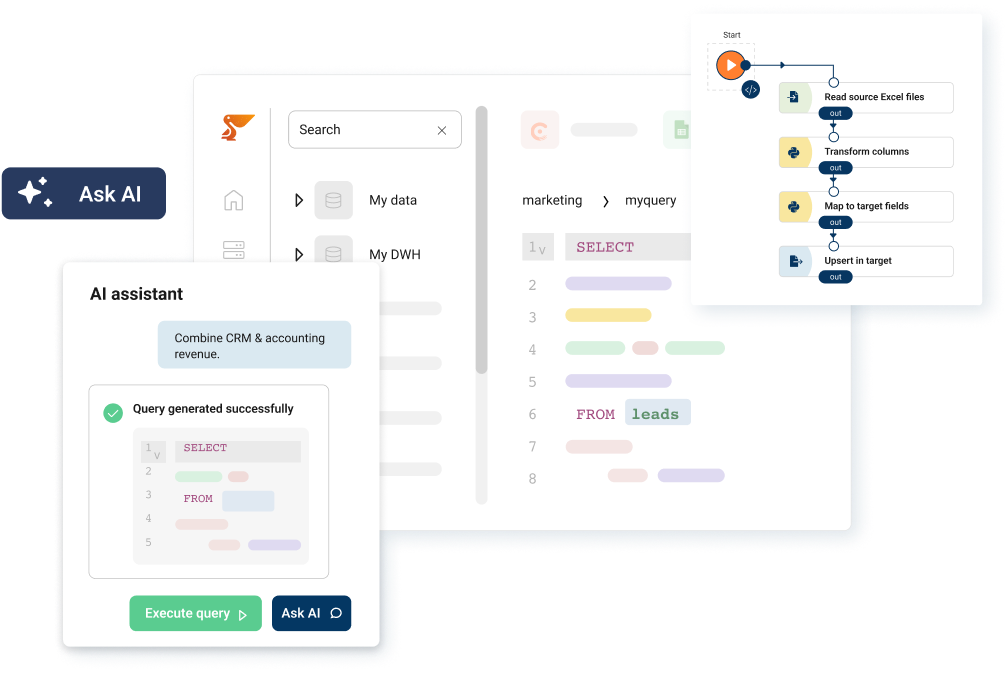
Several of the data quality best practices above – monitoring, lineage, transformation, alerting, and pipeline-integrated quality checks – depend heavily on your data platform’s capabilities. Peliqan is an all-in-one data platform that addresses multiple layers of the quality stack within a single environment, rather than requiring separate tools for each function.
🔍 Data quality capabilities in Peliqan
Peliqan’s approach to data quality is practical rather than theoretical. Instead of a standalone “data quality module,” quality is embedded into the platform’s core workflow: data lands in a built-in warehouse (Postgres/Trino), transformations cleanse and standardize it, monitoring apps run scheduled checks, and lineage tracks every dependency. When an anomaly is detected, alerts fire to Slack or email, and the lineage view shows exactly which downstream assets are affected.
For organizations that want to implement the data quality best practices covered in this guide without assembling a fragmented stack of separate profiling, monitoring, lineage, and transformation tools, Peliqan consolidates these capabilities into a single platform – with transparent pricing starting at ~$199/month and SOC 2 Type II certification.
Conclusion
Data quality best practices are not about perfection. They are about building systematic processes that catch issues early, prevent errors from compounding, and create a foundation of trust that enables everything downstream – from warehouse modeling and BI reporting to AI model training and automated decision-making.
The 12 practices outlined in this guide form a comprehensive framework: define standards, govern consistently, profile before fixing, validate at entry, automate cleansing, monitor continuously, assign ownership, build lineage, embed quality in pipelines, invest in literacy, leverage AI detection, and cultivate a quality-first culture.
Start with the practices that address your most painful data quality issues today, and expand coverage iteratively. The organizations that treat data quality as a strategic capability – not a maintenance chore – are the ones building durable competitive advantages in the AI era.
Ready to centralize your data and embed quality into every step of the pipeline? See how Peliqan handles data activation – or start a free trial to experience the full platform from ingestion to quality monitoring.