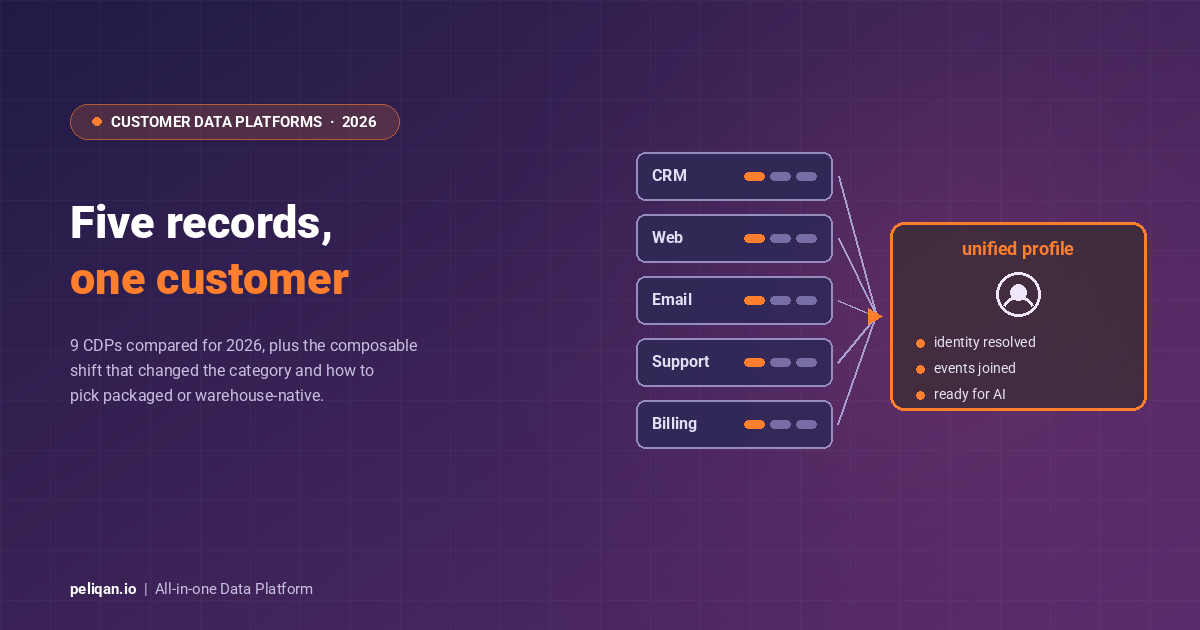





A customer data platform (CDP) collects first-party customer data from every touchpoint and resolves identities into one profile per person. It then pushes those profiles back into the tools your teams use. This guide compares the 9 CDPs worth evaluating in 2026, explains the composable CDP shift, and shows how to match a platform to your data environment.
However, the problem a CDP solves is a familiar one. Customer data sits in a CRM, a web analytics tool, an email platform, a support desk, and a billing system. Each holds a partial view, and none agrees with the others. A CDP builds the single record that all of them lack.
Mechanically, a CDP then does three things in sequence. First, it ingests raw customer events such as page views, purchases, and support calls from databases, cloud storage, web and mobile apps, and SaaS systems. Next, it resolves identities across devices and channels, so one person stops appearing as four records. Finally, it enriches those profiles with demographic and behavioural attributes and activates them in downstream tools.
Why invest in a customer data platform?
- Unified customer profiles. CDPs aggregate first-party data from CRM records, website events, app behaviour, email interactions, and support tickets into one profile per customer. Data silos disappear, and targeting stays consistent across marketing and service teams.
- Simpler data integration. A CDP acts as the central hub for dozens of sources without custom engineering for each one. Pipelines and reverse ETL are handled by the platform, so insights flow back into CRM, email, and ad tools automatically.
- Governance and compliance. Modern CDPs include cataloging, lineage, and privacy controls. Unified consent management makes GDPR and CCPA obligations far easier to meet.
- AI and analytics readiness. Unified profiles feed BI tools, propensity models, and AI agents. Connecting a product recommendations engine to clean profile data, for example, produces far better suggestions than raw event streams would.
The composable CDP shift: what changed by 2026
This is the most important change in the category, and it reframes the whole buying decision. Traditional CDPs store a copy of your customer data inside their own black box. Composable CDPs instead sit on top of the data warehouse you already own, run identity resolution and segmentation there, and activate from the same place.
The practical consequences matter. You keep one copy of the data, so governance and lineage stay intact. Costs scale with your warehouse rather than with a per-profile licence. And because the profiles live in SQL, the same unified data serves analytics, machine learning, and AI agents through MCP, not only marketing campaigns.
In short, the question is no longer only “which CDP?” but “packaged or composable?” Teams that already run a warehouse usually find the composable route cheaper. Teams with no data infrastructure and a marketing-only use case often still prefer a packaged CDP.
Top 9 customer data platforms in 2026
The right CDP delivers 360-degree customer visibility, real-time personalization, and reliable activation. The nine below cover every category: all-in-one data platforms, developer-first event pipes, enterprise suites, and composable warehouse-native tools.
1. Peliqan – all-in-one data platform
Peliqan is an all-in-one data platform for startups, agencies, and mid-market teams. It unifies customer data without a data engineering team.
It connects databases, data warehouses, cloud storage, and SaaS apps into one centralized customer view. From there, teams can activate that data in the tools they already use.
It is not a traditional packaged CDP. Instead, it delivers the core CDP capabilities on top of a built-in Postgres and Trino data warehouse. That covers ingestion, identity resolution and transformation, and activation. In effect, it is a composable CDP with the warehouse included.
Core capabilities:
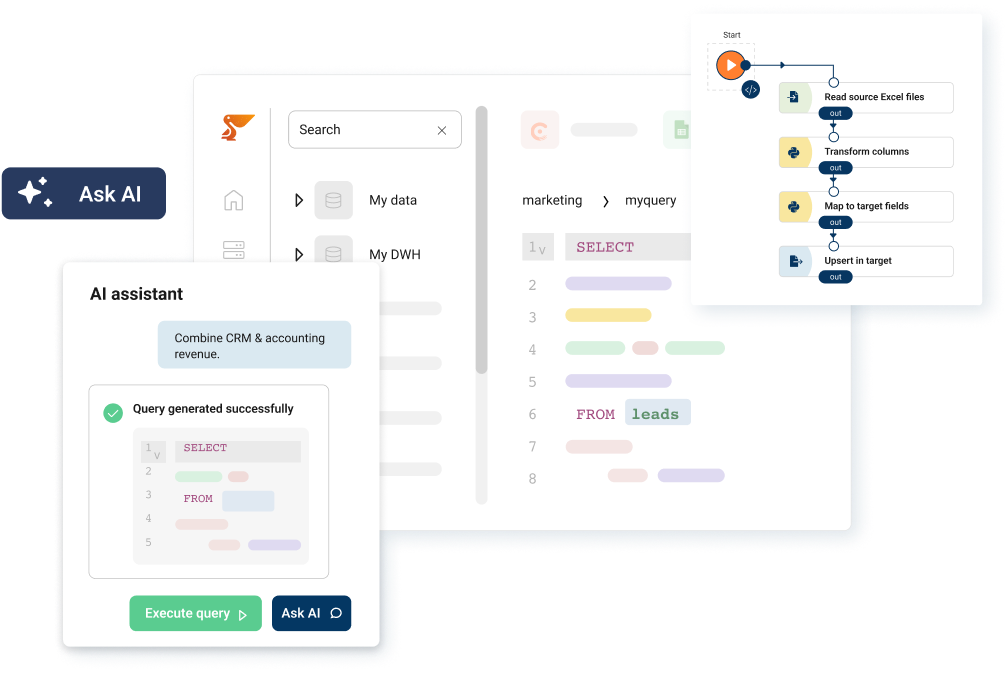
- Spreadsheet-like interface for exploring and transforming customer data
- Connects to 300+ sources including CRMs, databases, and web or app analytics, with custom connectors delivered within 2 weeks
- Built-in data catalog and lineage tracking for governance
- Low-code SQL and Python for segmentation, plus reverse ETL activation
- Auto-sync to marketing tools, CRMs, and internal dashboards
- Built-in MCP server, so AI agents query governed customer data directly
Best for: small to mid-size companies and agencies that want CDP outcomes plus a real data warehouse, without hiring engineers. Marketing and operations teams can onboard quickly, and the platform is SOC 2 Type II, ISO 27001, GDPR, HIPAA, and CCPA certified, EU-hosted on AWS Frankfurt. Trade-off: newer than the incumbents, with a smaller partner ecosystem, and no purpose-built campaign manager.
2. Twilio Segment – developer-friendly CDP
Segment is the best-known developer-first CDP. It excels at collecting and routing event data from websites, mobile apps, and servers, then forwarding it to analytics tools, marketing platforms, or a warehouse.
Key features: developer SDKs make instrumenting apps quick. There are 450+ integrations, called destinations, including Google Analytics, Salesforce, and Snowflake. SQL-based functions clean and normalize data in flight, and identity resolution merges events into unified profiles.
Best for: tech startups and SaaS companies that have engineering capacity, since that need strong event collection and a large destination ecosystem. Trade-off: it assumes engineering support, and the self-serve experience is thinner than marketer-focused tools.
3. Tealium – real-time CDP for enterprise personalization
Tealium, for example, offers an enterprise Customer Data Hub that combines tag management, an API hub, and a CDP. Its CDP layer, formerly AudienceStream, is known for real-time segmentation. It ingests web and mobile tags plus server-side sources, then builds enriched profiles on the fly.
Key features: real-time audience criteria, such as visitors who bought item X and viewed Y. The API hub connects hundreds of marketing tools. Action-based triggers fire emails or ad campaigns when a profile qualifies. Consent tracking and data obfuscation controls round out the privacy side.
Best for: large enterprises with heavy web and mobile traffic, especially existing Tealium iQ Tag Manager users. Trade-off: high setup cost and a pace that rarely suits startups.
4. Adobe Real-Time CDP – part of Experience Cloud
Adobe Real-Time CDP, similarly, sits inside Adobe Experience Cloud and connects Adobe Analytics, Marketo Engage, and the rest of the suite. It centres on Real-Time Customer Profiles, which combine online and offline data into one persistent record.
Key features: source connectors cover Adobe Analytics, AEM, and external CRM or ERP systems. Profile stitching runs on AI-powered identity graphs. A segment builder targets marketers directly, and activation flows natively into Adobe Campaign, Target, and Advertising Cloud.
Best for: organizations already invested in Adobe products, where the integration depth pays off. Trade-off: long onboarding cycles and meaningful lock-in.
Adobe also gives marketing teams adjacent AI tooling, such as the Adobe Express voice generator AI for producing voiceovers inside the same ecosystem.
5. Salesforce Data Cloud – CRM-first CDP
Salesforce Data Cloud unifies data from Salesforce CRM, Service Cloud, and external sources, with the goal of making Salesforce’s own records usable for personalization and AI. It is now also the data foundation for Agentforce, which makes it central to Salesforce’s agent strategy.
Key features: identity resolution builds on existing leads, contacts, and transactions. Audiences activate directly in Marketing Cloud. Einstein predictive models cover churn, lifetime value, and recommendations. Zero-copy sharing also links warehouses such as Snowflake and BigQuery.
Best for: Salesforce-first businesses aligning sales and marketing around shared segments. Trade-off: complex licensing, and value drops sharply outside the Salesforce estate.
Because implementations get complicated fast, consulting partners such as ThinkBeyond often handle Data Cloud rollouts across multi-cloud environments.
6. Microsoft Dynamics 365 Customer Insights
Customer Insights is Microsoft’s CDP, part of the Dynamics 365 suite. It ingests data from Dynamics CRM, commerce systems, and third-party apps to build a 360-degree view. It now ships with Copilot for natural-language segment creation too.
Key features: prebuilt connectors cover Dynamics 365 Sales, Marketing, and Commerce, plus Azure Data Lake. Azure AI adds sentiment analysis, segmentation, and propensity scoring. Integration with Power BI and Power Automate is native, and you can bring your own data lake.
Best for: enterprises already on Azure and Dynamics. Trade-off: it presumes that Microsoft infrastructure is in place.
7. Lytics – predictive CDP for marketers
Lytics, by contrast, is a marketer-friendly CDP built around audience segmentation and personalized campaigns, and it now offers warehouse-native deployment options as well.
Key features: predictive segmentation finds high-value audiences with built-in machine learning. Real-time tracking updates segments instantly from web and mobile analytics. Omnichannel activation reaches email and ad platforms, and engagement analytics report per segment.
Its activation integrations cover the usual marketing stack, including Mailchimp, Smartlead, and Marketo.
Best for: mid-market B2C and e-commerce brands focused on personalization without heavy IT involvement. Trade-off: limited for complex data transformation work.
8. Hightouch – composable CDP on your warehouse
Hightouch, meanwhile, pioneered the composable CDP model. Rather than storing customer data itself, it runs audience building and activation directly against Snowflake, BigQuery, Databricks, or Redshift, and syncs the results to hundreds of destinations.
Key features: a no-code audience builder runs over warehouse tables. Reverse ETL pushes segments to ad platforms and CRMs. Identity resolution happens inside the warehouse, and event collection is available for teams that need it.
Best for: companies that already run a cloud warehouse and want activation without duplicating data. Trade-off: it assumes the warehouse and its modelled tables already exist, so someone still has to build and maintain that layer.
9. RudderStack – warehouse-native event pipeline
RudderStack started as an open-source Segment alternative, and it later became a warehouse-native CDP. It treats the warehouse as the source of truth for both event collection and profile building.
Key features: SDKs and streaming ingestion, profile building in the warehouse, reverse ETL activation, and self-hosted deployment options for teams with strict data residency requirements.
Best for: engineering-led teams that want Segment-style event collection with warehouse ownership. Trade-off: more technical than marketer-first CDPs, and it needs data modelling discipline.
Real-world example: Ziggu, a SaaS company serving the housing industry, unified customer and product data across its stack on one platform and saved 200+ hours of manual reporting work. Read the Ziggu case study.
How to choose the right CDP
Choosing a CDP means matching capabilities to your use cases and existing data environment. Six factors decide most evaluations.
- Packaged or composable. Start here. If you already run a warehouse, a composable CDP avoids a second copy of your customer data. If you do not, a packaged CDP or an all-in-one platform with a warehouse included is simpler.
- Use case priorities. Ad retargeting, email personalization, and customer analytics reward different tools. Tealium suits real-time web personalization, while Salesforce Data Cloud suits CRM-driven marketing.
- Integration requirements. Inventory your sources first, such as Shopify, Stripe, Zendesk, and in-house databases. Then confirm the CDP has connectors or an API for each one.
- Identity resolution needs. Deterministic matching on email or user ID is straightforward. Cross-device and probabilistic matching is not, so test it against your own data before buying. Modelling those rules in SQL keeps them auditable.
- Ease of use versus depth. Self-service tools get marketing teams productive fast. Enterprise CDPs need technical setup but go deeper.
- Privacy and compliance. Check consent management, anonymization, and where data is stored. GDPR and CCPA obligations are unavoidable when handling personal data, and residency matters for EU teams.
Customer data platforms compared
On budget, most packaged CDPs price by profile count or event volume. Enterprise deals commonly run into five figures per month. Composable tools shift that spend toward warehouse compute instead. Therefore, compare total cost across platform and infrastructure, not the licence alone. Check the pricing page of each candidate at your projected volume, not today’s.
Conclusion
In short, customer data is a growth engine rather than a record-keeping exercise. A CDP turns fragmented data into rich profiles, which then power personalized experiences, smarter campaigns, and real-time analytics.
The category has matured, though, and the packaged-versus-composable choice now matters more than any feature list. Enterprise CDPs bring depth at the cost of complexity. Composable tools bring flexibility but assume you own the warehouse. All-in-one platforms sit in between by including the warehouse, the pipelines, and the activation layer in one product.
Whichever route you take, the goal is the same: one trustworthy customer profile that serves marketing, analytics, and AI alike. Start by mapping your sources and your use cases, then pick the category before the product. That order makes the decision much easier.