




Customer data integration (CDI) is the process of collecting customer information from CRM, e-commerce, marketing, and support systems, resolving duplicate identities, and unifying it into a single profile per customer. This guide covers the three CDI models, identity resolution techniques, implementation architecture, and the warehouse-native approach that is replacing traditional CDPs for data-forward teams.
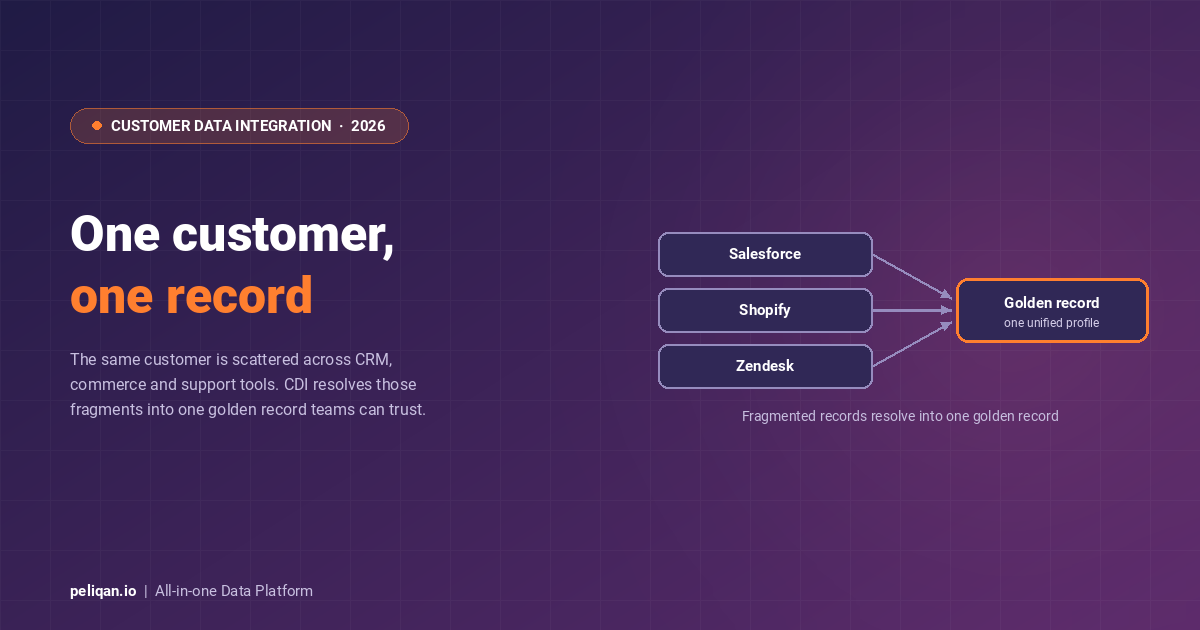
A single customer can exist as a lead in Salesforce, a subscriber in Mailchimp, an order record in Shopify, and a ticket in Zendesk, each with a slightly different email, name spelling, or phone number. Research from Gartner shows that only 14% of organizations have achieved a complete 360-degree view of their customers. The other 86% are making decisions based on fragments.
The cost of that fragmentation is concrete: marketing sends duplicate campaigns to the same person, support agents lack context from previous interactions, and sales teams miss upsell signals because purchase data lives in a system they never check. Customer data integration solves this by creating one trusted record per customer, a golden record, that every team and system can reference.
What is customer data integration?
Customer data integration is the process of extracting customer information from every system that holds it, resolving which records refer to the same person, and consolidating those records into a single, accurate profile. It is not just data aggregation. CDI includes data cleansing (fixing typos, standardizing formats), deduplication (merging “Jon Smith” and “John Smith”), and enrichment (appending third-party data like firmographics or intent signals).
The output is a unified customer profile, sometimes called a golden record or single customer view, that contains the best-known value for every attribute: the most recent email, the verified phone number, the complete purchase history, every support interaction, and all engagement signals across channels.
The four types of customer data
CDI pulls from four distinct categories of customer data. Understanding what each contains determines which source systems you need to integrate and how you structure your unified profile.
A complete CDI strategy integrates all four types. Most organizations start with identity and behavioral data, the minimum for a useful golden record, and layer in engagement and attitudinal data as the integration matures.
Three CDI models: consolidation, propagation, federation
There are three architectural approaches to unifying customer data. The right choice depends on your data volume, real-time requirements, and how many source systems you operate.
Consolidation
All customer data is extracted from source systems, cleansed, deduplicated, and loaded into a centralized repository, typically a data warehouse or data lake. This is the most common model and produces the most reliable unified profiles because all data physically resides in one place where SQL queries and identity resolution logic can operate across the full dataset.
Best for: organizations with 5+ customer data sources, teams that need historical analysis and advanced analytics, and any company planning to use AI or ML on customer data. Trade-off: higher storage costs and ETL complexity, and data freshness depends on pipeline frequency.
Propagation
Data changes in one system are automatically copied to other connected systems. When a customer updates their email in your CRM, that change propagates to your marketing platform, support tool, and billing system. This is essentially reverse ETL combined with real-time sync.
Best for: smaller organizations with 2-3 systems that need to stay in sync, and operational use cases where speed matters more than analytics. Trade-off: it does not create a unified repository, so each system still holds its own copy, which works well for keeping systems aligned but poorly for cross-system analytics.
Federation
Data stays in its original source systems, but a virtual layer provides a unified view on demand. When a user or application queries customer data, the federation engine pulls from multiple sources in real time and presents a combined result. No data is physically moved.
Best for: large enterprises where moving data is prohibited by regulation or where the cost of consolidation is prohibitive, and use cases that need real-time access to source-of-record data. Trade-off: query performance depends on source system speed, and it is not suited to heavy analytics or ML workloads.
Which model should you choose?
- Under 3 data sources, no analytics requirement: propagation is sufficient, just keep systems in sync
- 3-10 sources, analytics and reporting needed: consolidation into a data warehouse is the standard approach
- 10+ sources, regulatory constraints on data movement: federation for real-time access, with selective consolidation for analytics
- Most mid-market companies: start with consolidation, since it covers the widest range of use cases and scales well
Identity resolution: building the golden record
Identity resolution is the core technical challenge in CDI. It answers a deceptively simple question: which records across your systems refer to the same real-world person? A customer might appear as one email in your CRM, a different work email in your support tool, and a different name spelling with a new phone number in your e-commerce system. Identity resolution links these records into a single profile.
Deterministic matching
Matches records based on exact identifier matches: same email address, same phone number, same customer ID. This is the highest-confidence method but misses records where identifiers differ across systems. Use deterministic matching as your first pass, since it catches the easy matches with near-zero false positives.
-- Deterministic match: link records sharing an exact email
SELECT
  crm.customer_id   AS crm_id,
  shop.customer_id  AS ecom_id,
  crm.email
FROM crm.contacts crm
JOIN ecommerce.customers shop
  ON LOWER(TRIM(crm.email)) = LOWER(TRIM(shop.email))
WHERE crm.email IS NOT NULL;
Probabilistic matching
Uses fuzzy logic and ML models to match records where identifiers are similar but not identical. This catches “Jon Smith” and “John Smith” matches, typos, name changes, and records that share a combination of weaker signals such as the same zip code plus a similar last name plus overlapping purchase dates. Probabilistic matching assigns a confidence score to each potential match, and you set a threshold above which merges are automatic and below which they require human review.
Multi-pass matching strategy
Production identity resolution typically uses a multi-pass approach. Pass 1 matches on hard identifiers (exact email, phone, or customer ID) for highest confidence with no false positives. Pass 2 groups records that share a physical address or email domain, which is useful for B2B account-level matching. Pass 3 applies phonetic matching and address standardization to catch spelling variations and formatting differences.
Survivorship rules
When two records are merged, conflicting values need to be resolved. If the CRM says the phone number is one value and the billing system says another, which one wins? Survivorship rules define this logic through source priority (rank systems by trustworthiness per attribute), recency (the most recently updated value wins), and completeness (prefer the record with more populated fields).
The output of identity resolution is your golden record: one row per customer, with the best-known value for every field, plus an identity graph that tracks which source records were merged and why.
CDI vs CDP: when you need which
Customer data integration and customer data platforms overlap but serve different purposes. Understanding the distinction prevents over-buying or under-building.
The industry trend is moving toward the composable CDP: using your own data warehouse as the CDI backbone with reverse ETL to activate unified profiles back into marketing and sales tools. This approach gives you full ownership of your data, full visibility into identity resolution logic, and avoids the vendor lock-in that traditional CDPs impose.
CDI as the foundation for AI agents
Unified customer data is the prerequisite for every AI use case that involves customers. An AI agent recommending products, predicting churn, or routing support tickets is only as good as the customer profile it reads from. If your chatbot can see support history but not purchase history, it will recommend things the customer already owns. If your churn model trains on CRM data but misses engagement data from email and product analytics, its predictions will be shallow.
CDI provides that context by unifying all customer signals into a single profile that any AI model or agent can query. The golden record becomes the context window for every customer-facing AI system, from text-to-SQL agents that answer business questions to automated workflows that trigger actions based on behavioral signals. Organizations deploying AI agents today are discovering that their models underperform not because the algorithms are wrong but because the training data is fragmented across systems that were never integrated.
Step-by-step CDI implementation framework
Implementing CDI is a phased process. Trying to integrate everything at once is the most common reason CDI projects stall. Start narrow, prove value, and expand.
Phase 1: Audit and prioritize (weeks 1-2)
Map every system that holds customer data and, for each, document the customer identifier used and the data types it contains. Define your use case, since the decision or action that unified data enables (churn prediction, personalized campaigns, support context) determines which sources are highest priority. Then assess data quality per source with deduplication counts, null-rate checks, and format consistency audits.
Phase 2: Build the integration layer (weeks 3-6)
Set up ELT pipelines from your top 3-5 systems into a central warehouse, using incremental loading so you process only new or changed records. Design a common schema that maps fields from each source to a shared model, standardizing email to lowercase, phone numbers to E.164, and addresses to postal standards, since this normalization is critical for matching accuracy. Add validation rules at ingestion and monitor data quality per source.
Phase 3: Identity resolution and golden records (weeks 7-10)
Run deterministic matching first on exact email, phone, and account ID, which catches 60 to 80% of duplicates with zero false positives. Add probabilistic matching for the rest, setting a confidence threshold (auto-merge above 90%, queue for review between 70 and 90%, reject below 70%). Then define survivorship rules per attribute and document every rule so the golden record stays explainable and auditable.
Phase 4: Activate and iterate (weeks 11+)
Push unified profiles back to operational systems through reverse ETL so teams work from unified data. Track merge accuracy, duplicate rates, and profile completeness, run monthly audits, and refine matching rules as data quality improves. Expand sources over time by adding engagement, attitudinal, and third-party enrichment data to deepen profiles.
Real-time vs batch CDI architecture
Not all customer data needs real-time integration. Batch integration (hourly or daily) is sufficient for analytics, reporting, segmentation, and any use case where decisions are made on aggregate trends. Most CDI implementations start here because it is simpler to build and cheaper to operate, using ELT pipelines with incremental loading.
Real-time integration (sub-minute) is required for live personalization, fraud detection, and support routing where agents need the customer’s latest information, using change data capture or event streaming. The practical default is hybrid: batch for historical data and analytics, real-time streams only for the specific high-value touchpoints where latency matters.
Data quality and governance in CDI
CDI without data quality is just faster access to bad data. Quality must be embedded at every stage: validate schema conformity and null rates at extraction, standardize formats and deduplicate at transformation, and reconcile record counts with anomaly detection at loading. Route failures to a quarantine table for manual review rather than letting them pollute the golden record.
GDPR, CCPA, and similar regulations require that integrated customer data respects consent preferences. Every golden record should include a consent status field, and when a customer revokes consent or requests deletion, your CDI pipeline must propagate that action across every system. This is where data lineage becomes operationally critical, since you need to trace every field back to its source to fulfill regulatory requests accurately.
CDI tools and platforms
CDI can be implemented with different categories of tools, depending on your team’s technical maturity and the complexity of your data landscape.
The warehouse-native CDI approach with Peliqan
- 250+ pre-built connectors: extract customer data from CRM, e-commerce, marketing, support, ERP, and database systems with one-click ELT setup
- Built-in data warehouse: a Postgres and Trino engine serves as the consolidation layer, or bring your own Snowflake, BigQuery, or Redshift
- SQL and Python transformations: write identity resolution logic, transformations, and quality checks directly in the warehouse
- Reverse ETL activation: push unified profiles back into CRM, marketing tools, and operational systems, closing the CDI loop
- Data lineage and governance: trace every field from source to golden record for GDPR compliance and audit trails
This approach replaces the traditional CDP architecture with a stack you own and control. The warehouse holds the golden records, integration tools feed data in, and reverse ETL pushes unified profiles out to every tool that needs them.
Real-world example: CIC Hospitality
CIC Hospitality unified fragmented data from 50+ sources into one platform and now saves 40+ hours per month by automating board-level reports that were previously built by hand in Excel, giving every team a single view of operations and customer activity across their hospitality portfolio. Read the case studies.
Measuring CDI success
CDI is not a deploy-and-forget initiative. Track these metrics monthly: duplicate rate (target under 2% post-resolution), profile completeness (average percentage of fields populated per golden record), match accuracy (above 95% for deterministic, above 85% for probabilistic), time to insight (how long from a customer event to it reflecting in the golden record), and activation coverage (percentage of operational systems receiving unified profile data via data activation or reverse ETL).
Six mistakes that derail CDI projects
- Boiling the ocean: integrating every system at once instead of starting with 3-5 high-impact sources and expanding.
- Ignoring data quality: running identity resolution on dirty data produces bad golden records. Clean before matching, not after.
- Over-merging records: setting probabilistic thresholds too low creates false merges, which are harder to fix than missed matches.
- No survivorship documentation: if nobody knows why the golden record chose one value over another, trust erodes.
- Forgetting activation: building unified profiles that live only in the warehouse and never reach the tools teams use. Reverse ETL is the delivery mechanism.
- Treating CDI as a one-time project: customer data changes constantly, so without automated data management pipelines, quality degrades within months.
Conclusion
Customer data integration is the foundation for every customer-facing operation that depends on knowing who your customers are: personalization, analytics, AI agents, support, and sales. The core technical components, data consolidation, identity resolution, survivorship rules, and activation via reverse ETL, are well-understood. The challenge is execution: choosing the right CDI model for your scale, cleaning data before matching, and building pipelines that keep unified profiles current as source data changes.
For teams that want the full CDI stack without assembling five separate tools, Peliqan combines 250+ connectors, a built-in data warehouse, SQL and Python transformations, reverse ETL, and data lineage in a single platform.
It is SOC 2 Type II, ISO 27001, GDPR, HIPAA, and CCPA certified, EU-hosted on AWS Frankfurt, builds custom connectors within 2 weeks, and uses transparent fixed pricing, with current tiers on the pricing page.