





Zoho launched its dedicated ERP product on January 23, 2026 – not in 2024 or 2025 as widely anticipated, but just three weeks ago from its rural development center in Kumbakonam, Tamil Nadu. According to The Federal, the product, officially named simply “Zoho ERP,” is a unified platform built over five years that consolidates finance, supply chain, manufacturing, payroll, and commerce into a single system with embedded AI.
ERP Today reports it launched in India only, with a global rollout planned but not yet scheduled. For data integration platforms like Peliqan, this launch creates an immediate and significant opportunity: Zoho ERP has no existing third-party data warehouse connectors, and the broader Zoho ecosystem already suffers from well-documented integration challenges that drive demand for ETL/ELT solutions.
What Zoho ERP actually is and why it matters
Zoho ERP is a standalone product separate from Zoho One – it is not included in Zoho One subscriptions and carries its own pricing. This is a critical distinction. While Zoho One bundles 50+ apps as an “operating system for business,” Zoho ERP is purpose-built for organizations with complex, interdependent operations requiring deeper operational control.
The product took five years to develop, building on what Sivaramakrishnan Iswaran (Global Head of Finance & Operations) called “17-18 years of effort creating a suite of products,” as reported by Business Today. It is not simply a rebundling of Zoho Books, Zoho Inventory, and Zoho People – it is a unified platform with a shared data model and design system that eliminates the data silos that exist when running these products independently.
According to Zoho’s official blog, the six core solution areas are:
- Core Financials: Accounting, fixed asset management, budgeting, multi-currency, bank reconciliation.
- Supply Chain Management: Supplier onboarding, automated scoring, procurement (RFx, e-bidding), warehouse management with bin-level tracking, quality control.
- Billing Management: Subscriptions, revenue recognition aligned with IFRS 15 and ASC 606, project billing.
- People and Payroll: Salary configuration, statutory compliance (EPF, ESI, TDS), full & final settlements.
- Spend Management: AI-powered AP automation with 2/3-way matching, expense management, travel management.
- Omnichannel Commerce: Store builder, POS, social selling, multi-currency checkout.
Beyond these, Indian Startup News notes the platform includes manufacturing modules (production orders, job cards, shop-floor management with live time clocks), quality inspection workflows, and beat management for field sales distribution – capabilities that go well beyond what the individual Zoho apps offer.
The AI layer, branded as Zia, is embedded throughout rather than bolted on. ERP Today positions this as “India’s first AI-native ERP.” Zia powers natural language queries (“What’s my inventory level for SKU X?”), predictive cash flow forecasting, anomaly detection in financial data, AI-driven invoice extraction, and workflow creation through natural language prompts.
Target market sits in the gap between Tally and SAP
Zoho ERP targets the massive space between basic accounting tools and expensive enterprise ERP systems. Business Standard reports the primary audience is Indian SMEs and mid-market companies that have outgrown Tally or basic finance software but find SAP, Oracle NetSuite, and Microsoft Dynamics prohibitively expensive and consultant-dependent.
Zoho’s pricing page reinforces this positioning aggressively:
| Pricing component | Cost (Premium tier) | Notes |
|---|---|---|
| Per user (Admin) | ₹2,499/month (~$29 USD) | Full module access |
| Per employee | ₹249/month (~$3 USD) | Role-limited access |
| Advanced edition | Custom pricing | For larger organizations |
ZBrains reported a client who migrated from NetSuite to Zoho’s finance tools lowered subscription costs from $50,000 to roughly $5,000 per year.
The four launch verticals are manufacturing, distribution, retail, and non-profits, each with industry-specific features. ERPocean notes that manufacturing gets BOM management, job cards, and shop-floor execution. Distribution gets dealer management and field sales beat planning. Retail gets POS and demand forecasting. Non-profits get donation tracking and Indian tax compliance (Form 10BD).
BW Disrupt quoted Iswaran on the competitive positioning: “Most of the ERP systems available in the market are heavily consultant dependent. Small businesses don’t have the luxury of paying for expensive consultants, long rollouts, or complex deployments. There is a huge gap in the market.” The low-code/no-code customization capabilities are designed to reduce this consultant dependency – a direct challenge to the implementation-heavy models of SAP and Oracle.
Geographically, the product is India-only at launch with full GST, e-invoicing, EPF, ESI, and TDS compliance built in. Enterprise Times confirms Zoho has plans for a phased global rollout, with Europe and the US expected next, but no specific timeline has been announced.
The data integration gap is real and growing
The Zoho ecosystem’s data integration challenges are well-documented, and Zoho ERP’s launch amplifies them significantly. The core problems fall into several categories.
API rate limits throttle data extraction
Zoho Books documentation confirms a maximum of 10,000 API calls per day even on its top-tier plans, with a hard cap of 100 requests per minute. Zoho CRM’s API limits page shows a credit-based system that is more generous (up to 5 million credits on Enterprise) but still requires careful management for large-scale extraction.
| Zoho product | API limit | Impact on data extraction |
|---|---|---|
| Zoho Books | 10,000 calls/day (max 100/min) | Limits sync frequency to once per 24 hours for large datasets |
| Zoho CRM | Credit-based (up to 5M on Enterprise) | More generous but requires careful management |
| Zoho ERP | Not yet confirmed | Expected to follow similar patterns |
No native export to data warehouses exists
Zoho does not offer built-in connectors to Snowflake, BigQuery, Databricks, Redshift, or any major cloud data warehouse. Every data pipeline must go through REST APIs – there is no read replica, JDBC connection, or database-level access available. This is a common challenge addressed by modern ETL tools.
Each product has its own separate API
Zoho Books API and Zoho CRM API each have distinct authentication flows, rate limits, data models, and regional endpoints (US, EU, IN, AU, JP, CN). Building a unified view of business data requires extracting from each product independently and joining in the destination warehouse. Zoho ERP’s unified data model may partially solve this within the ERP itself, but exporting that unified data outward still requires API-level extraction.
BI tool connectivity is indirect at best
Microsoft Fabric Community discussions confirm Power BI has no native Zoho CRM connector – only Zoho Creator has one. Tableau and Looker also lack native Zoho connectors. The standard recommendation across community forums is to stage Zoho data in an intermediary database or cloud data warehouse first, then connect BI tools to that.
Research.com’s analysis note that Zoho Analytics offers a competing BI solution but faces its own limitations: slow performance with large datasets, limited SQL query capabilities, fewer visualization types than Tableau or Power BI, and row limits that enterprise organizations quickly exceed.
Zoho ERP has zero third-party connectors today
As a product launched only three weeks ago, no ETL/ELT platform – Fivetran, Airbyte, Stitch, Hevo, or any other – has a Zoho ERP connector. The API documentation for Zoho ERP is not yet fully published, and rate limits are not yet confirmed. This creates an immediate data integration vacuum for early adopters.
Existing integration landscape has significant coverage gaps
The current state of third-party Zoho connector coverage reveals meaningful gaps that a platform like Peliqan can address.
| Platform | Zoho connectors available | Key limitations |
|---|---|---|
| Fivetran | Zoho CRM, Zoho Books | No Inventory, People, Creator, or ERP. Books connector cannot capture deletes incrementally. |
| Airbyte | Zoho CRM, Books, Desk, Bigin, Campaign | No Inventory, People, or ERP. Requires engineering resources for custom connectors. |
| Peliqan | Zoho CRM, Zoho Creator, Zoho Invoice | New connector development within 2 weeks. Combined ETL + warehouse + BI + reverse ETL. |
| Stitch | None | No native Zoho connectors. |
| Hevo Data | None | No native Zoho connectors. |
| Portable.io | Zoho CRM, Books, Inventory, Campaign | No ERP connector. |
The fundamental gap: no platform currently offers a Zoho ERP connector, and Peliqan’s 14 days connector development positions it to be first to market.
Partner and community response signals strong demand
The partner ecosystem has responded with cautious enthusiasm.
- Integs Cloud has positioned itself as a Zoho ERP “Initial Launch Partner,” advertising implementation services.
- Zenatta Consulting (Zoho Partner of the Year in the Americas) covered the launch through their podcast and community platform, noting the product’s India-first availability with Europe and US coming next.
- ZBrains has been comparing Zoho’s ERP capabilities favorably against NetSuite.
Industry analysts have taken a measured view. Enterprise Times raised pointed questions about the lack of industry customization details, unclear partner implementation structures, and absence of a global rollout timeline.
ERP Today called it “India’s first AI-native enterprise resource planning system” and noted it “fundamentally alters how organizations interact with business-critical data.” Notably, Zoho does not yet appear in Gartner’s Cloud ERP Magic Quadrant or Forrester’s ERP Wave – though Zoho is recognized as a Challenger in Gartner’s LCAP quadrant and appears in the BI Magic Quadrant for Zoho Analytics.
The market timing is favorable. According to Grand View Research:
- The global ERP market reached $64-66 billion in 2024 and is projected to hit $123 billion by 2030 at 11.7% CAGR.
- Cloud ERP accounts for 70% of the market and grows at 14.5% annually.
NetSuite’s ERP statistics show that among SMBs, 80% of companies with revenue under $50 million now use ERP systems. Cargoson’s market analysis notes the Asia-Pacific region is the fastest-growing ERP market at 14% CAGR.
ETV Bharat reported that Sridhar Vembu, now serving as Chief Scientist after transitioning from CEO (Shailesh Davey is the current CEO), framed the launch around technological sovereignty: “True sovereignty for a nation requires absolute control over its core technologies.” Devdiscourse notes Zoho will remain private, avoiding public markets to maintain long-term R&D investment – Vembu himself spends approximately 70% of his time on research.
How Peliqan solves Zoho ERP data integration
Peliqan is an all-in-one data platform that bridges the gap between Zoho ERP and your modern data stack. Here’s how it addresses the challenges outlined above:
Zoho connector ecosystem
Peliqan already offers connectors for Zoho CRM, Zoho Creator, and Zoho Invoice.
Complete data pipeline architecture
Unlike point-to-point integration tools, Peliqan provides the complete infrastructure for data integration:
| Capability | What it does | Why it matters for Zoho ERP |
|---|---|---|
| 250+ Connectors | One-click ELT from SaaS apps, databases, files, APIs | Extract Zoho ERP alongside CRM, marketing, and other systems |
| Built-in data warehouse | Managed warehouse or bring your own (Snowflake, BigQuery, etc.) | No need to provision and manage separate infrastructure |
| Data transformation | SQL, Python, and AI-powered data prep | Clean, model, and enrich Zoho ERP data for analytics |
| Reverse ETL | Push data back to SaaS tools | Sync warehouse insights back to Zoho CRM or other tools |
| BI & Reporting | Built-in dashboards + export to Power BI, Tableau | Unified reporting without API limitations |
Designed for ERP users
Peliqan has deep experience with ERP data integration. Customer success stories include:
- Rezolv: Built an Odoo data cloud, connecting legacy and third-party systems for a single source of truth, enabling seamless ERP migrations.
- Jims Fitness: End-to-end integration from membership platforms to financial tools, powered by a hosted data warehouse and robust data models.
These same patterns apply directly to Zoho ERP deployments.
For Zoho Partners
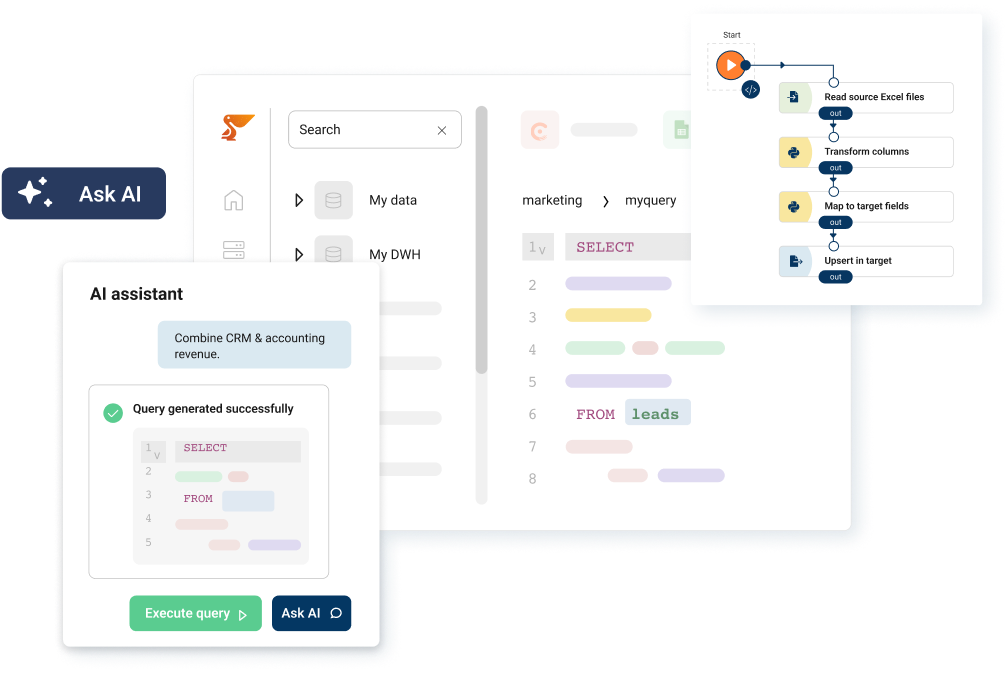
The flood of requests you’re likely to receive – ranging from custom integrations to advanced analytics – can be overwhelming. This is where Peliqan can make a difference. Peliqan is an all-in-one data platform and iPaaS that enables you to quickly connect Zoho ERP (and Zoho Creator) to 250+ other business systems, including data warehouses like Snowflake and BigQuery, and leading BI tools like Power BI, Tableau, and Looker.
With Peliqan, partners can:
- Rapidly deliver integrations and migrations without custom coding.
- Offer clients unified analytics and reporting across all their business systems.
- Leverage white-label and multi-tenant capabilities to scale your services and manage multiple customers efficiently.
- Rely on Peliqan’s partner support, including custom connector development, onboarding, and premium support packages.
Conclusion
Zoho ERP’s launch creates a distinct market opportunity at the intersection of three forces:
- A brand-new ERP product with zero existing third-party data connectors serving a rapidly growing customer base.
- The broader Zoho ecosystem’s persistent integration challenges – low API limits, fragmented per-product APIs, no native warehouse export, and indirect BI tool connectivity.
- A target customer segment (SMEs and mid-market companies) that increasingly needs centralized data warehousing and enterprise BI but lacks the engineering resources to build custom ETL pipelines.
The companies adopting Zoho ERP will be organizations with complex operations generating significant data across finance, supply chain, manufacturing, and HR. They will need that data in Snowflake, BigQuery, or Databricks for cross-system analytics, and they will need it in Power BI or Tableau for enterprise reporting. Zoho Analytics, despite being capable, faces real limitations with large datasets and lacks the depth of dedicated BI platforms.
The opportunity for a platform like Peliqan is not just connecting Zoho ERP to warehouses – it is providing the complete data infrastructure layer that Zoho’s ecosystem lacks: extraction from multiple Zoho products, transformation, warehouse loading, and reverse ETL back into Zoho, all without requiring the customer to manage API complexity, rate limits, or authentication flows across regional endpoints.
Ready to build your Zoho ERP data strategy? Request a demo or explore how Peliqan connects your entire data ecosystem.