




The landscape for Odoo partners in Europe is evolving at breakneck speed. Today’s clients expect more than technical implementation – they demand data-driven strategies, seamless system integrations, real-time analytics, and ongoing innovation. As the ERP market matures, Odoo partners face complex, multi-layered challenges that threaten both project success and long-term business growth.
This blog provides the most comprehensive synthesis of the pain points faced by Odoo partners – especially around data integration, migration, analytics, compliance, and the shift to recurring revenue. It also demonstrates, in detail, how Peliqan directly addresses these issues, enabling partners to become digital transformation leaders rather than mere implementers.
The pain points & challenges for Odoo Partners
#1 Data integration and migration complexity
Data integration and migration are at the heart of every modern Odoo project, yet they remain some of the most challenging aspects for partners. The demand for seamless connectivity between Odoo and other business systems has never been higher, and the risks associated with integration failures can jeopardize entire projects.
In fact, up to 75% of ERP projects fail to meet their original objectives, and only 23% of implementations are considered fully successful, with 74% exceeding budget and over 61% taking longer than expected to implement.
Integration complexity:
Odoo projects rarely exist in isolation. Clients expect their ERP to connect flawlessly with e-commerce platforms, financial systems, CRMs, and legacy databases. Each new integration brings risk: mismatched data models, authentication headaches, and the ever-present threat of delays and cost overruns.
Industry research and leading partner blogs repeatedly highlight integration gaps as a primary cause of project complexity and failure. Even a single failed connector can undermine client trust and jeopardize the entire project.
Migration is not a one-off event:
Gone are the days of one-time, end-of-project data imports. Modern Odoo rollouts require live data pipelines that synchronize legacy systems and Odoo throughout transition phases. This ensures business continuity, supports parallel operations, and allows for iterative testing. However, relying on manual CSV exports, ad-hoc scripts, or brittle one-off connectors makes these migrations error-prone and unsustainable.
The result? Failed imports, data loss, and costly rework.
Data quality issues:
Data quality is a chronic pain point. Inconsistent formats, duplicates, missing fields, and mapping errors plague migration efforts, leading to failed imports, reporting inaccuracies, and ultimately, a loss of trust in the ERP system. Partners must invest significant resources in data cleansing and validation – resources that could otherwise drive value.
Multi-module complexity:
Odoo’s strength lies in its modularity, but this also creates headaches. With hundreds of apps – CRM, e-commerce, inventory, manufacturing, and more – partners must coordinate complex, multi-module rollouts. Ensuring data consistency and process alignment across modules requires specialized expertise and robust orchestration, raising both project risk and operational overhead.
#2 Lack of real-time analytics & automation
As clients increasingly expect instant access to actionable insights, Odoo partners face mounting pressure to provide real-time analytics and automated reporting. Traditional approaches to reporting are no longer sufficient in a landscape where data-driven decision-making is the norm. The ability to deliver timely, accurate, and self-service analytics has become a key differentiator.
Manual reporting:
Traditional reporting methods – manual exports, direct SQL queries, and isolated BI setups – are slow, error-prone, and unscalable. As clients demand real-time dashboards and automated reporting across Odoo and connected platforms, partners struggle to keep up using legacy tools.
Infrastructure gaps:
Many Odoo partners lack the infrastructure needed for unified data warehousing, federated queries, and cross-source analytics. This restricts their ability to deliver actionable insights and meet rising client expectations for self-service analytics and business intelligence.
Self-service bottlenecks:
Non-technical business users increasingly need access to data but are often blocked by the technical complexity of SQL or BI tools. This creates bottlenecks, increases support demands, and slows down decision-making.
KPI and MRR tracking challenges:
Subscription-based business models demand sophisticated tracking of KPIs such as Monthly Recurring Revenue (MRR), churn, and customer lifetime value. Many partners lack the tools and templates to deliver these insights reliably, limiting their value proposition.
#3 Operational overhead & scalability
Scaling an Odoo practice brings operational challenges that can quickly overwhelm partners who lack robust systems. Managing integrations, maintaining service quality, and supporting multiple clients all require visibility and efficient processes. Without the right tools, operational overhead can stifle growth and erode profitability.
Visibility and control challenges:
As partners scale, it becomes difficult to monitor which integrations are running, where failures occur, and how to deploy improvements without risking downtime. This lack of operational transparency undermines both service quality and scalability.
Technical debt:
Custom scripts and one-off solutions accumulate technical debt, making it harder to onboard new consultants, maintain quality, and scale the business effectively.
Multi-tenant management:
Serving multiple clients means supporting distinct customizations, branding, and data isolation requirements. Without a robust multi-tenant architecture, operational costs and complexity can spiral out of control.
#4 Evolving client expectations
The Odoo partner ecosystem is in flux, with clients now expecting a complete data platform and ongoing innovation rather than simple implementation.
As of 2025, Europe accounted for approximately 27% of Odoo’s global partner base, with around 500 partners in the region – a testament to both the opportunity and competition in this market.
Full data platform expectations:
Today’s clients want more than integrations – they expect a full-fledged data platform: real-time syncs, automated migrations, audit trails, rollback options, and strict compliance with GDPR and SOC2. Partners who can’t deliver this risk losing out to more forward-thinking competitors.
Business model transformation:
The partner business model is shifting from project-based, hourly work to recurring revenue streams based on managed data services, premium connectors, and value-added analytics. Partners who fail to adapt will be left behind as clients prioritize ongoing value over one-off implementations.
Competitive differentiation:
With over a thousand Odoo partners in Europe, competition is fierce. Differentiation now depends on the ability to offer packaged, repeatable solutions and managed services, not just technical implementation.
#5 Customization & maintenance burden
Custom development is often unavoidable, but it brings its own set of risks and complexities. Partners must navigate issues of code ownership, ongoing maintenance, and the impact of frequent Odoo version updates. These factors can significantly affect project timelines and client satisfaction.
Code ownership issues:
Custom developments raise intellectual property and legal concerns, especially if clients later switch partners. This can create friction, slow down projects, and even result in disputes.
Upgrade cost contingency:
Each Odoo version update can break custom code, requiring costly rework. Accurately forecasting and pricing these future maintenance costs is a persistent challenge.
Version migration complexity:
Frequent Odoo releases mean partners are under constant pressure to upgrade client systems. This requires extensive testing, data migration, and customization updates – a resource-intensive process that many struggle to manage efficiently.
#6 White-label & branding challenges
Building a strong brand identity is essential for differentiation, yet Odoo’s native branding and licensing model present significant obstacles. Partners seeking to offer a white-label solution face technical and commercial limitations that can hinder their growth and client relationships.
Limited white-label capabilities:
Partners seeking to present Odoo as their own face technical hurdles. Third-party debranding modules often break with updates and rarely remove all Odoo references, making true white-labeling elusive.
Brand identity conflicts:
Odoo’s branding is pervasive across interfaces, emails, and reports, making it hard for partners to establish their own brand identity and build direct client relationships.
Pricing control limitations:
Odoo’s licensing model restricts partners’ ability to set their own pricing, typically limiting them to a 10-20% commission on Enterprise sales.
#7 GDPR & compliance
Regulatory compliance, especially under GDPR, is a top concern for European Odoo partners. Ensuring data protection, residency, and rapid incident response requires more than technical know-how – it demands robust processes and infrastructure to avoid severe financial and reputational penalties.
GDPR fines across Europe totaled €1.2 billion, demonstrating the escalating financial risk for businesses that lack robust compliance measures.
Data protection requirements:
European partners must meet stringent GDPR requirements, including data mapping, security measures, audit trails, and rapid response to data subject requests. Non-compliance risks fines up to €20 million or 4% of global turnover.
Data residency concerns:
Ensuring client data remains within EU borders, managing backups, and ensuring all subprocessors comply adds significant complexity.
Incident Response Obligations:
GDPR requires breach notification within 72 hours. Many partners lack the tools and processes to meet these timelines.
#8 Implementation methodology & project management
Delivering successful Odoo projects requires balancing best-practice methodologies with the unique needs of each client. Partners often struggle to manage scope, ensure user adoption, and maintain project control as requirements evolve throughout the engagement.
Methodology misalignment:
Balancing Odoo’s recommended methodology with client-specific needs is tough. The pressure to deliver on time and on budget often conflicts with the need for thorough requirements gathering and change management.
User adoption failures:
Even technically successful implementations can fail due to poor user adoption. Many partners lack structured training and change management programs.
Scope creep management:
Odoo’s flexibility often leads to expanding project scopes, making it hard to manage expectations and control costs.
#9 Post-implementation support challenges
Support doesn’t end at go-live; in fact, it often becomes more demanding. Partners must provide continuous assistance, transfer knowledge effectively, and optimize performance as client data grows – challenges that can strain even the most experienced teams.
Ongoing support demands:
Clients expect continuous support after go-live, but partners often underestimate the resources required, leading to downtime and unresolved issues.
Knowledge transfer gaps:
Heavy reliance on external partners means client teams often lack hands-on ERP expertise, creating ongoing dependency and support costs.
Performance optimization needs:
As client databases grow, performance issues emerge. Many partners lack the expertise in PostgreSQL optimization, Odoo tuning, and infrastructure scaling needed to keep systems running smoothly.
How Peliqan Directly Solves These Pain Points
Unified, automated data integration and migration
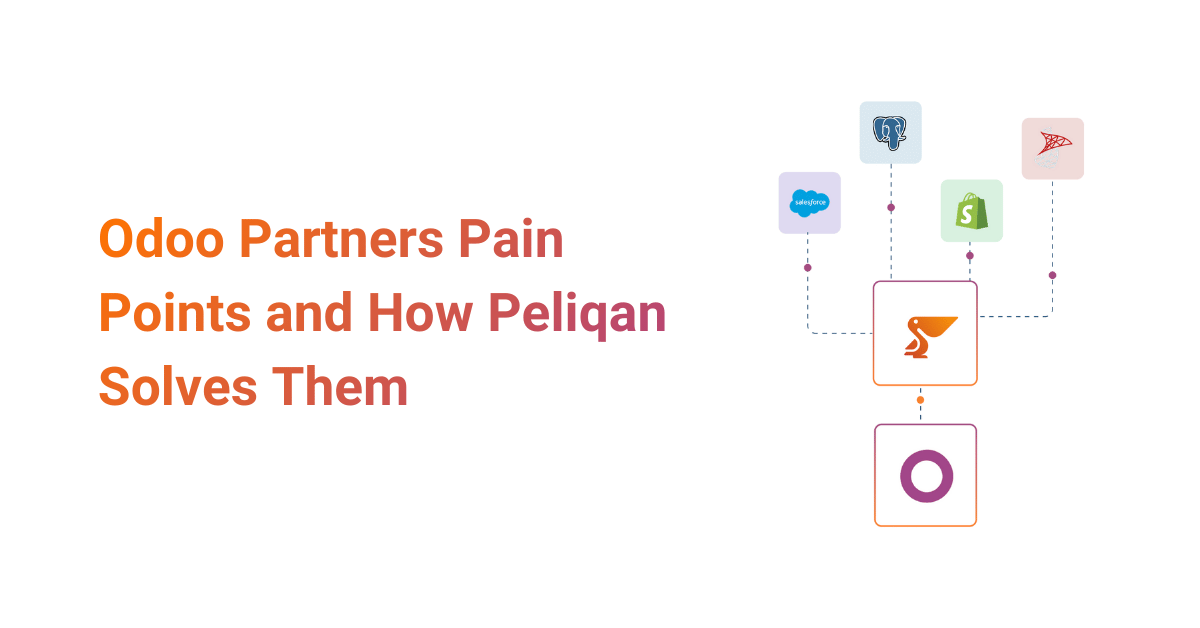
Peliqan provides Odoo partners with a powerful integration platform featuring 250+ pre-built connectors, including a comprehensive Odoo connector that supports both standard and custom fields and models. This enables rapid, reliable integrations with SaaS, legacy, and on-premise systems.
Partners can launch projects with a white-label data cloud from day one, turning every “can we also…?” into a repeatable upsell.
Key features include plug-and-play connectivity (handling authentication, paging, rate limiting, incremental data fetching), automated migration pipelines (live syncs for legacy systems), rerunnable and incremental migrations (supporting robust QA and staged cutovers), built-in data quality assurance, and seamless multi-module orchestration.
Real-time analytics, dashboards, and self-service
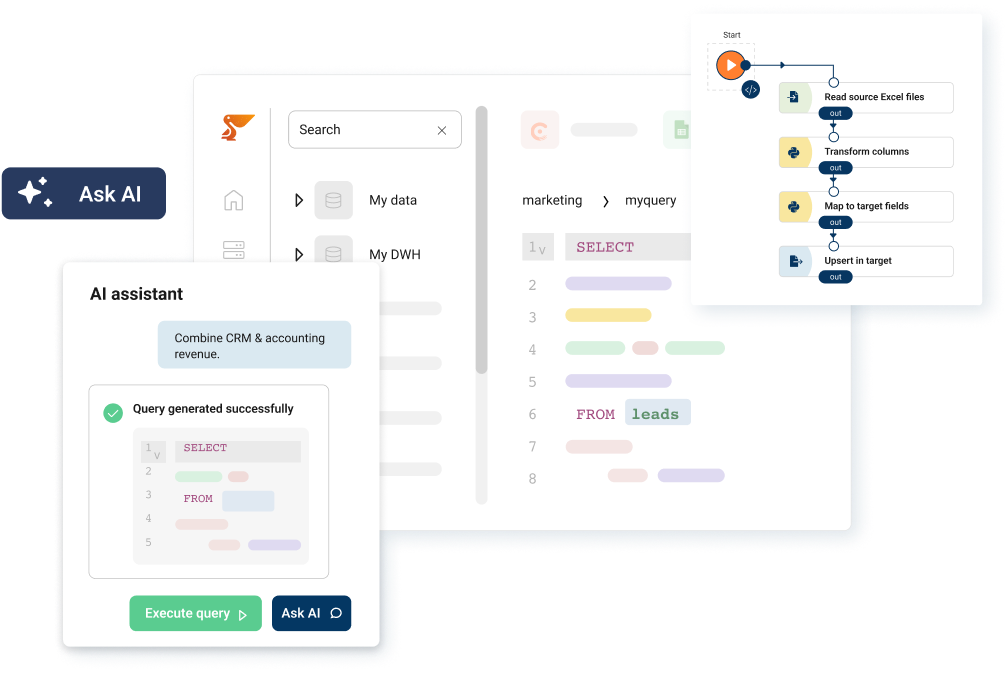
Peliqan’s built-in data warehouse and federated query engine unify Odoo, e-commerce, and finance data. Partners can deliver real-time dashboards and AI-powered insights directly within client projects. Both consultants and business users can leverage natural language queries, spreadsheet-like UIs, and low-code tools for analytics – without writing SQL.
This includes a self-service data cockpit, instant analytics go-live with Metabase or Power BI, secure data sharing, pre-built MRR and subscription analytics templates, and AI-driven insights for non-technical users.
Centralized control and scalable operations
Peliqan’s partner dashboard and sub-account model provide a single view of all pipelines, usage, and health across the entire client base, allowing partners to scale confidently, deliver more projects with less overhead, and maintain high service quality.
Features include multi-customer management, automated error handling and audit trails, reusable templates and blueprints, true multi-tenant architecture, and real-time performance monitoring.
Compliance, security, and white-label experience
Peliqan is GDPR and SOC2-compliant, offering EU-only data hosting for regulated clients. Partners can offer branded, white-label portals and data clouds, delivering a seamless, professional experience while retaining full control over branding and customer relationships.
This includes per-customer tenant management, custom branding and API embedding, robust compliance features (EU data residency, audit trails, breach detection), and total white-label freedom.
Partner enablement and support
Unlike traditional Odoo partnerships, Peliqan provides comprehensive enablement resources: rapid onboarding, technical documentation, a dedicated partner success team, no certification barriers, and flexible pricing models.
Enabling the modern Odoo Partner business model
With Peliqan, Odoo partners can transform past projects into packaged products – multi-warehouse syncs, financial dashboards, e-commerce accelerators – turning client problems into recurring revenue streams through managed services and optimization retainers, all under their own brand. This positions partners to win more RFPs, deliver faster, and provide deeper insights, becoming trusted advisors rather than mere implementers.
Top Odoo Partners like Dynapps, Rezolv, OdooExperts, erp|open, Aardug – use Peliqan so they can say “yes” to those steps without rebuilding everything from scratch. They start with a white-label data environment from day one, so every new ask becomes a planned add-on instead of a custom fire drill.
Case Study: Rezolv
Rezolv, a certified Odoo partner, specializes in supporting wholesalers and manufacturers through digital transformation. Their challenge: efficiently handling complex data migrations, live data synchronization, and enabling actionable business insights for clients.
Using Peliqan’s all-in-one data platform, Rezolv streamlined data onboarding and ensured seamless integration between legacy systems and Odoo ERP.
With 250+ connectors – including a robust Odoo connector – Rezolv automated data pipelines, performed live syncs, and delivered business-ready data for analytics and BI. The built-in data warehouse enabled ongoing analysis, while automated pipelines and quality assurance scripts ensured data integrity and accelerated project timelines.
Read the full story and discover how Rezolv leverages Peliqan: Download the Rezolv Case Study
Conclusion
The strongest Odoo partners will evolve beyond implementation. By standardizing on a partner-ready data platform like Peliqan, you can:
- Deliver repeatable, testable integrations fast
- Offer white-label dashboards and productized services
- Build predictable recurring revenue and improve client retention
- Comply with GDPR and enterprise security expectations
With the right platform, partners become trusted advisors – and that wins deals. See Peliqan connectors or contact us to explore a partner pilot.