





Agentic data pipelines use AI agents to autonomously ingest, transform, validate, and orchestrate data flows – replacing brittle, rule-based ETL with adaptive, self-healing workflows. This guide covers how they work, where adoption stands today, what they can and can’t do, and what changes for data teams.
Data engineering teams spend a disproportionate amount of time keeping pipelines running rather than building anything new. A Wakefield Research survey found that enterprise data engineers spend a median of 44% of their time on building and maintaining ETL pipelines – costing organizations an average of $520,000 per year on pipeline upkeep alone.
The cost isn’t only financial. The same study found that 71% of respondents said end users were making business decisions with old or error-prone data, and 85% said their enterprises had made bad decisions that directly cost them revenue. Meanwhile, the data integration market is projected to grow from $17.58 billion in 2025 to $33.24 billion by 2030 at a CAGR of 13.6%, according to MarketsandMarkets.
The volume and complexity of data that organizations need to move, transform, and govern keeps accelerating. Traditional pipelines – static, rule-based, requiring constant manual intervention – haven’t kept pace. This is the gap that agentic data pipelines aim to close.
What is an agentic data pipeline?
An agentic data pipeline is a data pipeline where AI agents autonomously handle the ingestion, transformation, validation, and orchestration of data flows – with minimal human intervention.
The word “agentic” is the key differentiator. Traditional data pipelines are rule-based: a human writes transformation logic, schedules jobs, defines error handling, and manually intervenes when something breaks. An agentic pipeline replaces portions of that manual loop with AI agents that can perceive their environment, make decisions, and take action.
Informatica defines agentic data management as a system where “AI-powered agents autonomously perform complex data management tasks, operating independently over extended periods using various tools to accomplish sophisticated objectives.” The critical distinction from earlier AI-assisted tools is autonomy: these agents don’t just recommend actions – they execute them.
Agentic data pipeline – key dimensions
Why agentic data pipelines matter in 2026
The pressure on traditional pipelines comes from multiple directions simultaneously – and it’s accelerating.
⚠️ Why traditional pipelines are breaking
- Schema drift is constant – SaaS applications update APIs frequently; a single Salesforce release can alter field names, deprecate endpoints, or change data types, requiring developer intervention each time
- Volume and variety are accelerating – organizations now integrate data from SaaS platforms, IoT devices, event streams, third-party APIs, and unstructured sources; rule-based ETL was designed for structured, batch-oriented movement between a handful of systems
- Error handling is reactive – traditional pipelines fail silently or break loudly; either way, a data engineer gets paged, investigates, writes a fix, and deploys, creating lag between failure and resolution
- The talent bottleneck is real – when a team of 10-12 engineers is spending 44% of their time on maintenance, that’s 4-5 engineers worth of capacity permanently consumed by keeping the lights on
- Data consumers are growing faster than data teams – business teams need self-service access to integrated data, but traditional pipelines require engineering involvement for every new source or transformation
Gartner predicts that 40% of enterprise applications will feature task-specific AI agents by the end of 2026, up from less than 5% in 2025. By 2028, they expect 33% of enterprise software to include agentic AI capabilities – up from less than 1% in 2024. Data pipelines are one of the most natural targets for this shift because they involve repetitive, pattern-recognizable tasks that follow well-defined workflows.
The cost of broken data pipelines
Before diving into how agentic pipelines work, it’s worth quantifying what the current approach actually costs. The numbers make the case for automation more clearly than any architectural diagram.
The real cost of pipeline maintenance
- $520,000/year – average annual cost per organization spent on ETL pipeline maintenance alone (Wakefield Research/Fivetran)
- 44% of engineering time – median portion of data engineers’ time consumed by building and maintaining pipelines instead of innovation
- 71% of organizations – make business decisions using old or error-prone data due to pipeline reliability issues
- 85% of enterprises – report having made bad decisions that cost them revenue due to data quality problems rooted in pipeline failures
These aren’t edge cases. They’re the baseline experience for most data integration teams. Every hour spent debugging a broken connector or manually reconciling schema changes is an hour not spent building the data products that drive business value.
How agentic data pipelines work
An agentic data pipeline relies on three foundational components working together. Understanding these layers explains both the potential and the limitations of the approach.
1. The planning layer – large language models
LLMs serve as the brain of an agentic data pipeline. They parse complex requests – whether from a user’s natural language input or from a system alert – and decompose them into a sequence of actionable steps. For example, when a data quality issue is detected, the LLM determines the appropriate diagnostic and remediation workflow: check the source schema, compare against the expected contract, identify the divergence, and route to the correct fix.
2. The execution layer – autonomous agents
Autonomous agents form the hands of the system. These agents interact with data tools, APIs, databases, and cloud storage to perform the actual tasks: cleaning, transforming, moving, and validating data. Multiple agents can operate concurrently across different parts of a pipeline – one handling ingestion from a new source while another monitors data quality on an existing flow.
3. The memory layer – vector databases
Vector databases provide semantic memory that allows agents to understand context. For instance, an agent can recognize that a column called “cust_id” in one system maps to “customer_identifier” in another – without needing explicit configuration for every mapping. This contextual understanding is what separates agentic pipelines from simple automation scripts.
💡 Pro tip
The most effective agentic pipeline architectures don’t run LLM inference on every record. They use small, specialized models for routine tasks (schema validation, null checks, type coercion) and reserve larger models for complex reasoning – like diagnosing why a pipeline started failing after a source system upgrade. This hybrid approach keeps costs manageable while preserving the intelligence that makes agentic pipelines valuable.
Traditional pipelines vs. agentic data pipelines
The differences between traditional and agentic approaches span every stage of the pipeline lifecycle. This comparison highlights where agents add the most value – and where traditional approaches still have advantages.
What agentic data pipelines can do today
Based on frameworks described by Informatica, Matillion, and independent analysis, agentic data pipelines are being applied across six areas today. The maturity level varies significantly across these capabilities.
1. Data quality management
Agents autonomously profile incoming data, identify anomalies against learned patterns, and apply cleansing rules. Instead of waiting for a downstream report to surface a quality issue, agents detect and remediate problems at the point of ingestion. This is one of the most mature agentic use cases because data quality checks follow well-defined patterns that LLMs can reason about effectively.
2. Dynamic data integration
Agents discover new data sources, generate field mappings based on semantic understanding, and orchestrate the integration pipeline. What used to be weeks of connector development becomes a shorter, partially automated process. The agent identifies source schemas, matches fields to target models, and generates the ETL logic – though most implementations still require human review before deployment.
3. Continuous governance
Rather than periodic compliance audits, agents monitor data access in real-time, enforce masking and encryption policies, and generate audit trails automatically. This is particularly relevant for organizations subject to GDPR, HIPAA, or SOC 2 requirements where continuous enforcement is more defensible than periodic checks.
Governance capabilities in agentic pipelines
4. Metadata management
Agents extract, classify, and maintain metadata catalogs – keeping data lineage documentation current as pipelines evolve. Manual catalog maintenance is one of the first tasks teams abandon under time pressure, making this a high-impact use case for automation.
5. Anomaly detection in data streams
Using machine learning models, agents monitor data flows in real-time and flag statistical outliers, distribution shifts, or unexpected null rates before they propagate into analytics. This moves data quality from reactive (“the dashboard looks wrong”) to proactive (“the agent caught a 3x spike in null rates before it reached the warehouse”).
6. Self-healing pipelines
When a pipeline fails, agents can diagnose the root cause, attempt recovery actions – such as rolling back to the last known good configuration or dynamically adjusting transformations – and escalate to a human only when autonomous resolution isn’t possible.
⚠️ A note on maturity
These capabilities exist on a spectrum. Data quality profiling and anomaly detection are the most mature. Fully autonomous self-healing and dynamic integration are still early-stage, with most implementations requiring human approval for significant actions. No vendor has a production-grade, fully autonomous pipeline that works reliably across arbitrary data environments. If someone tells you otherwise, they’re selling.
Where adoption actually stands
The gap between vendor marketing and real-world deployment is significant. Deloitte’s 2025 Emerging Technology Trends study, which surveyed 500 US technology leaders from June to July 2025, provides the most granular snapshot of where organizations actually are with agentic AI.
Agentic AI adoption snapshot (Deloitte, 2025)
These numbers are for agentic AI broadly, not data pipelines specifically – but they represent the infrastructure and organizational maturity that agentic data pipelines depend on.
Gartner’s predictions add important context. While they forecast rapid adoption of AI-powered automation in enterprise apps, they also predict that over 40% of agentic AI projects will be canceled by the end of 2027 – primarily because legacy enterprise systems can’t support the data infrastructure that agentic AI demands. This is a critical detail that most coverage omits.
The cancellation prediction highlights a fundamental tension: agentic data pipelines are meant to modernize data infrastructure, but they themselves require modern data infrastructure to function. Organizations running on fragmented legacy systems face a chicken-and-egg problem.
Challenges and risks of agentic data pipelines
Deploying agentic data pipelines in production introduces challenges that go beyond typical pipeline engineering. These aren’t theoretical concerns – they’re the primary reasons behind Gartner’s 40%+ cancellation forecast.
1. Explainability and auditability
When an AI agent autonomously decides to remap a field, apply a transformation, or exclude a data source, the reasoning behind that decision needs to be auditable. LLM-based systems are inherently less transparent than hand-coded rules. For regulated industries, this isn’t a nice-to-have – it’s a compliance requirement.
2. Security with autonomous access
An agent that can autonomously connect to databases, APIs, and cloud storage is also an agent with a large attack surface. If the agent’s credentials are compromised, or if the agent makes an incorrect autonomous decision about data access, the blast radius is larger than a traditional pipeline failure.
3. Legacy system incompatibility
Most enterprise data architectures were built around batch ETL and data warehouses. These architectures create friction for agent deployment, because agents need real-time access to data with rich semantic context – not periodic batch dumps into staging tables.
4. LLM reliability in production
LLMs hallucinate. When a language model is planning the steps for a data pipeline transformation, a hallucinated step doesn’t just produce a wrong answer in a chat window – it corrupts production data. Building sufficient guardrails, validation layers, and human-in-the-loop checkpoints adds complexity that partially offsets the automation gains.
🚨 The cost problem no one talks about
Running LLM inference at every stage of a data pipeline – for every record, every schema check, every quality assessment – is expensive at scale. The economics of agentic pipelines only work when the agent’s intervention is targeted at high-value decisions, not applied indiscriminately to every row of data. Organizations that fail to design this selectivity upfront often find their agentic pipeline costs exceeding the engineering time they were meant to save.
5. Organizational readiness
Agentic pipelines require data teams to shift from writing pipeline code to defining governance policies, approval workflows, and agent boundaries. This is a cultural shift as much as a technical one – and many organizations underestimate the change management involved.
Agentic data pipeline maturity model
Not every organization needs – or is ready for – fully autonomous data pipelines. The path from traditional to agentic is a spectrum, and the right starting point depends on your current data architecture maturity.
🎯 Quick decision guide
- Start with agentic quality monitoring if your team spends more than 30% of time on data quality firefighting – it’s the most mature capability with the fastest payback
- Pilot agentic schema management if you integrate 20+ SaaS sources and experience frequent schema drift breaking your pipelines
- Invest in agent observability first if you’re in a regulated industry – you’ll need full audit trails before deploying any autonomous actions
- Stay at Level 2 (assisted) if your data infrastructure is primarily legacy on-prem systems – the prerequisite modernization may need to happen first
- Skip agentic entirely for now if you have fewer than 5 data sources and a small team – the overhead of agent governance will exceed the maintenance time saved
What changes for data engineers
Agentic data pipelines don’t eliminate the need for data engineers. They change what data engineers spend their time on.
The shift is from pipeline construction and maintenance to agent design, governance, and oversight. Instead of writing transformation logic and debugging cron jobs, data engineers increasingly define the guardrails within which agents operate: what data quality thresholds are acceptable, what governance policies must be enforced, what actions require human approval versus autonomous execution.
Think of it as a shift from pipeline plumber to data product owner. The plumbing still matters, but an increasing portion of it runs autonomously. The engineer’s value moves up the stack – toward defining business logic, ensuring data contracts are met, and governing how autonomous agents interact with sensitive data.
This is consistent with a broader trend in software engineering, where AI coding assistants haven’t replaced developers but have shifted their focus toward architecture, review, and system design. The same pattern is emerging in data engineering.
💡 Pro tip
The data engineers who will thrive in an agentic world are those who understand both the data domain and the agent architecture. Start building fluency with pipeline workflow patterns, prompt engineering for data tasks, and agent observability. These skills will compound as the tooling matures.
Agentic data pipelines and your data platform strategy
An agentic data pipeline doesn’t exist in isolation. It’s only as effective as the broader data platform it operates within. The organizations seeing success with agentic approaches share a few common characteristics in their platform architecture.
First, they have a centralized data layer – typically a data warehouse or lakehouse – that serves as the single source of truth. Agents need a consistent target environment to write to and read from. Fragmented storage across dozens of siloed databases makes agent orchestration exponentially harder.
Second, they have strong metadata and semantic models in place. Agents that understand what data means – not just where it lives – make dramatically better decisions about transformations, quality checks, and governance enforcement.
Third, they have invested in reliable connectivity to their source systems. An agentic pipeline can’t autonomously heal a broken connection if the underlying connector infrastructure is brittle. The foundation has to be solid before you layer intelligence on top.
How Peliqan supports agentic data workflows
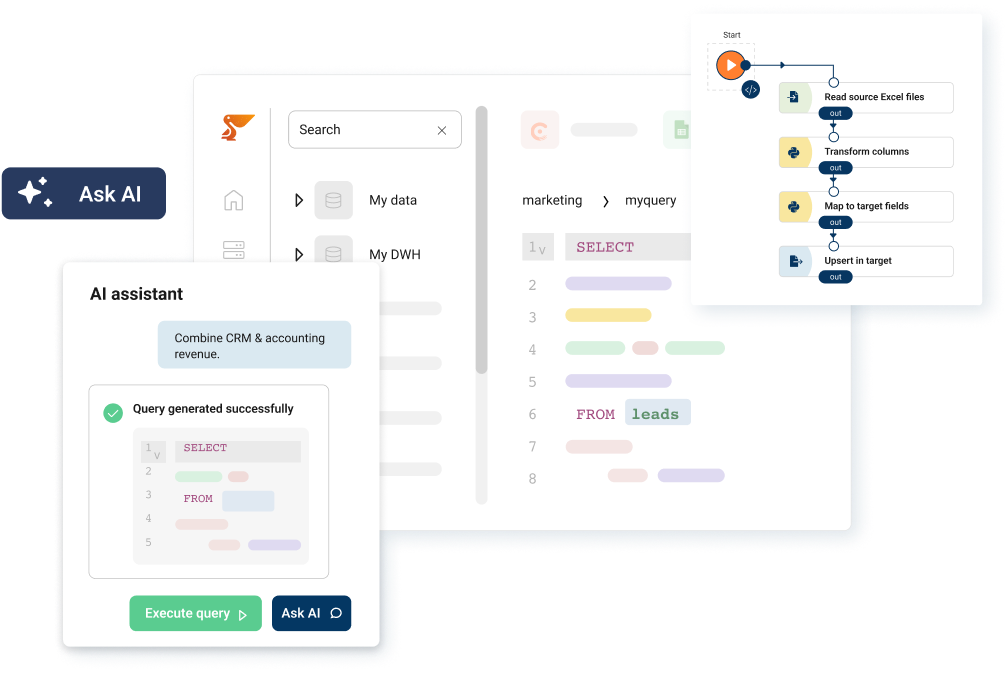
Peliqan is an all-in-one data platform that provides several foundational capabilities relevant to building agentic data pipelines – from automated ingestion through to governance and data activation.
Peliqan platform capabilities
Peliqan also supports building AI agents directly within the platform – allowing teams to create agents that interact with their data warehouse, run quality checks, and trigger actions across connected systems.
Combined with low-code Python workflows and reverse ETL capabilities, this provides a foundation for teams looking to move incrementally toward agentic data workflows without replacing their entire stack.
For teams already using Peliqan’s reverse ETL to push data back into operational systems, adding agentic monitoring and quality checks is a natural next step – building intelligence on top of existing data flows rather than starting from scratch.
What to watch next
Agentic data pipelines represent a real architectural shift in how organizations will move, transform, and govern data. The core idea – replacing brittle, rule-based pipelines with autonomous agents that can adapt, self-heal, and optimize – addresses problems that data teams face daily.
But the technology is early. With only 11% of organizations running agentic AI in production and Gartner warning that 40%+ of projects may be canceled, this is not a mature, deploy-everywhere solution.
Three developments to watch over the next 12-18 months:
Agent observability tooling. As agents make autonomous decisions in data pipelines, the ability to trace, audit, and replay agent decision-making will become as critical as pipeline monitoring is today. Vendors who solve explainability will win enterprise trust.
Cost optimization of LLM inference in pipelines. Running frontier models on every data event is economically impractical. Expect hybrid architectures where small, specialized models handle routine tasks while larger models are reserved for complex reasoning.
Industry-specific agent frameworks. Generic data integration agents will give way to agents trained on domain-specific schemas, compliance requirements, and data patterns – healthcare agents that understand HL7/FHIR, financial agents that enforce SOX controls, and so on.
The question isn’t whether data pipelines become more autonomous – the economic and operational pressure guarantees that. The question is how quickly the supporting infrastructure, governance frameworks, and trust mechanisms mature enough to support production-grade agentic data pipelines at scale.
If you’re evaluating where to start, focus on the foundation first: reliable connectivity, centralized storage, strong metadata, and automated quality monitoring. That foundation is what separates organizations that successfully adopt agentic workflows from those that join the 40% cancellation statistic.