

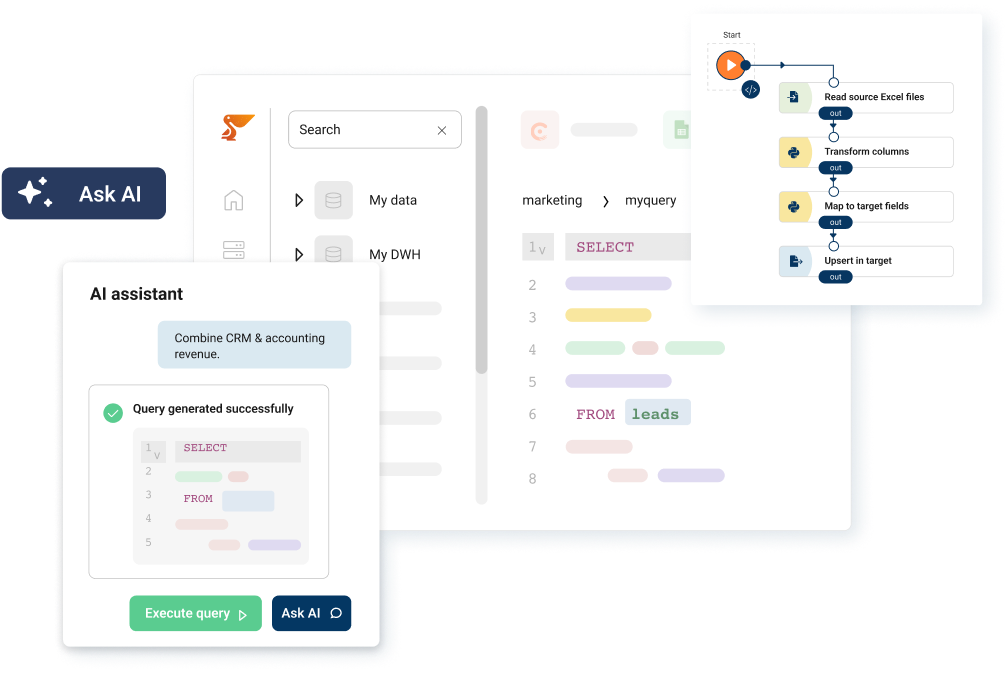

Reverse ETL sends data from your warehouse back into the tools people work in. This demo syncs companies and contacts from Pipedrive, the CRM, into Odoo, the ERP, and sets it to keep running on a schedule.
How to set up reverse ETL
- 1Connect both systems. With connections to Pipedrive and Odoo in place, the data is already in the built-in data warehouse and ready to use as a source.
- 2Prepare the source. You can sync a table directly, or use a query when the target needs a field the source does not have. The demo adds two queries: companies with an Is Company column set to true, and contacts with the same column set to false.
- 3Install the Reverse ETL app. Find it in the Build section and install it in your account. Bookmarking it on the homepage keeps it within reach.
- 4Add a sink per object, in the right order. Companies first, because contacts are linked to them. For each sink choose the source table or query, set the primary key, and pick the target – here the partner object in Odoo. Then map the fields: name, email and the static Is Company. Under relations, configure the foreign key so contacts link to their company through org_id, mapped to the parent ID.
- 5Test, then schedule. Sync a single record per sink and check it in the target before going further. Then set the schedule – hourly or daily – as an incremental sync using a timestamp field, with a sync mode that allows inserts and updates.
What you can do with reverse ETL
- Push modelled warehouse data into a CRM, an ERP or another business application
- Map source fields onto target fields, including static values added in a query
- Keep parent and child records correct with foreign key relations between sinks
- Run incremental syncs on a schedule so only new and updated records are processed
About link tables
The app creates link tables that record what it has already processed. For each object you get the source ID, the target ID, whether the sync succeeded, any errors, and the timestamps of the first and most recent sync. This gives you full visibility into every sync.
Ready to sync data back to your tools? Get started with Peliqan.