


Peliqan is an all-in-one data platform: ETL connectors and a data warehouse, a SQL explorer, and low-code Python apps in one place. This short tour walks through all three parts, so you can see how data gets in, how you shape it, and what you build on top.
What the demo covers
- 1Connect your sources. Every new account starts with a built-in data warehouse, and you can bring your own instead – Snowflake, BigQuery, Redshift or Azure. Add a connection, sign in once, and choose which tables to sync.
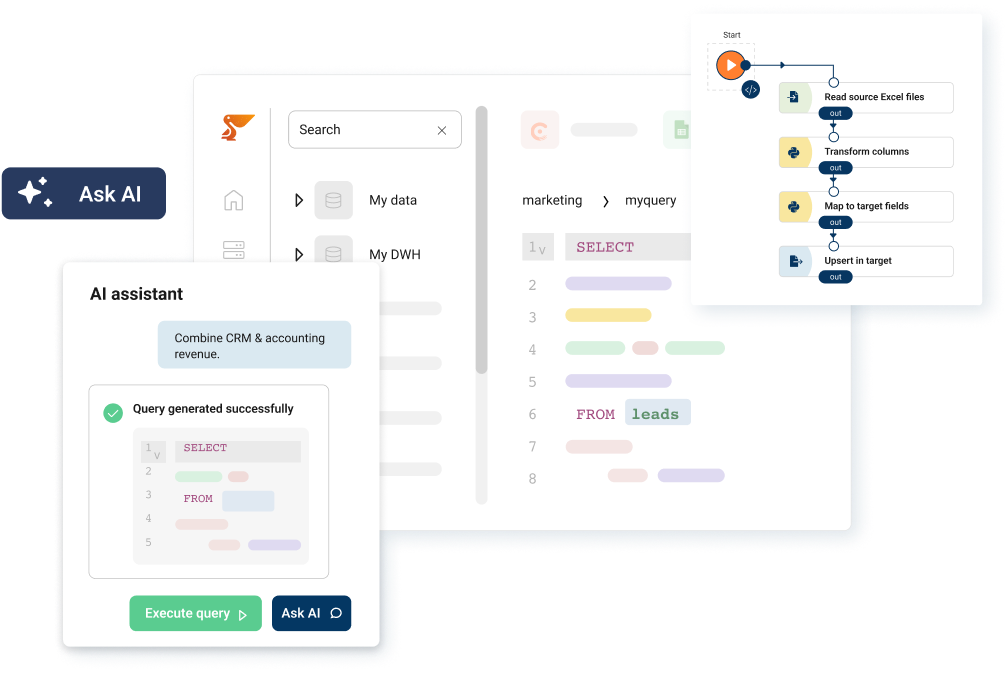
- 2Explore and transform with SQL. Open any table in the Explore section, then write queries that join data across sources. The built-in AI data engineer drafts queries for you, highlights the tables used, and suggests a fix when a query has an error.
- 3Publish a query to your BI tool. Queries live inside Peliqan by default. Create one as a view and it appears in the data warehouse, ready for Power BI or any other BI tool.
- 4Build data apps in low-code Python. Start from a template or an empty app. Streamlit is imported for you, so you can add a UI and charts, run the app on a schedule, and check the logs of every run.
What you can do with Peliqan
- Sync business applications, databases and cloud storage into one warehouse with 300+ connectors
- Query and join data across sources in SQL, with an AI data engineer to draft and correct queries
- Expose queries as views so your BI tool reads the same definitions
- Build reports, automations and custom pipelines as low-code Python apps
One platform, three parts
In Peliqan the connectors, the warehouse, the SQL layer and the Python layer are one product, so a table you sync is queryable straight away and available to an app. Browse the full list of Peliqan connectors to see what you can connect.
New to Peliqan? Get started with Peliqan.