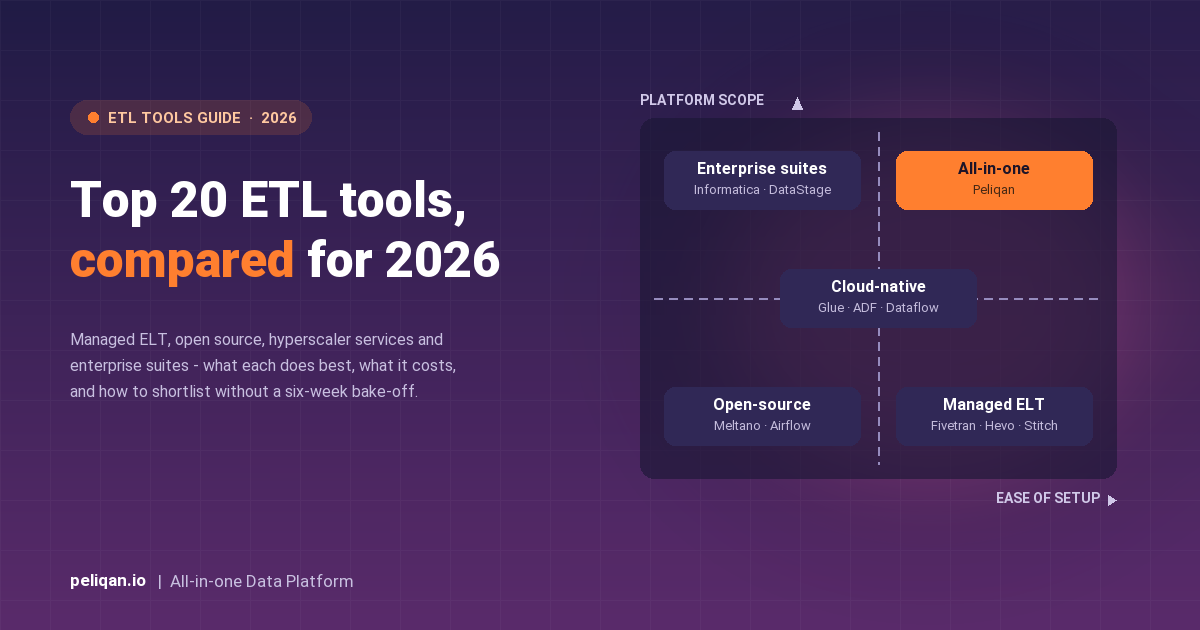





ETL tools move data from the systems where it is created – ERPs, CRMs, databases, SaaS apps – into the systems where it is analyzed, cleaned up and made consistent along the way. The market in 2026 spans free open-source frameworks, managed ELT services, hyperscaler-native services, and heavyweight enterprise suites, and the differences in cost and operating model are enormous. This guide compares the top 20 ETL tools by what each one actually does best, how it is priced, and where it fits, so you can shortlist in minutes instead of weeks.
What changed in ETL for 2026
- Consolidation reshaped the vendor list. The dbt-Fivetran merger completed, Informatica was acquired by Salesforce, and Talend and Stitch now sit under Qlik. If your shortlist is more than a year old, several “independent” tools on it no longer are.
- ELT is the default, ETL is the exception. Most modern tools load raw data first and transform inside the warehouse. Understanding the difference still matters for tool choice – see our ETL vs ELT breakdown.
- AI became a data consumer. Pipelines increasingly feed agents and LLMs, not just dashboards, which rewards platforms that expose governed, queryable data rather than one-way syncs.
Top 20 ETL tools at a glance
| Tool | Best for | Deployment | Pricing model |
|---|---|---|---|
| Peliqan | All-in-one: ETL + warehouse + BI + AI | Cloud (EU) | Fixed, transparent |
| Meltano | Open-source, config-as-code ELT | Self-hosted | Free |
| Matillion | Visual ELT for cloud warehouses | Cloud | Credit-based |
| Fivetran | Fully managed ELT at scale | Cloud | Consumption (MAR) |
| Stitch | Simple replication to warehouses | Cloud | Row-based tiers |
| Apache Airflow | Orchestrating custom pipelines | Self-hosted / managed | Free (infra costs) |
| Integrate.io | Low-code pipelines, fixed fee | Cloud | Flat fee |
| Oracle Data Integrator | Oracle-centric enterprises | On-prem / OCI | License |
| IBM DataStage | High-volume enterprise workloads | On-prem / cloud | License / capacity |
| AWS Glue | Serverless Spark on AWS | AWS | Pay-per-use (DPU) |
| Azure Data Factory | Pipelines in the Azure ecosystem | Azure | Pay-per-activity |
| Informatica | Enterprise governance and MDM | On-prem / cloud | Consumption (IPU) |
| Talend (Qlik) | Integration + data quality suite | Cloud / hybrid | Subscription |
| Qlik Data Integration | CDC and warehouse automation | Cloud / hybrid | Subscription |
| Pentaho | Visual ETL with a free edition | Self-hosted | Free CE / license |
| Google Cloud Dataflow | Streaming + batch on GCP | GCP | Pay-per-use |
| SSIS | On-prem SQL Server shops | On-prem | Included in SQL Server |
| Hevo Data | No-code ELT for lean teams | Cloud | Event-based tiers |
| SAS Data Management | Analytics-heavy SAS environments | On-prem / cloud | License |
| Ab Initio | Extreme-scale regulated enterprises | On-prem / cloud | Custom license |
1. Peliqan: the all-in-one data platform
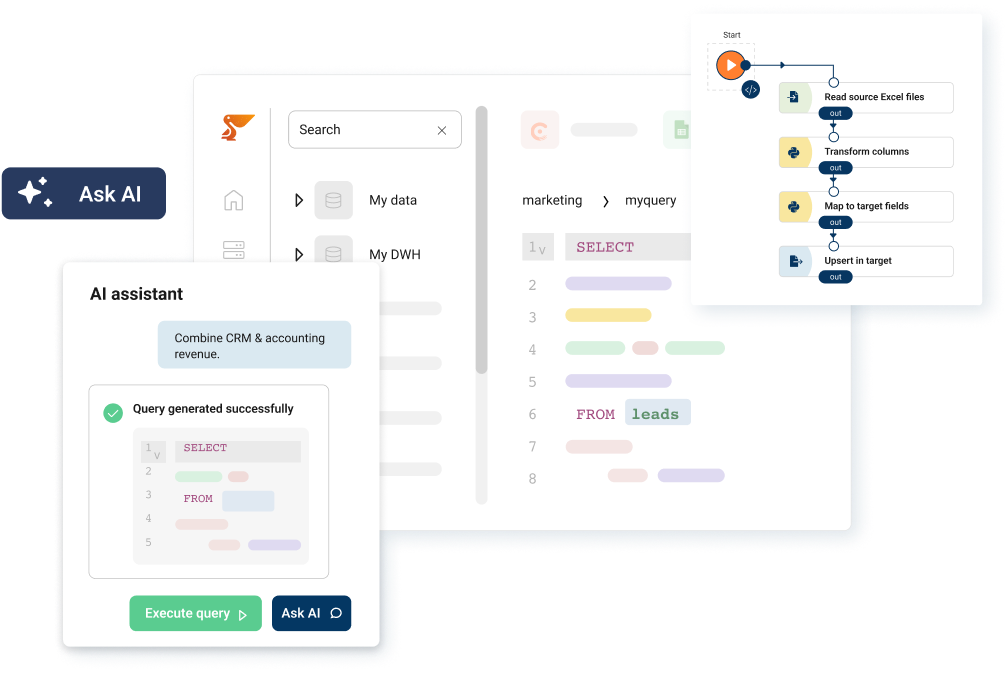
Peliqan combines what usually takes four separate tools: ETL/ELT pipelines, a built-in data warehouse, transformation tooling, and activation. Instead of wiring a connector service to a warehouse to a BI layer, you connect your sources and get queryable, governed data in minutes. It is an all-in-one data platform aimed at teams that want outcomes rather than infrastructure projects.
Key features of Peliqan
- 300+ connectors for SaaS applications, databases and file sources, with custom connectors delivered on a 2-week SLA.
- Built-in warehouse (Postgres + Trino), or bring your own: Snowflake, BigQuery, Redshift or SQL Server.
- Federated queries across all connected sources with SQL on anything, plus a spreadsheet UI for business users.
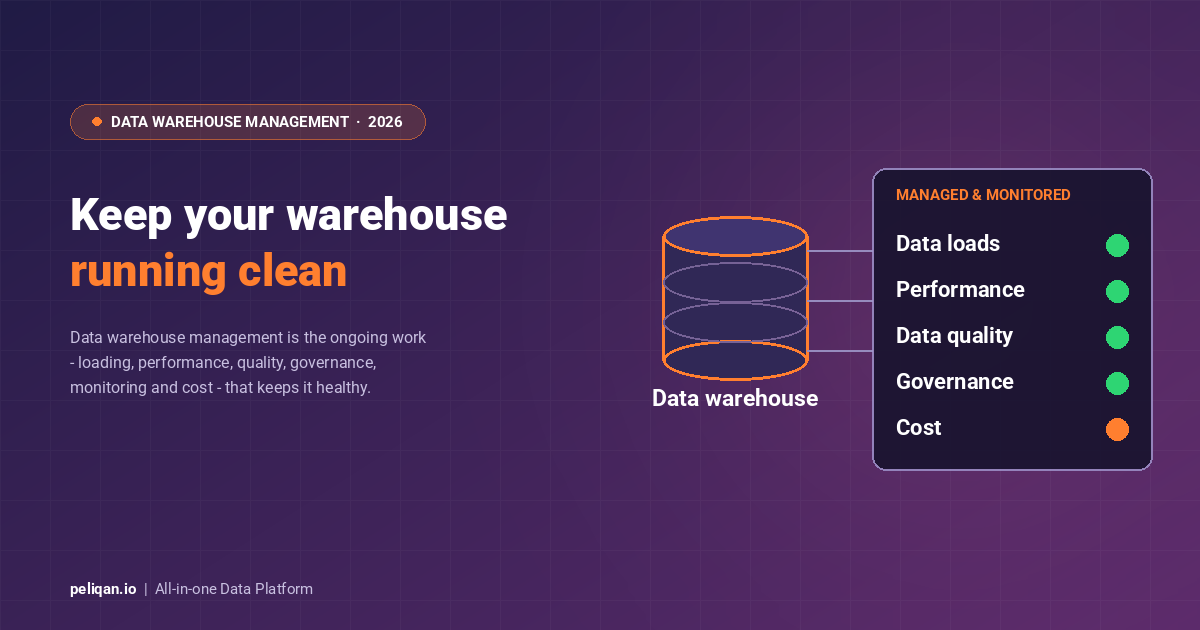
- Transformations in SQL or low-code Python, with data quality monitoring built in.
- Reverse ETL and writeback to sync clean data back into business tools.
- Alerting and human-in-the-loop workflows on top of your data.
- BI-ready out of the box with connections to Metabase, Power BI and other reporting tools.
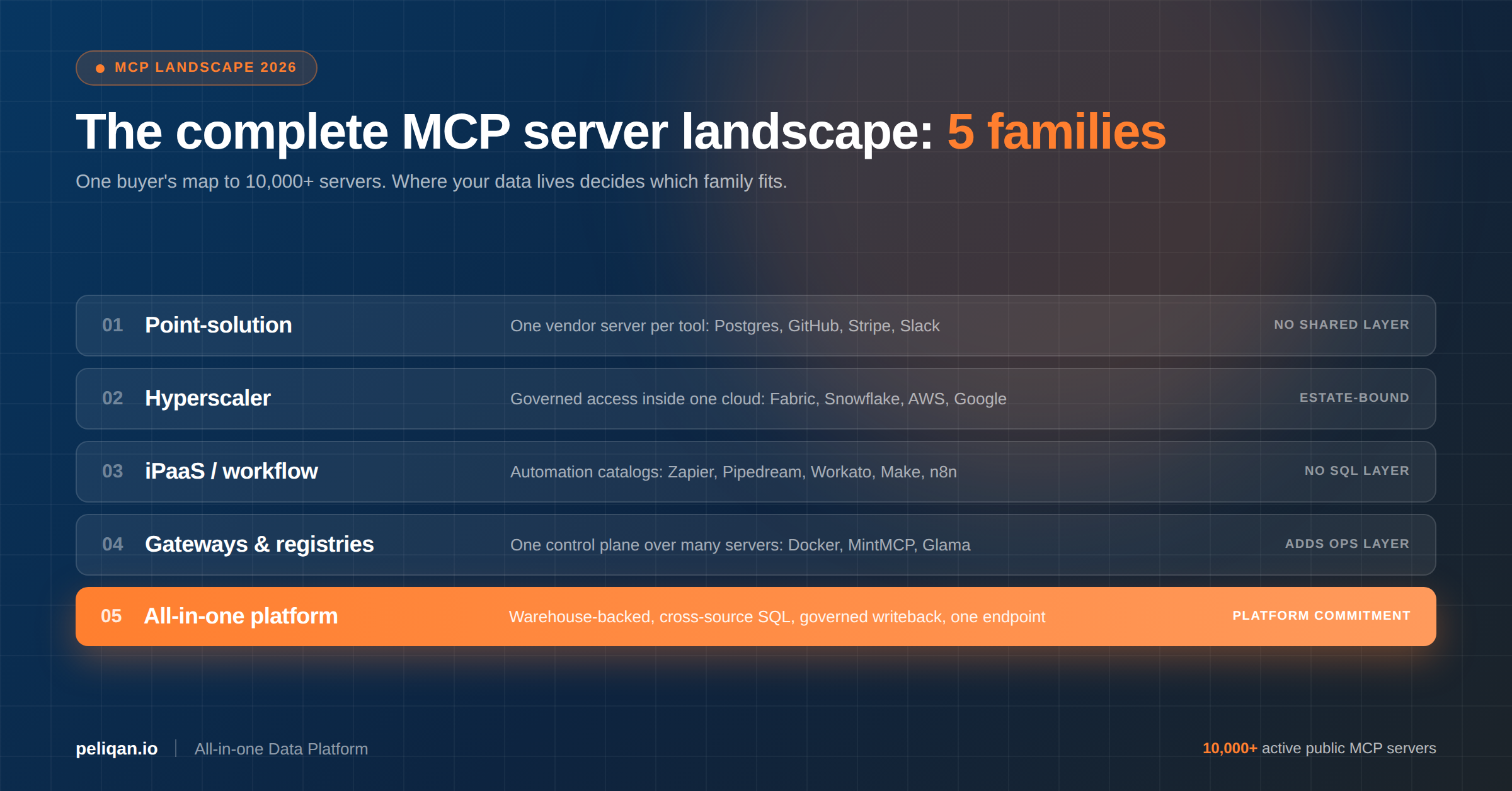
- AI-ready with a native MCP server, so AI agents query governed business data instead of raw APIs.
- Compliance: SOC 2 Type II, ISO 27001, GDPR, HIPAA and CCPA, EU-hosted on AWS Frankfurt – see the trust center.
Use cases for Peliqan
Teams use Peliqan to replace an assembled data pipeline stack with one platform: consolidating ERP, CRM and accounting data for reporting, building customer 360 views, powering embedded analytics for SaaS products, and feeding AI agents.
Its low-code approach means data engineers go faster and analysts self-serve instead of filing tickets.
Real-world example: CIC Hospitality
CIC Hospitality replaced manual exports across 50+ sources – PMS, booking, accounting and operations systems – with Peliqan pipelines, saving 40+ hours per month and standardizing group-wide reporting. Read the CIC Hospitality case study.
Best for: teams that want ETL, warehouse, transformations, BI and AI access in one platform with fixed, transparent pricing instead of consumption-based surprises.
2. Meltano
Meltano is an open-source ELT framework built around the Singer taps-and-targets standard, managed entirely as code. Pipelines live in version control, run in CI/CD, and extend to 600+ community connectors of varying maturity. There is no visual interface to speak of – that is the point. It appeals to engineering teams that treat data integration tooling like software: tested, reviewed, reproducible.
Best for: engineering-led teams that want free, code-first ELT and accept connector maintenance as part of the deal. Watch out for: Singer tap quality varies widely; budget time for testing.
3. Matillion
Matillion’s Data Productivity Cloud provides visual, drag-and-drop pipeline design with pushdown execution: transformations compile to SQL that runs inside Snowflake, BigQuery, Redshift or Databricks rather than on Matillion’s own compute. Recent releases lean heavily into AI-assisted pipeline building with its Maia copilot. Pricing is credit-based, which scales smoothly but needs monitoring on spiky workloads.
Best for: teams standardized on one cloud warehouse that want visual ELT development with warehouse-native execution.
4. Fivetran
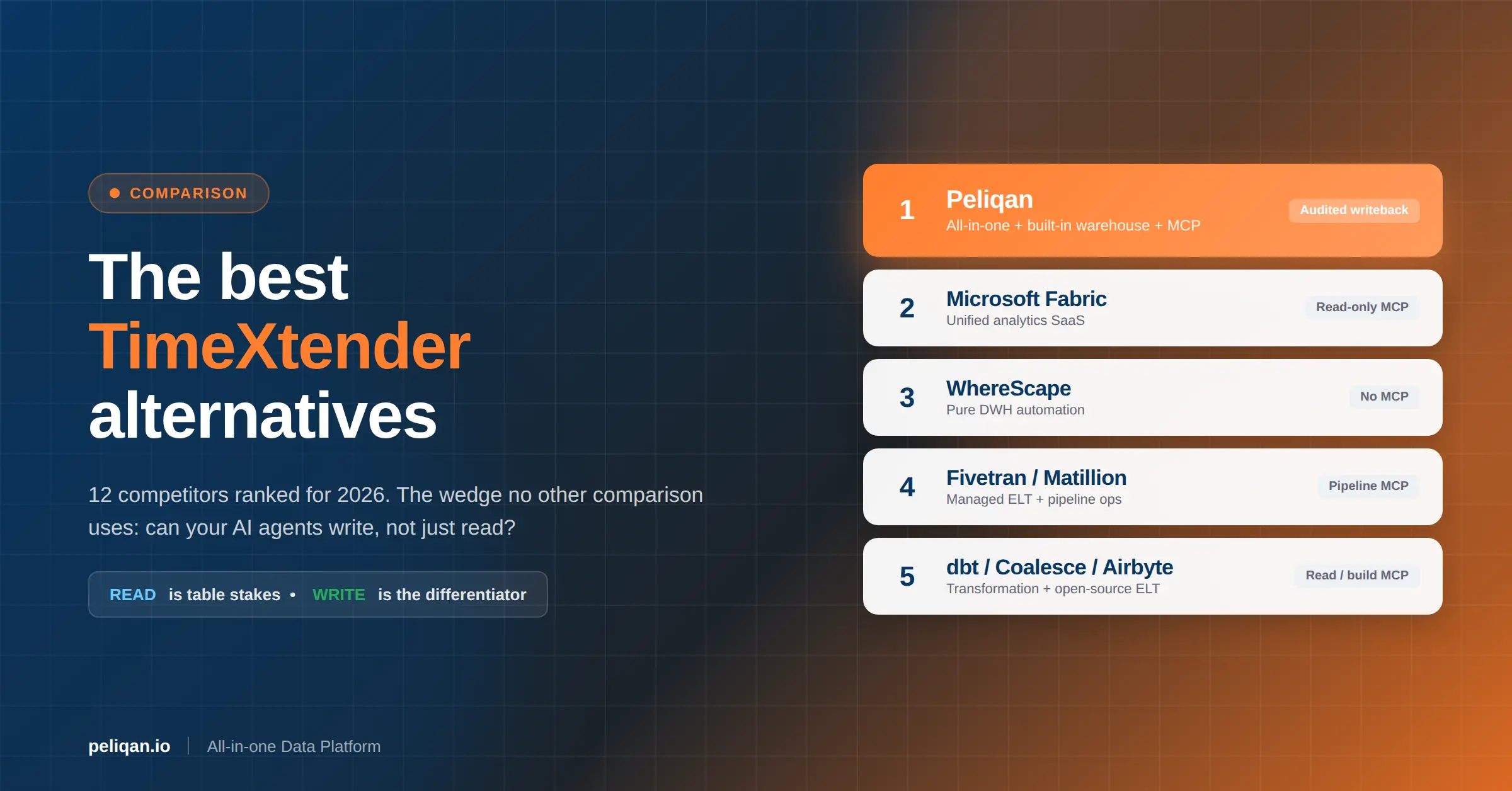
Fivetran is the reference for fully managed ELT: 700+ connectors that handle schema drift, incremental syncs and API changes automatically. After completing its merger with dbt, it now spans ingestion and transformation in one vendor, alongside its Census acquisition for reverse ETL. The trade-off is cost: consumption pricing based on monthly active rows becomes a serious line item at scale, and totals are hard to predict. We compare the approaches in detail in Peliqan vs Fivetran.
Best for: data teams with budget that want zero-maintenance ingestion into an existing warehouse. Watch out for: MAR-based costs that grow with data volume, not with value.
5. Stitch
Stitch is a lightweight ELT service, also Singer-based, that replicates 130+ sources into cloud warehouses with minimal setup. Once acquired by Talend and now under Qlik, its development pace has visibly slowed, and it remains extract-and-load only: transformations happen downstream in your data warehouse. Row-based pricing keeps entry costs low for small volumes.
Best for: small teams needing simple, cheap replication today. Watch out for: an uncertain roadmap under Qlik ownership.
6. Apache Airflow
Airflow is not an ETL tool in the strict sense – it is the open-source standard for orchestrating pipelines written as Python DAGs. Airflow 3.0 modernized the architecture with a new UI, DAG versioning and event-driven scheduling. You write the extract and transform logic; Airflow schedules, retries and monitors it. Many teams run it alongside dedicated ingestion tools, or connect outputs onward – Peliqan ships an Apache Airflow connector for exactly that pattern.
Best for: engineering teams orchestrating complex, custom pipeline logic. Watch out for: you are building and maintaining the actual ETL code yourself.
7. Integrate.io
Integrate.io packages low-code pipeline building, 60-second CDC replication and API generation under a flat-fee pricing model – a deliberate contrast to consumption-priced rivals. The visual designer covers common transformation needs without code, and fixed pricing makes budgeting straightforward for predictable workloads.
Best for: mid-market teams that value cost predictability over the deepest connector catalog.
8. Oracle Data Integrator
ODI is Oracle’s ELT workhorse: declarative mappings with pushdown execution on the target database, tight integration with Oracle databases, EBS and OCI services. It remains a solid choice inside Oracle-standardized enterprises, less so anywhere else – the skills pool and ecosystem are Oracle-specific, and modern cloud warehouse patterns often fit newer tools better.
Best for: enterprises with significant Oracle estates and existing ODI expertise.
9. IBM InfoSphere DataStage
DataStage is IBM’s enterprise ETL engine, known for parallel processing that moves very large volumes on schedule. It now lives inside Cloud Pak for Data, adding containerized deployment and governance integration. Implementations are substantial projects with matching license and consulting costs, which is the price of its scale and reliability in regulated industries. Building a modern data warehouse on it from scratch in 2026 is rare; running mission-critical legacy volume on it is common.
Best for: large enterprises with high-volume, compliance-heavy workloads already invested in IBM.
10. AWS Glue
Glue is AWS’s serverless ETL service: Spark jobs without cluster management, a Data Catalog for metadata, crawlers for schema discovery, and Glue Studio for visual job building. Pay-per-use DPU pricing means you pay for compute consumed, nothing idle. It shines when your stack is AWS-native (S3, Redshift, Athena) and your team is comfortable with Spark; it frustrates when you want simple SaaS connectors or a low-code Python approach without Spark overhead.
Best for: AWS-centric teams with Spark skills processing large datasets into Redshift or S3.
11. Azure Data Factory
ADF is Azure’s pipeline service: 90+ connectors, visual pipeline authoring, mapping data flows for transformations, and per-activity pricing. Microsoft’s center of gravity is shifting toward Fabric Data Factory, but ADF remains the standard for Azure-hosted integration today, especially for hybrid on-prem-to-cloud scenarios via self-hosted integration runtimes. Complex logic tends to accumulate across many pipeline activities, so keep transformations centralized where possible.
Best for: organizations standardized on Azure, particularly with hybrid connectivity needs.
12. Informatica PowerCenter
Informatica remains the enterprise data management heavyweight: ETL, data quality, master data management and governance in one (large) platform, now under Salesforce ownership following the acquisition. PowerCenter is the legacy on-prem engine; IDMC is the cloud successor with consumption-based IPU pricing. For enterprises managing complex SaaS and on-prem integration estates with strict governance requirements, it is still a default – at a matching price point.
Best for: large enterprises where governance, lineage and MDM matter as much as pipelines. Watch out for: integration roadmap questions post-acquisition.
13. Talend
Talend built its name on open-source ETL, but Talend Open Studio was retired in January 2024 – the free on-ramp is gone. What remains under Qlik is Talend Cloud / Qlik Talend Data Integration: a commercial suite combining pipelines, data quality and governance with a large connector catalog. It is capable and mature, though teams that chose Talend specifically for open source now face a commercial decision and should factor in broader data management needs when re-evaluating.
Best for: organizations wanting integration plus data quality in one commercial suite.
14. Qlik Data Integration (Compose)
Qlik Compose has been folded into the broader Qlik Talend Data Integration portfolio, where its strengths persist: change data capture from operational databases (the former Attunity technology) and automated warehouse build-out that generates modeling and loading code. Combined with Qlik’s analytics stack, it targets end-to-end data automation from source CDC to dashboard.
Best for: teams needing low-latency CDC replication, especially into Qlik analytics environments.
15. Pentaho Data Integration
Pentaho Data Integration (Kettle) offers visual drag-and-drop ETL with a genuinely free community edition, now stewarded by Hitachi Vantara with commercial editions layering on support and enterprise features. It handles classic batch ETL and file-heavy workflows well and pairs with Pentaho’s reporting-oriented heritage. The ecosystem is quieter than it once was, but for budget-constrained visual ETL it still delivers.
Best for: teams wanting free, visual, self-hosted ETL and willing to accept a smaller community.
16. Google Cloud Dataflow
Dataflow is GCP’s managed runner for Apache Beam, unifying batch and streaming in one programming model with automatic scaling. It is the strongest option here for true streaming ETL – clickstreams, IoT, event processing – where latency matters. Like Glue, it assumes engineering capacity: Beam pipelines are code, and the learning curve is real.
Best for: GCP teams with streaming workloads, Beam skills, and data landing in BigQuery.
17. Microsoft SSIS
SQL Server Integration Services ships with SQL Server licenses, making it effectively free for on-prem Microsoft shops. It is mature, well-documented and deeply understood by a generation of DBAs. It is also firmly a previous-era tool: Windows-bound, weak on SaaS APIs, and Microsoft’s investment has moved to ADF and Fabric. Existing SSIS estates run reliably for years; new cloud-facing projects rarely start here.
Best for: on-prem SQL Server environments with existing SSIS skills and packages.
18. Hevo Data
Hevo is a no-code ELT platform with 150+ connectors, automatic schema mapping and near-real-time replication, priced on event volume with a free tier for small workloads. It positions as the approachable alternative to Fivetran for lean data teams, trading some connector depth and enterprise features for simplicity and lower entry cost. Teams often pair it with a separate data cloud strategy as they scale.
Best for: startups and mid-market teams wanting quick, no-code pipelines without enterprise pricing.
19. SAS Data Management
SAS Data Management serves organizations already committed to SAS analytics: integration, quality and governance tooling that feeds SAS’s statistical and AI workloads natively. Where advanced analytics teams live in SAS, keeping data preparation in the same ecosystem reduces friction. Outside that context, its licensing model and proprietary stack make it a hard sell against modern alternatives.
Best for: analytics-driven enterprises with existing SAS investments in regulated sectors.
20. Ab Initio
Ab Initio sits at the extreme end of enterprise ETL: co-operating parallel processing built for the largest banks, telcos and insurers, with metadata-driven development and full data lineage across sprawling estates. Pricing is opaque and famously high, sales are direct-only, and public documentation is scarce. For the handful of organizations at that scale, it earns its keep; for everyone else it is not really an option.
Best for: the largest regulated enterprises processing extreme volumes with dedicated platform teams.
Choosing the right ETL tool
- Match the tool to your team, not the hype. Code-first tools (Meltano, Airflow, Beam) assume engineers; visual tools (Matillion, Pentaho) assume analysts; managed services (Fivetran, Hevo) assume budget.
- Model total cost, not sticker price. Consumption pricing (MAR, credits, DPUs) scales with data volume whether or not value scales with it. Fixed-fee models trade peak flexibility for predictability.
- Count the tools you are assembling. Ingestion + warehouse + transformation + BI + reverse ETL as separate products means five contracts, five integrations, five failure points. All-in-one platforms collapse that stack.
- Check the AI path. If agents and LLMs will consume your data, prefer platforms that expose governed, queryable access – synced, clean tables beat raw API calls.
Conclusion
The ETL tools market in 2026 rewards clarity about your own situation: cloud ecosystem, team skills, data volumes and budget model. Hyperscaler services fit single-cloud engineering teams; managed ELT fits funded data teams with an existing warehouse; open source fits teams that trade time for license savings; enterprise suites fit governance-heavy scale. And if what you actually want is working, governed, AI-ready data without assembling a stack, an all-in-one platform gets you there fastest – see everything Peliqan includes.
Not sure where your setup fits? Talk to us and we will map it with you.