





Choosing the right multi-agent or agent-orchestration framework can dramatically affect reliability, auditability, and time-to-value for AI-driven automation.
CrewAI and AutoGen take different design paths for building agentic systems: CrewAI emphasizes structured, role-based crews and deterministic flows, while AutoGen (from Microsoft Research) emphasizes flexible, conversation-driven agent collaboration.
This article compares CrewAI and AutoGen side-by-side, answers the questions teams usually have when evaluating “crewai vs autogen”, and shows how a stable data foundation (like Peliqan) complements both approaches for production-grade AI automation.
Platform overview: structured crews vs conversational agents
CrewAI – role-based crews & deterministic flows

CrewAI is focused on defining teams of agents (“crews”) with explicit roles, tools, and responsibilities, then orchestrating them through event-driven flows. The core idea is that agents are specialists in a pipeline – each step is authored, tested and auditable.
This approach favours predictable outcomes, traceability, and integration into existing CI/CD and data pipelines. CrewAI is typically used as a code-first framework (Python-first) for engineering teams that want clear control over each agent’s behavior and lifecycle.
AutoGen – conversation-first multi-agent collaboration

AutoGen (originating from Microsoft Research) centers on agents that communicate through a conversational channel. Instead of a fixed ordered pipeline, AutoGen agents can debate, propose plans, and iteratively refine outputs via chat-like exchanges.
This makes it well-suited for exploratory, open-ended tasks where the best sequence of actions is not known ahead of time. AutoGen is also programmatic (Python + cross-language integrations) but its mental model is chat-first: agent messages, roles like commander/writer, and asynchronous exchanges drive orchestration.
Feature comparison – core differences that matter for adoption
At a glance: CrewAI gives deterministic, role-driven pipelines; AutoGen gives flexible, conversation-driven collaboration. Which pattern you prefer determines how you design, test, and govern your agentic systems.
CrewAI vs AutoGen — Comprehensive Comparison
| Concern / Feature | CrewAI | AutoGen |
|---|---|---|
| Primary Paradigm |
|
|
| Ease of Initial Setup |
|
|
| Flexibility / Dynamism |
|
|
| Observability / Debugging / Auditing |
|
|
| Scalability |
|
|
| Best-Suited Use Cases |
|
|
| Tool & Memory Integration |
|
|
| Testing & Validation |
|
|
| Governance & Compliance |
|
|
| Team Fit |
|
|
| Learning Curve & Technical Barriers |
|
|
| Risk / Trade-offs |
|
|
| Integration & Ecosystem |
|
|
Interpretation: both frameworks are primarily open-source SDKs; your bill mostly comes from where you host, how many model calls you make, and the infra needed to run agents at scale. If you prefer a managed, enterprise subscription to reduce ops, evaluate third-party vendors or hosted offerings around either framework.
Ease of use
CrewAI – engineered reproducibility
CrewAI assumes engineering ownership: you declare crews, their roles, and the flow of work. This yields fast time-to-production for teams that codify processes, and it simplifies testing and auditing because each step is explicit. Non-developers can run or trigger flows when a studio/console is provided, but the control plane is code-oriented.
AutoGen – conversation-first prototyping
AutoGen’s chat model is intuitive for prototyping: you can model agent interactions as message exchanges and iterate by inspecting transcripts. This lowers the friction of designing emergent behavior, but production hardening still requires engineering: tool integrations, safe guards, and observability.
Ease-of-use summary
- CrewAI: steeper up-front engineering but simpler operational guarantees and auditing.
- AutoGen: quicker to experiment with agent conversations; requires engineering discipline to make behaviors reproducible.
Integration ecosystem
CrewAI – pipelines & tool-driven
CrewAI is code-first, teams typically integrate any internal APIs, databases, or vector stores by writing tool adapters. This is ideal for controlled pipelines that must connect to enterprise systems, data warehouses, or internal knowledge bases.
AutoGen – conversational tools & adapters
AutoGen encourages creating small tool wrappers that agents call from chat. Its plugin-like architecture makes it straightforward to add connectors, memory backends, and external tools, enabling agents to call APIs as part of their conversations.
Integration highlights
- CrewAI: best when you want tight, testable integrations inside a defined pipeline.
- AutoGen: best when integrations are invoked opportunistically as part of agent dialogue.
Hosting & security
Self-hosting & enterprise controls
Both frameworks are typically self-hosted in production (containers, VMs, or serverless). Self-hosting gives you control over model keys, data residency, network policies and audit logs – which is critical for sensitive use cases.
When regulatory constraints demand strict governance, the CrewAI pattern can simplify compliance because workflows and approvals are explicit. AutoGen requires careful design of message storage, redaction, and audit trails to meet the same bar.
When to pick which hosting pattern
- Choose a CrewAI-first deployment when strict audit trails and deterministic approvals are required.
- Choose AutoGen when you need flexible agent collaboration but plan to build additional governance layers around transcripts and tool calls.
Customization & developer power
CrewAI – explicit control
CrewAI gives engineers primitives to author deterministic logic: conditional branching, retries, failure modes and explicit checkpoints. This is powerful for workflows that must satisfy SLAs and predictable outputs.
AutoGen – emergent behaviors
AutoGen exposes building blocks for agents, memory, and tools; developers compose these to enable emergent problem solving. The trade-off is that emergent systems can be harder to reason about without robust testing and traceability.
Technical edge
- CrewAI: best for deterministic integrations, reproducible pipelines and regulated environments.
- AutoGen: best for research, assistants and scenarios where multi-agent dialogue is a first-class requirement.
When to Use CrewAI, AutoGen, or a Hybrid
Based on the expanded landscape and recent developments, here’s a refined decision guide:
Use CrewAI when:
- You have well-defined, multi-step workflows with clear inputs, outputs, and dependencies (e.g. data pipelines, ETL + LLM processing, content generation pipelines, compliance workflows).
- You require auditability, traceability, reproducibility, and need to integrate with enterprise infra (databases, warehouses, APIs).
- You want predictability, simpler governance, and easier debugging/maintenance.
Use AutoGen when:
- The task involves open-ended reasoning, creativity, research, iterative planning, or dynamic problem-solving where you don’t know the final shape up front.
- You need agents to talk, debate, propose alternate strategies, adapt to new constraints — especially in prototyping, exploratory, or R&D settings.
- You are comfortable handling complexity: orchestration, tool integration, memory/ state management, logging, testing, and potential emergent behaviors.
Consider a Hybrid Approach (e.g. “Plan–then–Execute”) when:
- You want the best of both worlds: use AutoGen (or similar) for flexible planning, reasoning, delegation and then hand off to a stable, deterministic executor (CrewAI or structured flows) for actual execution.
- You care about safety, reproducibility, and auditability, but also need adaptability, creative planning, or dynamic responses.
- You are building a system that must evolve: e.g. research → feedback → automation → scaling to production.
How Peliqan complements CrewAI and AutoGen in AI + data workflows
Both CrewAI and AutoGen benefit from a stable, governed data foundation. Peliqan supplies that foundation so agentic frameworks operate reliably and at scale:
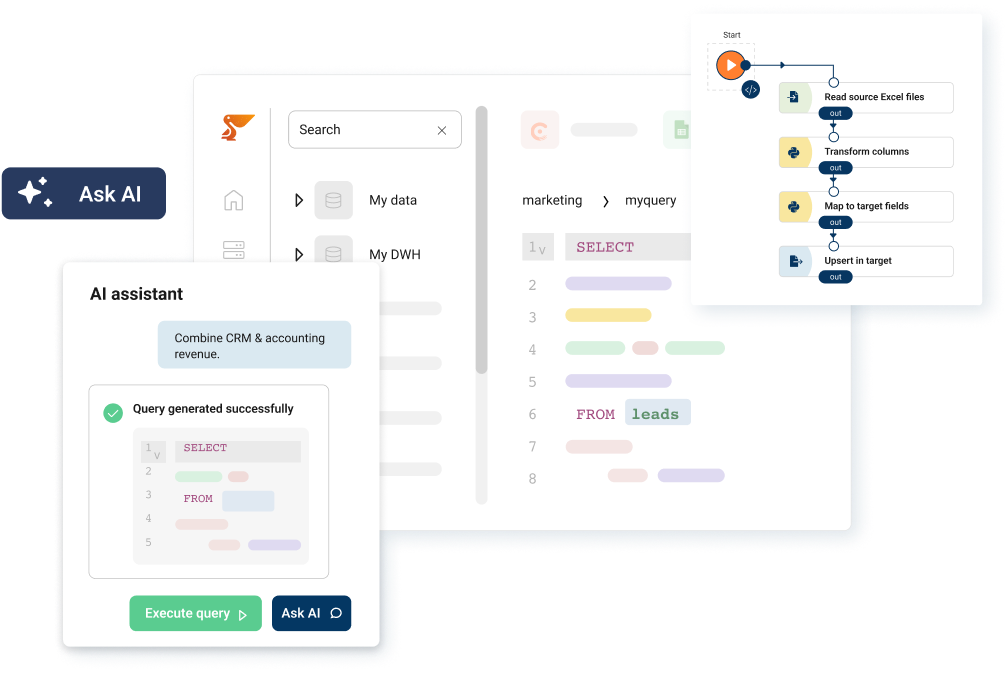
- 250+ connectors → unify SaaS, DBs, files and APIs into consistent ingestion pipelines so agents don’t rely on ad-hoc payloads.
- Centralized transformations → reusable Python/SQL pipelines to cleanse, enrich, de-duplicate and normalize data before agents consume it.
- AI readiness → snapshot and version datasets for RAG, embedding stores and inference so both CrewAI flows and AutoGen agents query consistent sources.
- Cached, queryable warehouse → reduce repeated model calls, throttle risk and embedding costs with cached retrieval layers.
- Governance & lineage → schema enforcement, lineage and observability for audits and debugging across agent runs and conversations.
Summary
The “crewai vs autogen” decision is less about which framework is objectively better and more about which mental model fits your product and compliance needs.
- CrewAI → Best when you need deterministic, auditable, and testable pipelines where each agent’s role and the sequence of steps are explicit.
- AutoGen → Best when you want agents that can collaborate dynamically through conversation and adapt to uncertain tasks or research problems.
- Peliqan → Use as the data backbone to make either approach reliable: centralized ingestion, transformations, caching, and governance reduce brittle prompts and scale agent-driven workloads.